

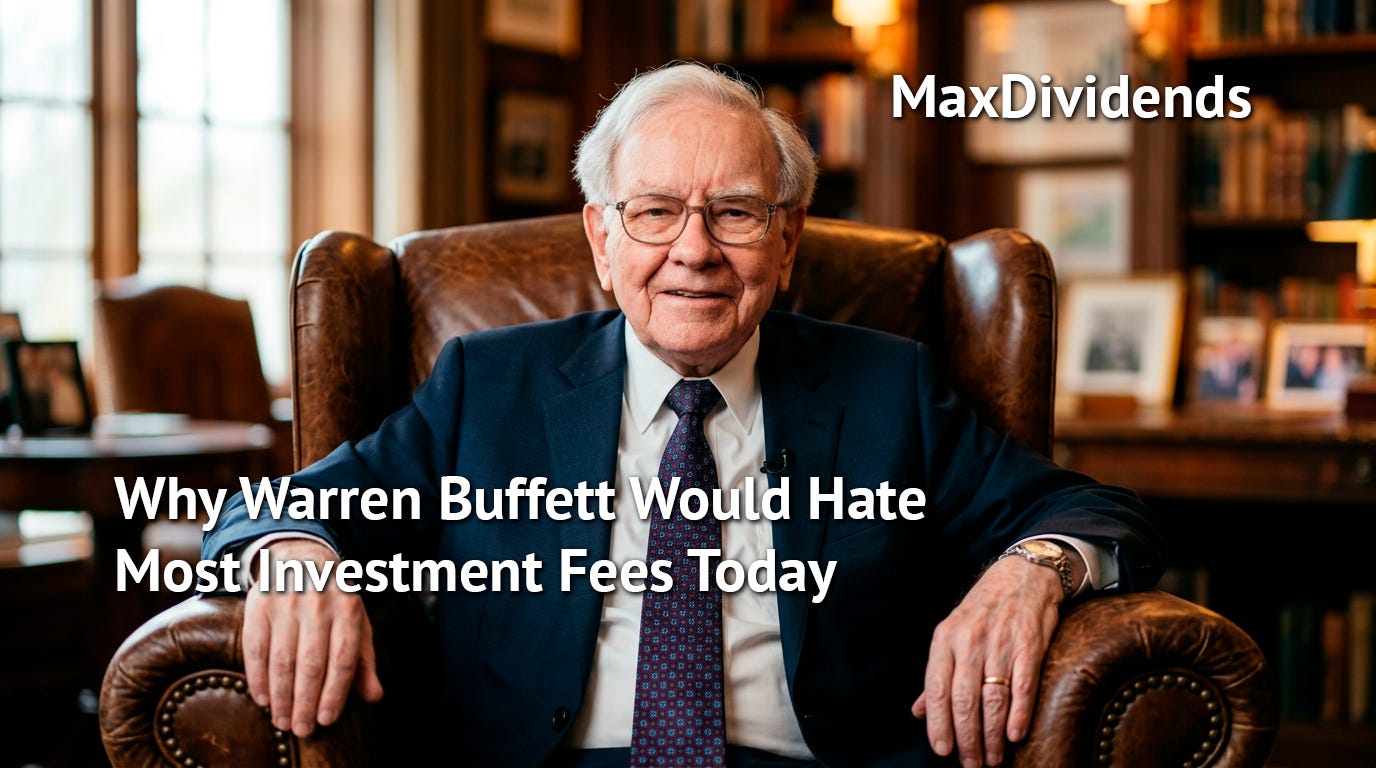
Warren Buffett didn’t just build one of the world’s biggest fortunes—he did it without ever charging his investors an arm and a leg. Unlike hedge fund titans who rake in billions while investors eat crumbs, Buffett ran Berkshire Hathaway with one of the most investor-friendly setups in history. For nearly 60 years, he took home just $100,000 a year as CEO. No bonuses. No performance fees. No 2-and-20. Just results.
If you were along for the ride since 1965, every $1,000 you invested would be worth over $61 million by March 2026, thanks to a compound annual growth rate of 19.8%. But here’s the kicker—if Buffett had run Berkshire like a hedge fund, with standard 2% management fees and 20% of gains, your $1,000 would’ve only grown to about $5.2 million. That’s right: over $55.8 million of your return would’ve gone to the manager. That’s not investing. That’s daylight robbery.
When the House Always Wins
Let’s talk about fees. Hedge funds love their 2-and-20 structure: 2% annual cut of your assets, plus 20% of any profits. Sounds small? It’s not. Those percentages snowball into millions over decades. Most funds barely beat the market—and some don’t even try. But the fee train keeps rolling.
Even if you somehow found a manager as sharp as Buffett (good luck), those fees still eat up the lion’s share. Just compare the outcomes: $61M vs. $5.2M. That’s the power of compound math working against you.
Buffett Knew the Game—And Played Fair
Early on, from 1956 to 1969, Buffett ran a partnership that did charge a fee—but only if he outperformed 6% annually. Anything above that, he took 25% of the excess. That’s fair. That’s aligned. He turned $100 into millions by 1970, and when he dissolved the partnership, it had over $100 million in assets.ivey.uwo+1 He could’ve become the richest person on Earth much faster if he’d slapped hedge fund terms on Berkshire. But he didn’t. And that’s why ordinary shareholders got rich alongside him.
The S&P Still Wins
Remember Buffett’s famous 2007 bet? He wagered that no group of hedge funds could beat the S&P 500 over a decade. He won. Not because the S&P is magical, but because fees are a silent killer. Even mediocre returns shine when you’re not bleeding 2% + 20% every year.
Let’s put it in perspective. From 1965 to 2026, the S&P 500 turned $1,000 into $427,000. Now compare that to the hypothetical $5.2 million in a fee-heavy Berkshire. Still better. But not remotely close to the $61 million the real Berkshire generated fee-free.
Keep More, Grow More
Here’s the real takeaway: fees matter more than most investors realize. They drag down performance year after year, compounding against you. You’re taking all the risk. You’re putting up all the capital. And the manager? He’s skimming the cream before you even see the milk. Buffett’s legacy isn’t just great returns. It’s proving you don’t have to pay through the nose to get them.
Someone’s sitting in the shade today because someone planted a tree a long time ago. ― Warren Buffett.
Learn the MaxDividends Way
Start Here
🔑 Explore the Premium Hub (exclusive — upgrade to unlock)
Guides & Step-by-Step
Deep Insights
📖 I ❤️ Dividends: Why I Believe Dividend Investing Is the Best Strategy | E-Book
How Effective is the MaxDividends Strategy for Building Growing Passive Income
Help & Support
Got a question about dividends? Ask Max, your AI Dividend Assistant!
Didn’t get the answer you need? Reach out: max@maxdividends.app or team@maxdividends.app — we’ll help you out.