


On the last trading day of the month, a few of the market’s most celebrated names stumbled, and almost every index paid for it. Yet inside the wreckage, a quieter group of businesses moved the other way, the ones paid to be boring. What happened, and what it says about owning ordinary companies that mail checks, is the story below.
The Day Wall Street Flinched
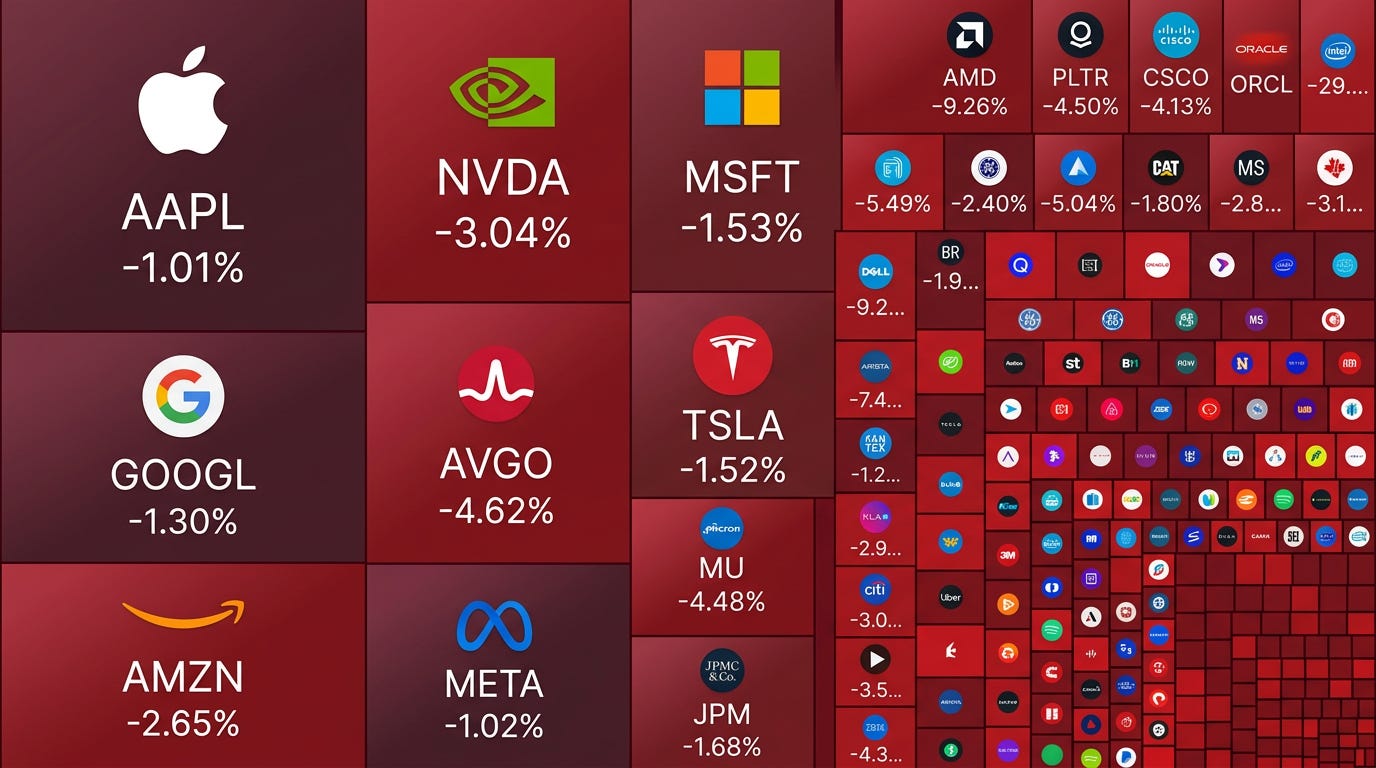
The panic arrived on Friday, October 30. The Dow Jones Industrial Average lost 572.25 points, or 1.09%, to close at 51,770.31, the S&P 500 fell 1.82% to 7,580.07, and the Nasdaq Composite dropped 2.86% to 25,437.00. It was the S&P 500’s worst day since June.
The trigger sat in technology. Intel fell 28.58%, its worst day since 1974, after weak guidance, and Alphabet had dropped more than 12% a day earlier. Nvidia’s 4.2% decline did the most to pull the S&P 500 down.
Where the Money Went
When tech sold off, capital did not vanish. It moved. Consumer staples rose 1.4% and energy rose 1.9%. A Friday comparison of sector funds shows the gap: the Technology Select Sector SPDR Fund lost 4.03% while the Consumer Staples Select Sector SPDR Fund gained 1.38%. Utilities and consumer staples had already risen more than 10% in October.
What Dividend Portfolios Did
While the S&P 500 sank 1.8%, a dividend ETF barely noticed. The Schwab U.S. Dividend Equity ETF (SCHD) closed at $35.78, up 0.48%, and its year-to-date return of 33.01% leaves its category’s 7.82% far behind.
The real stories were in the companies. ExxonMobil gained 1.8% and Chevron 1.7% after both beat profit estimates. Exxon marked the day with a 3.9% dividend raise, to $1.07 from $1.03, its 44th straight annual increase.
Colgate-Palmolive added 2.9% on a better-than-expected quarter. The company has paid dividends without a break since 1895 and has raised them every year for 63 years. Fuel and toothpaste were nobody’s idea of an AI bet, and on the day AI cracked, they were what investors reached for.
The Month Behind the Day
Friday closed a month with a clear split. The Nasdaq finished October down 5.3%, its worst month since March 2025, while the S&P 500 slipped 0.9% and the Dow gained 1.7%.
The Takeaway: Boring Keeps Winning
One day proves little, and dividend stocks are not immune to losses. But the cause of the panic was specific: worries that the frenzy around artificial intelligence had sent prices too high. Companies that sell fuel and toothpaste were not the subject of that worry, and their shares rose while the shares at its center fell. For a patient owner of a diversified group of dividend payers with streaks of 39 to 63 years, a day like Friday reads as a headline about someone else’s portfolio.