


The MaxDividends Macro Report is your monthly deep dive into global dividend trends — packed with data, insights, and analysis from the most dividend-focused team and community in the world.
💬 Like, share, and repost to spread the dividend mindset!
Hey Dividend Investors!
Our latest MaxDividends Macro Report — January 2026 is here, and it’s loaded with sharp, data-driven insights to keep your income strategy moving upward.
Each week, we track thousands of dividend-paying companies across global markets — studying trends, running the numbers, and cutting through the noise so you don’t have to. Every chart, metric, and signal you see here comes from hours of careful analysis by the MaxDividends team.
And the mission behind all that work stays the same: helping you build a dividend income stream that’s reliable today and growing for years ahead.
We’re the most dividend-focused community on Earth — and you’re right in the heart of it.
The MaxDividends Macro Report
Dividend Eagles: 3 Top-Performing Dividend Stocks of the Month
Updated Dividend Eagles Top Stocks List
The Most Notable Dividend Increases
Dividend Macro Highlights:
Global Dividend Trends
US Dividend Trends
⭐ My Personal Stock Watchlist for January 2026
The new MaxDividends PDF Macro Report for January is a must-see for every dividend investor.
🎁 Bonus!
Inside, you’ll find 5 outstanding dividend stock ideas, fresh market trends, macro insights, and real-world plans to grow your income — all crafted by the MaxDividends team.
We’re sharing it today with the entire community so everyone can see just how powerful these reports are — packed with value, guidance, and data worth far more than a couple cups of coffee. Trends, top lists, strategies, support, insights — and of course, the app that ties it all together.
Dividend Eagles Deliver ~$452M YTD
3 Top-Performing Dividend Eagles of January
The "Dividend Eagles List" comprises approximately 100 of the most reliable dividend-paying companies in the U.S. market, each boasting over 15 consecutive years of increasing dividends.
These companies have been meticulously selected based on stringent criteria established by the MaxDividends team.
🥉 +18.21% LMT — Lockheed Martin
The Backbone of Global Defense
Lockheed Martin is the world’s largest defense contractor, supplying advanced aircraft, missile systems, space technologies, and classified platforms to the U.S. government and allied nations. Its programs — from the F-35 fighter jet to missile defense and space systems — sit at the center of global security infrastructure.
Founded in 1995 and headquartered in Maryland, Lockheed operates with decades-long contracts, government-backed demand, and massive switching costs. Once a system is embedded into a military ecosystem, it stays there for decades — creating one of the most stable revenue models in the entire industrial world.
That stability flows straight into predictable free cash flow. With disciplined capital allocation and a shareholder-first dividend policy, Lockheed Martin continues to raise dividends through wars, recessions, and political cycles — exactly the kind of income machine long-term dividend portfolios are built on.
🥈 +20.78% TTC — The Toro Company
Quietly Powering the Real World
Toro designs and manufactures professional turf, landscaping, irrigation, and outdoor equipment used by golf courses, municipalities, sports complexes, and homeowners across the globe. When grass needs to be cut, fields need to be maintained, or cities need to stay clean — Toro is there.
Founded in 1914 and based in Minnesota, Toro has built a powerful portfolio of premium brands with strong dealer networks and high customer loyalty. Its products live in the physical world — where demand doesn’t disappear when software cycles slow or headlines change.
That makes its cash flows remarkably durable. Toro reinvests carefully, maintains a strong balance sheet, and steadily grows its dividend as the world keeps mowing, watering, and maintaining real infrastructure.
🥇 +27.84% KLAC — KLA Corporation
The Gatekeeper of the Semiconductor Industry
KLA is one of the most important — and least visible — companies in the global technology supply chain. It builds the inspection, metrology, and process-control systems that chipmakers rely on to produce advanced semiconductors. If fabs can’t measure and control defects, chips simply don’t get made.
Founded in 1975 and headquartered in California, KLA sits at a near-monopoly position in several critical steps of semiconductor manufacturing. As chips become smaller, more complex, and more expensive, KLA’s tools become even more indispensable.
That structural advantage translates into exceptionally high margins and powerful free cash flow generation. KLA uses that cash to invest in next-generation technology — while consistently returning capital to shareholders through growing dividends and buybacks.
Dividend One-Pager of the Month
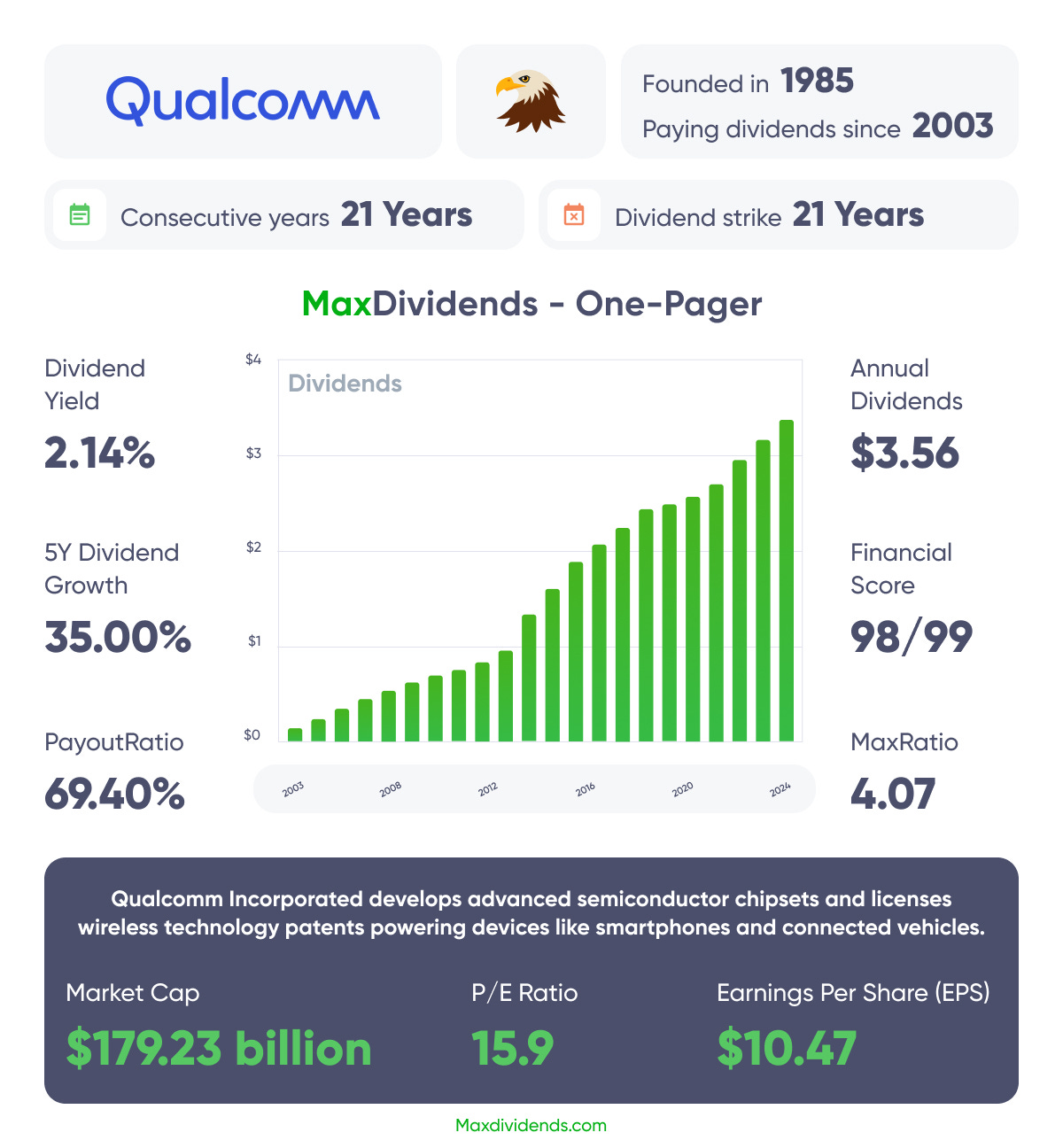
A Proven Dividend Eagle 🦅
15+ consecutive years of dividend increases
Qualcomm pays a quarterly cash dividend — as of now, it’s $0.89 per share. That adds up to roughly $3.56 per share per year, giving a yield of around 2.05%.
The company has been steadily raising its dividend: in March 2025, Qualcomm bumped it up from $0.85 to $0.89. Their long-term track record shows consistent growth — according to Dearborn Partners, that was the 21st consecutive annual dividend increase.
When it comes to sustainability, the payout ratio (how much of its earnings Qualcomm pays out as dividends) is moderate. Based on trailing earnings, it’s about 72.8%, but based on estimates for next year it drops to around 36%.
On top of dividends, Qualcomm also returns capital via share buybacks, which helps boost total shareholder returns.
If you want to dive deeper, the full list of all Dividend Eagles — with up-to-date analytics, financial scores, valuations, streaks, payout metrics, and every data point you need — is available inside the MaxDividends App for all partners right here:
👉 the full list of all Dividend Eagles
This is where you can explore every Eagle in detail, compare quality, screen for opportunities, and build a portfolio with true long-term horsepower.
And now, let’s get into the good part — a hand-picked set of dividend ideas worth your attention this month, selected for reliability, growth, and real income-producing strength. Let’s dive in.
List of Undervalued Dividend Stocks (January) 🔥

💡 This is a rare moment where some of the best dividend businesses in the world are trading at prices the market won’t offer for long.
The Most Notable Dividend Increases of the Month
Broadcom (AVGO) — Dividend Increase: +10.2%
14+ consecutive years of rising dividends
Broadcom is one of the most important infrastructure companies in the global technology ecosystem, supplying semiconductors and software that sit deep inside data centers, networking equipment, broadband systems, and enterprise IT environments. Its products power the physical backbone of cloud computing, AI, and global connectivity.
The company’s business is built around high switching costs, long product cycles, and mission-critical technology that customers simply cannot replace easily. That creates strong pricing power and highly durable free cash flow — even through volatile technology cycles.
Broadcom raised its dividend by 10.2%, extending its dividend growth streak to 14 consecutive years. The increase reflects management’s confidence in the company’s cash-generating power as demand for data, AI infrastructure, and connectivity continues to expand — reinforcing Broadcom’s role as a premium income-growth engine inside dividend portfolios.
Abbott Laboratories (ABT) — Dividend Increase: +6.8%
50+ consecutive years of rising dividends
Abbott is a global healthcare powerhouse spanning diagnostics, medical devices, nutrition, and branded generic pharmaceuticals. Its products are deeply embedded in hospitals, clinics, and households worldwide — supporting steady, non-cyclical demand driven by demographics and healthcare needs.
With diversified revenue streams and strong intellectual property, Abbott generates reliable cash flow across economic cycles. People don’t stop needing medical tests, heart devices, or infant nutrition when markets get volatile — and that stability is exactly what long-term dividend investors value.
Abbott increased its dividend by 6.8%, extending its remarkable streak to 53 consecutive years of dividend growth. This places Abbott firmly among the elite Dividend Kings, demonstrating how essential-services businesses can quietly compound income for decades.
Bank OZK (OZK) — Dividend Increase: +2.2%
25 consecutive years of rising dividends. Fourth increase in the past 12 months
Bank OZK is a specialized regional bank known for its disciplined credit underwriting, strong capital ratios, and focus on high-quality commercial real estate and specialty lending. Unlike many banks that chase growth through risk, OZK has built a reputation for protecting capital first — then compounding it steadily.
That conservative approach produces resilient earnings and excess capital, allowing the bank to reward shareholders even when the broader financial sector faces uncertainty.
OZK raised its dividend again by 2.2% — the fourth increase in the last 12 months — extending its dividend growth streak to 25 consecutive years. This pattern of frequent raises signals both confidence in cash flow and a shareholder-friendly capital policy, making Bank OZK a quiet but powerful income compounder inside dividend portfolios.
The Most Solid Recent Dividend Hikes
Automatic Data Processing (ADP) +10.39%
Atmos Energy (ATO) +14.94%
Griffon (GFF) +22.22%
Motorola Solutions (MSI) +11.01%
PulteGroup (PHM) +18.18%
Patrick Industries (PATK) +17.50%
Roper Technologies (ROP) +10.30%
Snap-on (SNA) +14.02%
Dividend Macro Highlights: Global Dividend Trends
The macro report is updated quarterly
Global: Latest Dividend Data
The global cumulative dividend payout for Q4 2025 continued the upward trajectory observed since the post-pandemic recovery. Total dividends reached approximately $1.67 trillion, with the vast majority coming from regular dividend payments rather than special distributions.
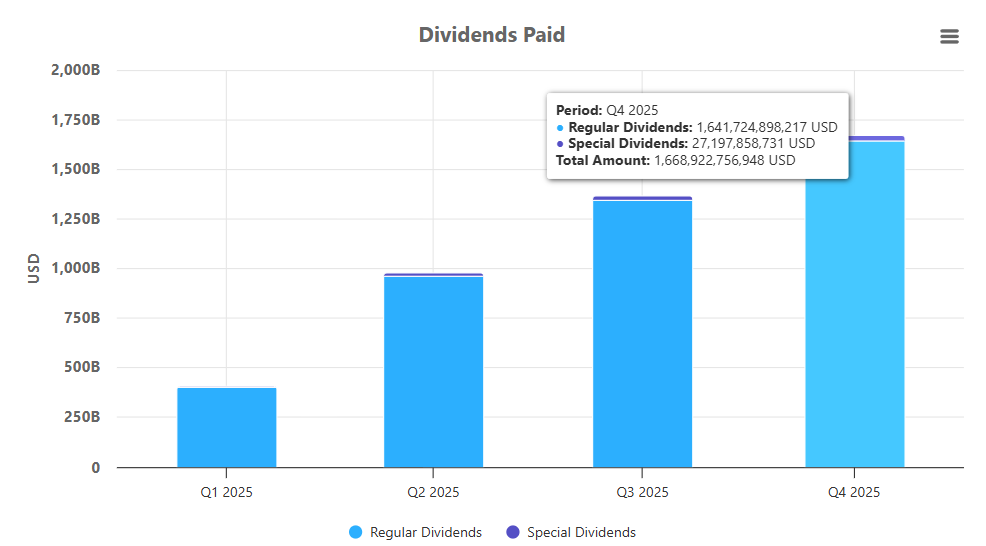
This composition indicates that dividend growth is being driven primarily by recurring operating cash flows, rather than one-time balance-sheet actions. The stability of regular payouts suggests that corporate earnings and cash-flow generation remain sufficiently strong to support ongoing shareholder distributions.
Global Total Quarterly Dividend Payments (US$ Billions)
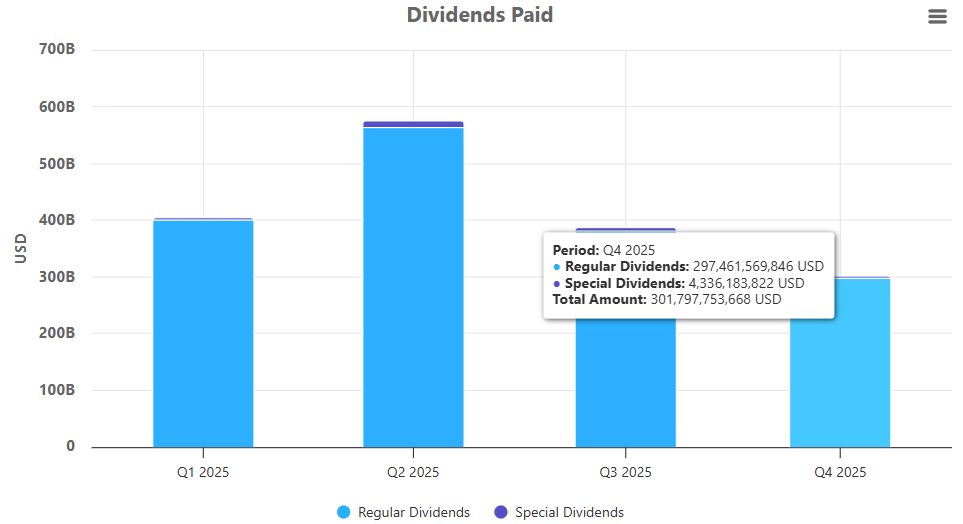
Global dividend payments remained elevated throughout 2025, reflecting stable corporate earnings and sustained shareholder return policies across major markets. Companies distributed approximately $400 billion in dividends during the first quarter, followed by a peak of nearly $570 billion in the second quarter, driven in part by elevated special dividends.
In Q3 2025, total payouts moderated to roughly $380 billion as special distributions declined, while regular dividends remained stable.
With Q4 2025 now fully reported, global dividends totaled approximately $302 billion, including $297.5 billion in regular dividends and $4.3 billion in special dividends. The sharp reduction in special payouts compared to Q2 and Q3 indicates that dividend flows in late 2025 were almost entirely supported by recurring operating cash flows rather than one-time balance-sheet actions.
Overall, the quarterly pattern shows that while special dividends created temporary volatility earlier in the year, the underlying level of regular dividend payments remained consistently strong, confirming the durability of global corporate income generation into year-end (Figure 1).
Global Dividend Breakdown — Q4 2025 Year-to-Date
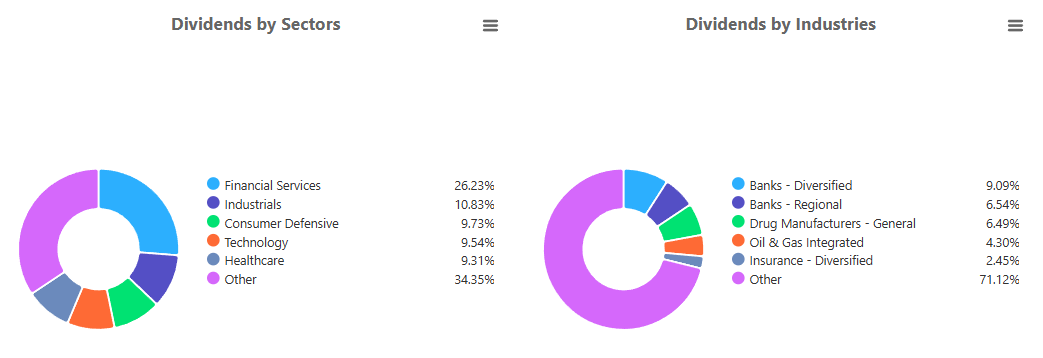
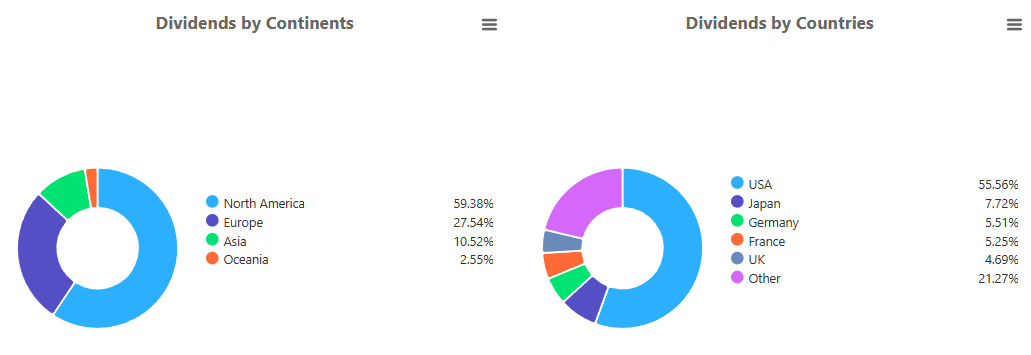
These charts show how global dividend payments have been distributed across sectors and industries through the latest data for 2025.
Financial Services remain firmly in the lead, accounting for 26.23% of all global dividend payouts. Industrials contribute 10.83%, while Consumer Defensive (9.73%), Technology (9.54%), and Healthcare (9.31%) each play similarly sized roles in the global income landscape. The broad 34.35% “Other” category underscores the growing diversification of dividend-paying companies worldwide.
At the industry level, banks continue to dominate, with diversified and regional banks combining for 15.63% of total global payouts. Drug manufacturers (6.49%), integrated oil & gas (4.30%), and diversified insurance (2.45%) also remain meaningful contributors.
Meanwhile, the large 71.12% “Other” segment reflects the wide range of industries now participating in global dividend generation.
U.S. Dividend Landscape
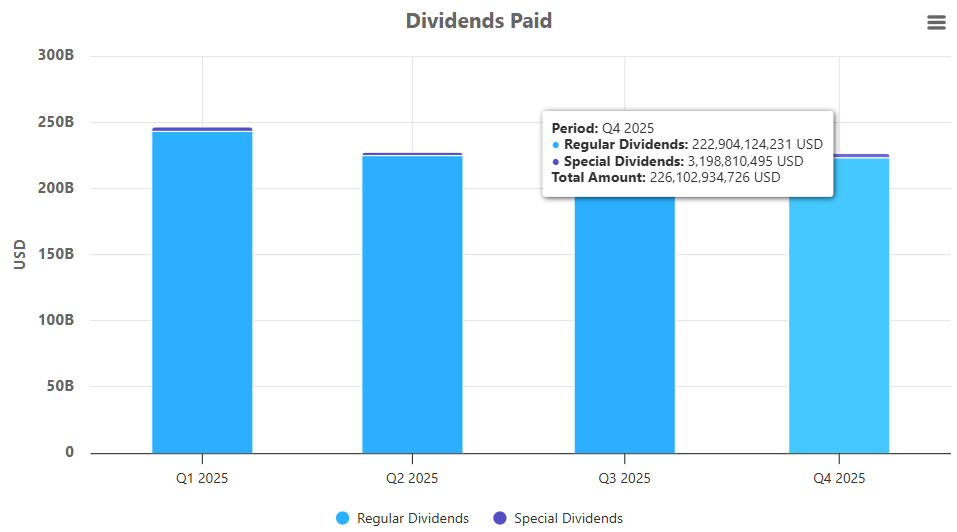
The chart shows total dividend payments by U.S. companies in 2025, broken down by quarter.
Dividend distributions remained relatively stable throughout the year. Q1 2025 delivered approximately $245 billion, followed by $225 billion in Q2 and $230 billion in Q3, reflecting consistent earnings and ongoing shareholder return policies across corporate America.
With Q4 2025 now reported, total U.S. dividends reached $226.1 billion, consisting of $222.9 billion in regular dividends and $3.2 billion in special dividends. The further decline in special payouts confirms that dividend income in late 2025 was driven almost entirely by recurring, operating cash flows rather than one-time distributions.
Overall, the quarterly pattern for 2025 indicates a stable and sustainable level of dividend payments, with regular dividends forming the core of shareholder returns as U.S. companies entered 2026.
U.S. Dividend Breakdown — Q4 2025 Year-to-Date
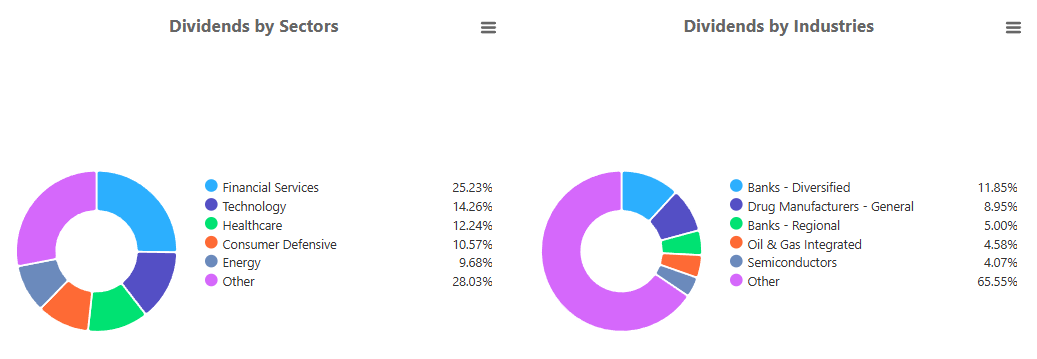
These charts show how dividend payments in the U.S. market are distributed across sectors and industries.
Financial Services remain the dominant dividend-paying sector, contributing 25.23% of all U.S. payouts. Technology follows with 14.26%, while Healthcare (12.24%), Consumer Defensive (10.57%), and Energy (9.68%) form a balanced group of steady contributors. The 28.03% “Other” category continues to signal a broadening dividend base across the market.
At the industry level, diversified banks lead with 11.85% of total payouts. Drug manufacturers add 8.95%, while regional banks contribute another 5.00%. Integrated oil & gas (4.58%) and semiconductors (4.07%) round out the next tier. The large 65.55% “Other” share highlights the wide variety of industries now playing meaningful roles in the U.S. dividend landscape.
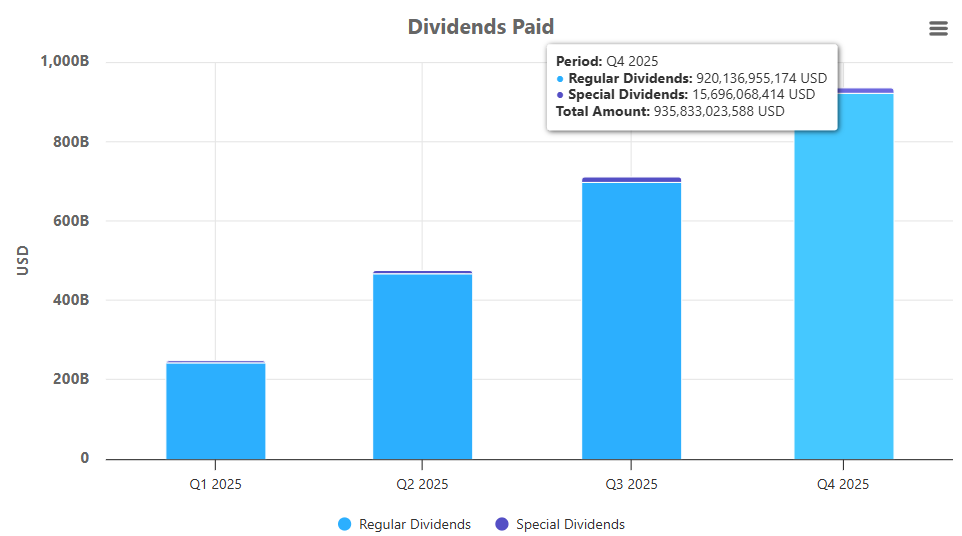
Cumulative dividends paid by US companies in 2025
Dividends paid by U.S. companies continued to rise steadily throughout 2025, reflecting stable earnings and a consistent commitment to shareholder distributions.
Cumulative payouts reached approximately $240B by Q1, increased to around $470B by Q2, and surpassed $700B by Q3. With Q4 2025 now fully reported, total dividends for the year reached $935.8 billion, consisting of $920.1 billion in regular dividends and $15.7 billion in special dividends.
The overwhelming share of regular dividends confirms that U.S. corporate payout growth in 2025 was driven primarily by recurring operating cash flows rather than one-time distributions, underscoring the stability and predictability of dividend income across the U.S. market.
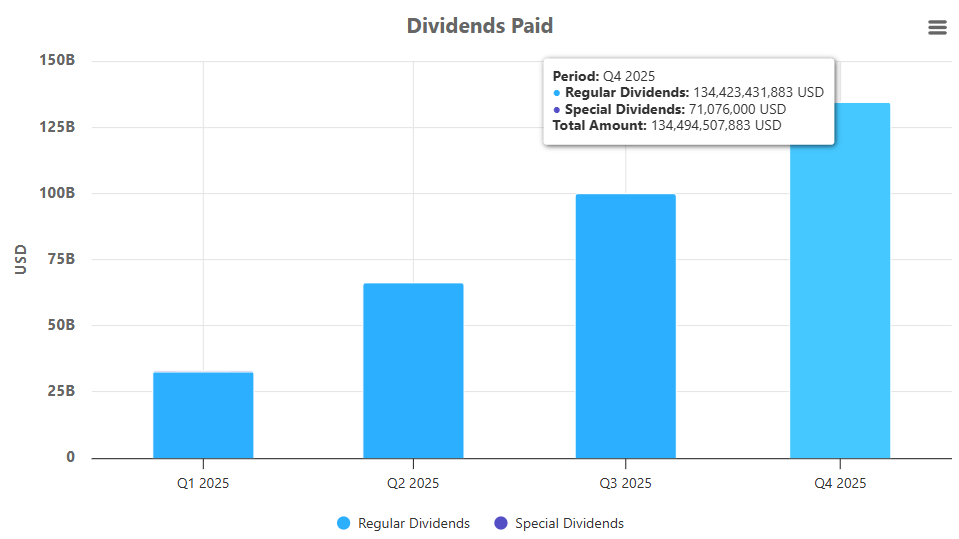
Cumulative dividends paid by US Dividend Eagles in 2025
Dividend Eagles — companies with 15+ years of consecutive dividend growth — continued to deliver steadily rising cash distributions throughout 2025.
Cumulative payouts reached approximately $32B by Q1, increased to around $65B by Q2, and surpassed $100B by Q3. With Q4 2025 now fully reported, total dividends paid by Dividend Eagles reached $134.5 billion, including $134.4 billion in regular dividends and only a negligible amount of special distributions.
The quarterly progression shows a smooth and consistent increase in payouts, reflecting the strength and stability of this group’s underlying earnings and cash-flow generation. The near-total reliance on regular dividends further underscores the predictability and durability of income produced by long-term dividend growth companies.
Proof That Dividend Eagles Deliver, Year After Year
Over the past decade, U.S. Dividend Eagles — companies with 15+ consecutive years of dividend increases — have shown a steady and sustained expansion in total cash returned to shareholders.
Annual dividend payouts grew from approximately $68 billion in 2015 to $134.4 billion in 2025, representing nearly a 100% increase over the period. This growth reflects not only rising earnings but also a consistent commitment by these companies to return cash through regular dividend increases across multiple economic cycles.
The decade-long trend demonstrates that Dividend Eagles have been able to maintain and expand their payout capacity through periods of economic recovery, inflation, and shifting market conditions — providing a long-term foundation of reliable and growing shareholder income.
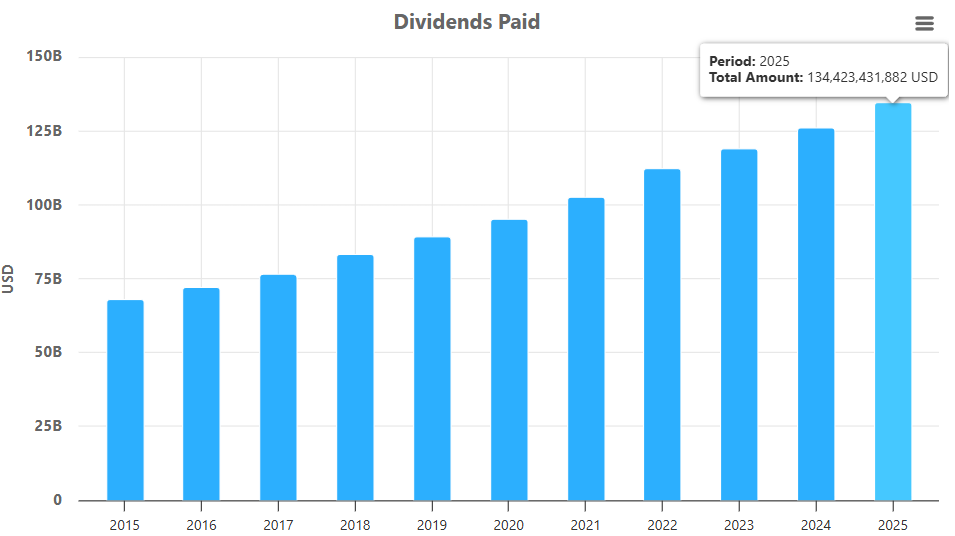
📊 This chart makes the MaxDividends concept crystal clear: when you own businesses that never stop paying and keep raising the bar every single year, your income stream snowballs in front of your eyes. These are not flashy promises — they are the most reliable wealth-building machines in the market.
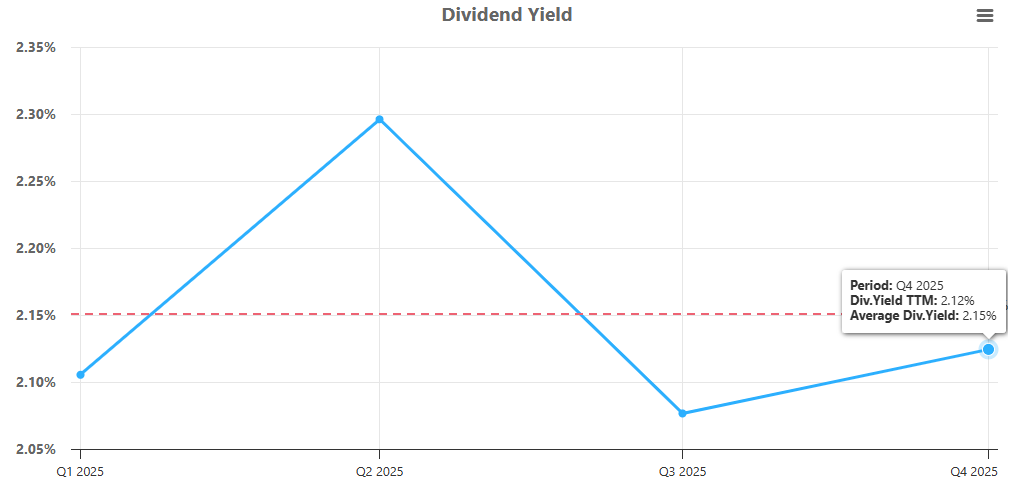
Average Dividend Yield of Dividend Eagles, Q4 2025
In 2025, the average dividend yield of Dividend Eagles moved through a modest midyear cycle before stabilizing into year-end. Yields started near 2.10% in Q1, peaked around 2.30% in Q2, and then dipped to just above 2.08% in Q3.
By Q4, the average yield recovered to 2.12%, landing slightly below the long-term average of 2.15%. This mild rebound suggests steady income conditions and a broadly stable valuation backdrop for America’s most reliable dividend growers.
🥇 Top 5 Dividend Eagles by Total Payouts (2025 YTD)
These are the heavyweights — the Dividend Eagles returning the most cash to shareholders right now:
Microsoft (MSFT) — 💵 $25.38B in dividends
Johnson & Johnson (JNJ) — 💵 $12.37B
Procter & Gamble (PG) — 💵 $10.25B
Home Depot (HD) — 💵 $9.02B
Coca-Cola (KO) — 💵 $8.81B
📊 Together, just these five companies alone have distributed over $55 billion in dividends so far — a powerful reminder of what it means to own reliable, world-class businesses that never stop paying.
And that’s exactly what the Dividend Eagles List is all about. 🦅 It’s our curated lineup of 100+ U.S. companies that have raised dividends for 15+ consecutive years — the strongest, most consistent payers in the market. These aren’t just stocks; they’re proven wealth-building machines built on financial stability, resilience, and decades of shareholder commitment.
👉 The full, always-updated Dividend Eagles List is available inside the MaxDividends App — exclusive to our community.
Created by the MaxDividends Team. Available only on MaxDividends. Exclusive.
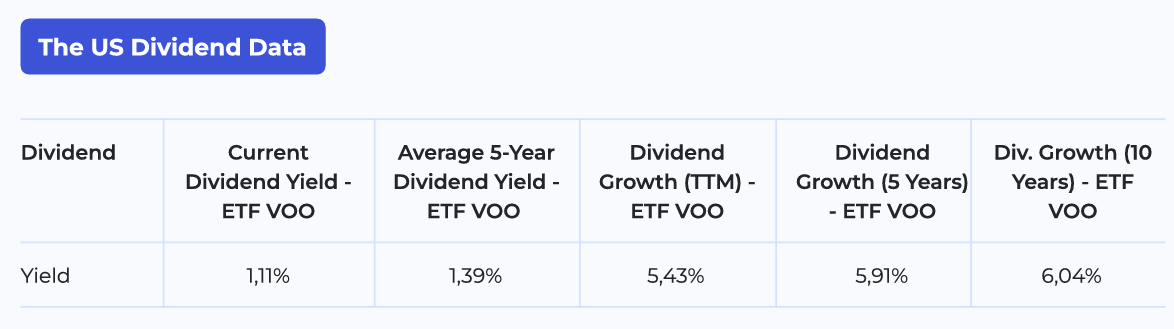
U.S. Dividend Landscape - (S&P 500)
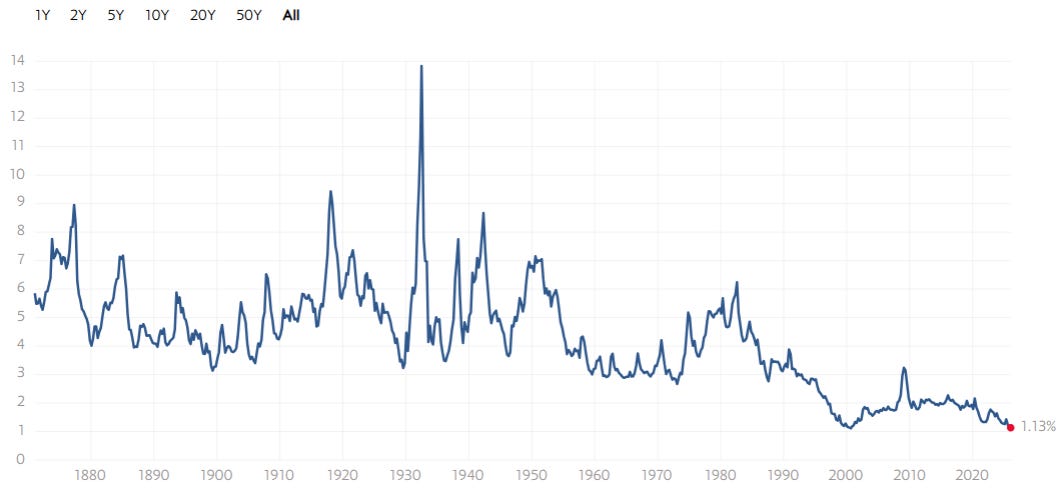
S&P 500 Dividend Yield — Historical Perspective
The S&P 500 dividend yield has drifted even lower, now sitting at 1.13% — one of the lowest levels in more than a century of market history. Stock prices remain high relative to the dividends companies pay, keeping yield levels deeply compressed.
When viewed against nearly 150 years of data, today’s yield stands far below the long-term historical norm of 3–5%.
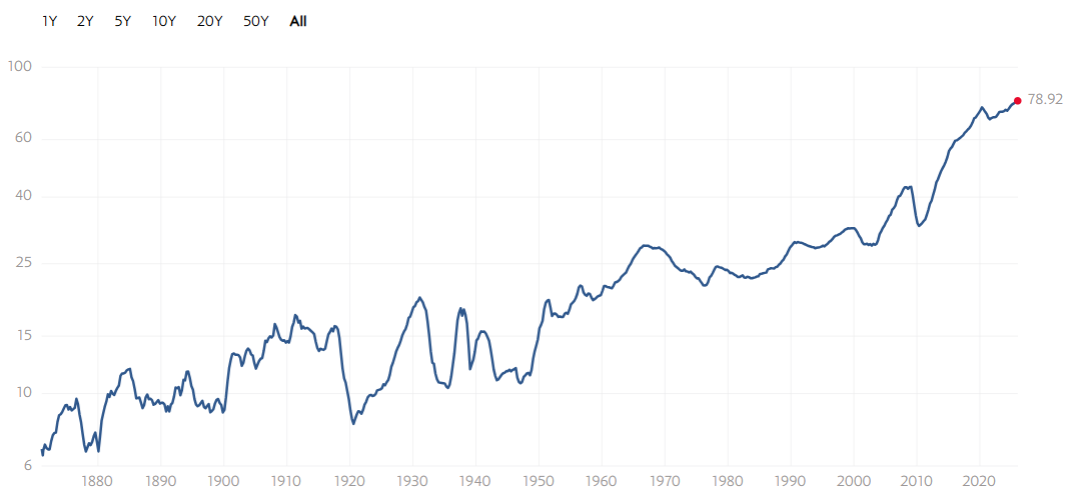
S&P 500 Historical Dividend Trends
Inflation-adjusted dividends for the S&P 500 continue to show a steady long-term upward trajectory. Even with periodic economic shocks and market volatility, the underlying growth trend in real dividends has remained intact for more than a century.
The previous inflation-adjusted peak came in May 2020, when dividends reached 73.09. Today, that figure stands at 78.92, setting a new all-time high and highlighting the ongoing strength of corporate cash flows within the index.

S&P 500 Dividend Growth
The S&P 500 dividend growth trend continues to demonstrate long-term resilience. Over more than three decades, negative dividend growth has occurred only during major economic stress periods, highlighting how rarely large U.S. companies reduce their payouts on a broad basis.
The latest reading shows dividend growth at approximately 5.46%, indicating a moderate but still positive pace of expansion across the index. While this level is below the higher growth rates seen during earlier recovery phases, it remains consistent with an environment of stable corporate earnings and ongoing cash distributions.
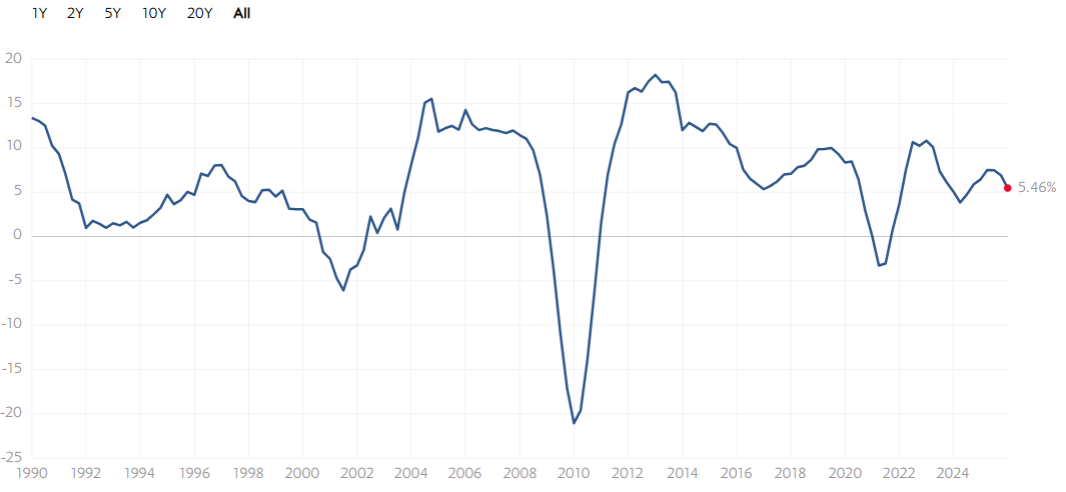
Despite market volatility and shifting economic conditions, the longer-term pattern of dividend growth remains positive, reflecting the ability of S&P 500 companies to maintain and gradually increase shareholder payouts over time.
Inflation’s Impact on Dividends
Inflation remained within a relatively narrow range through the second half of 2025, continuing to shape the real (inflation-adjusted) value of dividend income.
After easing to a low of approximately 2.3% in March, inflation gradually moved higher through mid-year, rising to around 2.7% in July and 2.9% in August, before reaching 3.0% in September. Following that peak, inflation moderated again, falling back to approximately 2.7% by December 2025.
This pattern indicates that while price pressures increased during the late summer, inflation did not become entrenched at higher levels. The return toward the mid-2% range by year-end suggests a relatively stable inflation backdrop, allowing real dividend growth to remain supported by nominal dividend increases rather than being eroded by accelerating consumer prices.
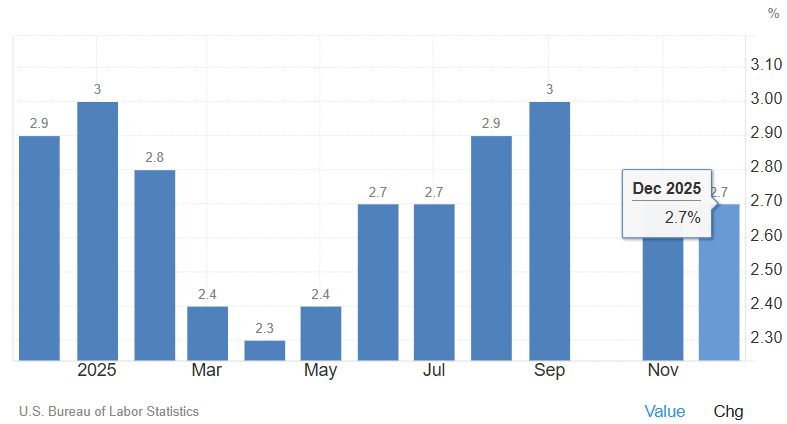
This moderation toward the mid-2% range reduces pressure on inflation-adjusted S&P 500 dividends compared with the late-summer peak, allowing real dividend growth to remain relatively stable.
However, inflation remains above the levels seen in early 2025, which continues to limit the pace at which real dividend income can accelerate, keeping growth steady rather than returning to the stronger expansion observed immediately after the 2022 inflation peak.
For your convenience, we have prepared a PDF version of the Dividend Macro Overview. You can download and review it at any time.
🎁 One More Bonus!
My Personal Stock Watchlist — January 2025
A hand-picked list of the dividend stocks I’m actively tracking this month.
Each month I hand-pick a focused shortlist of dividend stocks worth watching. No guesswork, no hype — I screen thousands of companies and keep only the ones with strong balance sheets, reliable dividend growth, and long-term wealth-building potential.
This watchlist is where I’m putting my energy — a mix of high-yield opportunities and growth names with the power to multiply income streams over time. If you’re serious about building a future where dividends cover your lifestyle, this is where to start.