


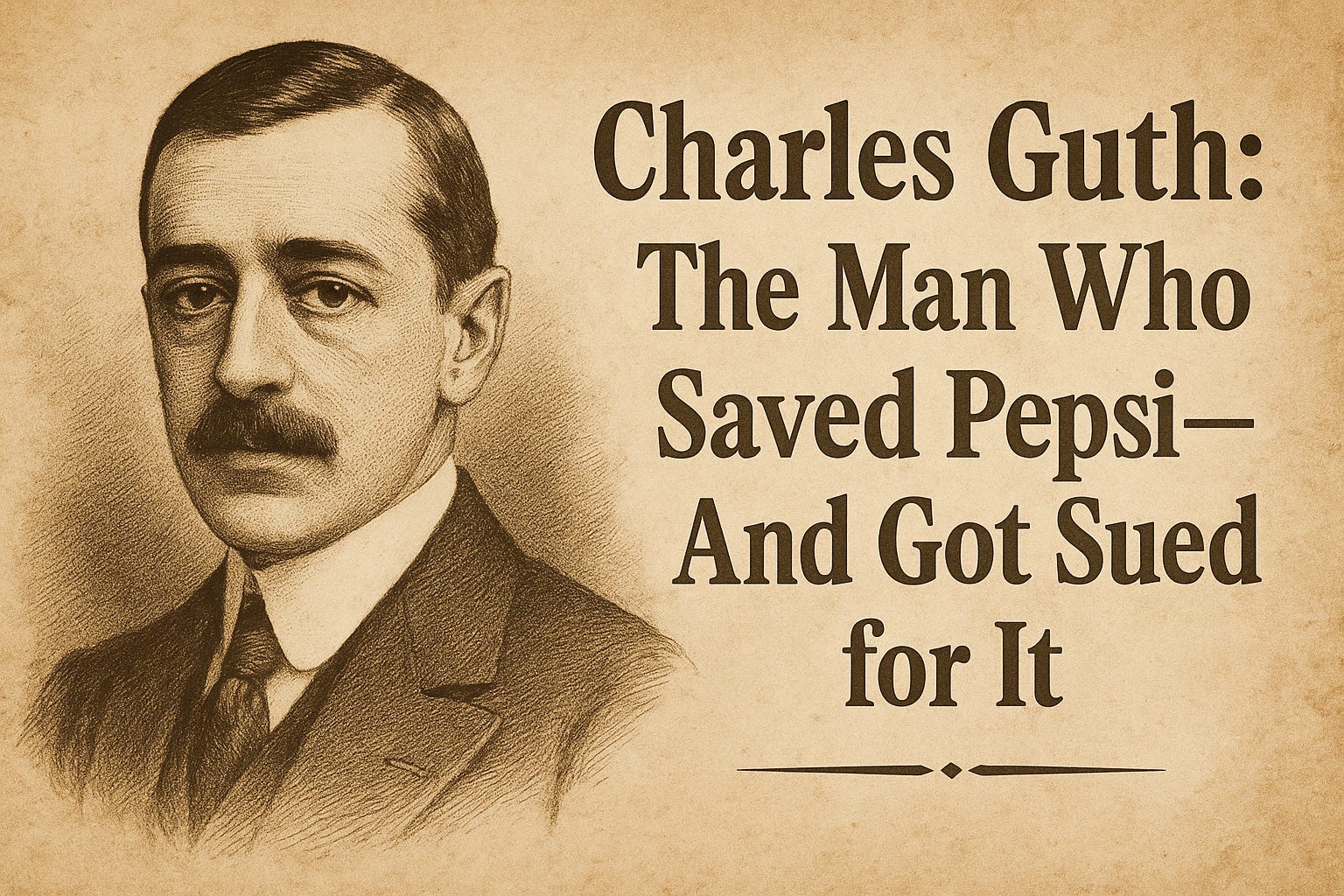
Most people sip their Pepsi without ever hearing the name Charles Guth. But if not for this aggressive, complicated, and controversy-courting candy executive, Pepsi might’ve died in the 1930s. Instead, it became one of the world’s most iconic brands—and it happened because one man got mad at Coca-Cola, rewrote the rules of soda marketing, and ended up in court for it.
This isn’t a story about bubbles. It’s about betrayal, branding, and a bitter legal brawl that changed American corporate law.
Murder, Power, and a Candy Empire (1913–1929)
Charles Guth didn’t exactly walk into the soda world clean. In 1913, while living in Baltimore, he killed his chauffeur, George A. Murphy, an African American employee. Guth claimed it was self-defense: he fired Murphy, an argument broke out, Murphy allegedly swung an axe, and Guth shot him.
A coroner and grand jury cleared him, but the NAACP called it murder—pointing to systemic injustice and how cheaply Black lives were treated in early 20th-century courts. Guth’s reputation never fully escaped that shadow.
Years later, he climbed the corporate ladder by building up Mavis Candies, then negotiating its acquisition by Loft Candy Company. He parlayed that into becoming VP at Loft, then President. By the late 1920s, he was running one of the largest candy chains on the East Coast. And soon, he had soda in his sights.
The $10,500 That Changed Pepsi Forever (1931)
Guth’s frustration started with Coca-Cola. As president of Loft, he tried to get favorable terms to sell Coke in his stores. They turned him down. So Guth turned around and bought something else: a bankrupt, half-dead cola brand called Pepsi, for $10,500.
That wasn’t just revenge—it was vision. Guth didn’t just want a cola. He wanted his own cola, and the assets he acquired—trademark, recipes, bottling lines—gave him a skeleton to rebuild from.
He quietly funneled Loft’s resources—cash, labs, ad staff—into reviving Pepsi. And it worked.
Pepsi Gets a Makeover (1932–1936)
Guth started by tweaking the formula. He and his chemists gave Pepsi a punchier, sweeter citrus profile to stand out from Coca-Cola’s smooth, mellow taste. But the real magic? The bottle.
Instead of the industry-standard 6 oz. serving, Guth offered 12 ounces of Pepsi for the same price. During the Depression, value trumped loyalty. It was marketing judo—same cost, double the soda.
By 1936, Pepsi’s sales had skyrocketed to 500 million bottles a year, and annual profits reached $2 million. That year, Pepsi even aired one of America’s first radio jingles, helping etch the brand into public memory.
The Lawsuit That Made Corporate Law (1935–1939)
Guth’s success with Pepsi was undeniable—but so was the fact that he’d built it using Loft’s money, facilities, and employees. In 1935, Loft sued him for breach of fiduciary duty. Their claim? Guth stole a business opportunity that should’ve belonged to them.
The case went to the Delaware Chancery Court—and Loft won. In 1939, the court ruled that Guth had violated the duties of loyalty and care he owed as a corporate officer. It was the birth of the “Guth Rule,” which became a landmark precedent in U.S. corporate governance.
The rule: Executives can’t seize opportunities for themselves that rightfully belong to the company—especially if the company has the means and interest to pursue them.
The Noxie-Kola Epilogue
Kicked out of Pepsi, Guth wasn’t done with soda. He joined a struggling rival called Noxie-Kola, hoping to replicate his magic. But lightning didn’t strike twice.
Noxie-Kola never cracked the market, and Guth’s later years were quieter. Still, his formula—literally and figuratively—had already changed the game. Pepsi would go on to become a global juggernaut, and the “Guth Rule” would become required reading in business law textbooks.
Bottom Line: One Man, One Bottle, One Precedent
Charles Guth didn’t invent Pepsi. He resurrected it with grit, marketing brilliance, and a knack for industrial judo.
He also bent the rules so hard they snapped—and a judge had to write new ones.
It’s a story of how spite, strategy, and soda collided—and how one man turned a $10,500 bankruptcy asset into a cola that still goes toe-to-toe with Coca-Cola today.
Someone’s sitting in the shade today because someone planted a tree a long time ago. ― Warren Buffett.
Learn the MaxDividends Way
Start Here
🔑 Explore the Premium Hub (exclusive — upgrade to unlock)
Guides & Step-by-Step
Deep Insights
📖 I ❤️ Dividends: Why I Believe Dividend Investing Is the Best Strategy | E-Book
How Effective is the MaxDividends Strategy for Building Growing Passive Income
Help & Support
Got a question about dividends? Ask Max, your AI Dividend Assistant!
Didn’t get the answer you need? Reach out: max@maxdividends.app or team@maxdividends.app — we’ll help you out.