


In every market cycle, investors tirelessly search for edges—new data, faster trades, sharper forecasts. But rarely do they talk about the one advantage available to everyone: the capacity to stay still. In an age where rapid movement is mistaken for progress, boredom may be the least celebrated yet most reliable engine of long-term compounding. Wealth, history shows, does not appear in surges of excitement but through quiet persistence that feels painfully uneventful while it’s happening.
The Discipline Behind Inaction
True investing discipline often looks indistinguishable from idleness. When screens are flashing and headlines predict turning points, doing nothing appears irresponsible. Yet over time, restraint outperforms reaction. A 2023 Morningstar analysis found that the average equity investor underperformed the market by roughly 3.5 percentage points annually over a decade—primarily due to impulsive trading during volatile periods. The consistency gap alone compounds into a 40% difference in terminal wealth after twenty years. Activity may ease anxiety, but it rarely increases returns.
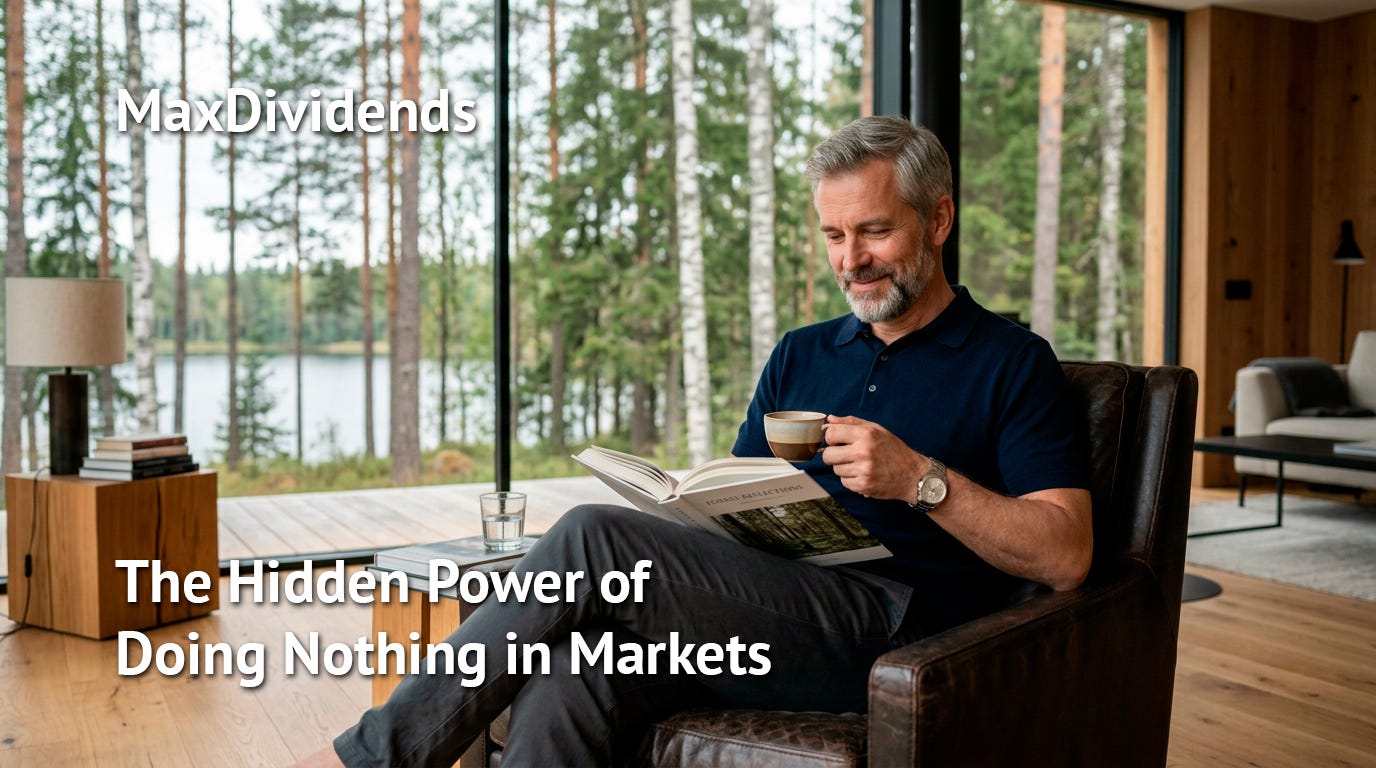
In modern markets, where constant commentary amplifies every minor fluctuation, the investor who resists noise earns a structural advantage. The real challenge is psychological: enduring monotony while assuming others are progressing faster. Patience, not prediction, becomes the true competitive edge.
Excitement Is the Enemy of Compounding
Financial data confirm that the pursuit of excitement correlates inversely with returns. The Dalbar Quantitative Analysis of Investor Behavior consistently shows that frequent traders—driven by enthusiasm or fear—capture less than half of the market’s long-term performance. Their portfolios chase narrative over numbers. The more thrilling an investment feels, the likelier it already reflects optimism priced into the market.
Meanwhile, investors who treat capital like an orchard rather than a lottery ticket benefit from the math of compounding. A portfolio growing 8% annually doubles every nine years; missing just three strong market years—often lost during attempts to time entries and exits—can delay that doubling by nearly a decade. Numbers, not instincts, explain why the dullest strategies usually end up the wealthiest.
The Invisible Engine of Time
Compounding functions best in silence. Checking performance daily imposes noise into what is fundamentally a long-duration process. A tree inspected too often never appears to grow; viewed every few seasons, it seems miraculous. Between 1980 and 2020, the S&P 500 delivered an annualized 11.8% total return, but investors who missed the 20 best days—a period equal to less than 0.1% of all sessions—saw their gains cut in half. The cost of impatience, measured in opportunity rather than fees, is staggering.
Wealth behaves like sediment—accumulating invisibly, compressing slowly, until a decade later it forms something solid. The process feels uneventful until it suddenly looks inevitable.
How Boredom Builds Strength
The investors often labeled “boring” usually apply the same framework year after year. They allocate capital to enterprises with durable earnings, reinvest dividends, and review progress on a calendar, not in response to headlines. Such predictability resembles mediocrity until compounding reveals its exponential bias. The difference between a 6% and 8% annual return over thirty years is a doubling of wealth; boredom, not brilliance, produces that gap.
A behavioral study from MIT found that individuals who delayed gratification under uncertainty achieved returns nearly 25% higher than peers who sought stimulation through frequent changes. Their portfolios looked lifeless in the interim, yet the arithmetic of consistency turned restraint into advantage.
The Quiet Endurance That Wins
Markets reward endurance disguised as indifference. True long-term investors behave more like archivists than gamblers—collecting small, deliberate positions, leaving them untouched, and letting time handle the heavy lifting. Every spectacular success story eventually reduces to a decade of uneventful compounding interrupted by brief surges of recognition.
Doing less, it turns out, demands uncommon conviction. It means trusting mathematics over motion, systems over spontaneity, and time over tension. For most investors, the hardest work lies in waiting long enough for their decisions to matter.
Final Reflection
The irony of investing is that excitement feels productive but exhausts capital. The quiet investor—the one able to endure dull months, negligible changes, and the emptiness between milestones—builds resilience that no algorithm can replicate. Boredom, properly defended, becomes the moat around wealth. The world notices only after patience has already done its job.
Someone’s sitting in the shade today because someone planted a tree a long time ago. ― Warren Buffett.
Learn the MaxDividends Way
Start Here
🔑 Explore the Premium Hub (exclusive — upgrade to unlock)
Guides & Step-by-Step
Deep Insights
📖 I ❤️ Dividends: Why I Believe Dividend Investing Is the Best Strategy | E-Book
How Effective is the MaxDividends Strategy for Building Growing Passive Income
Help & Support
Got a question about dividends? Ask Max, your AI Dividend Assistant!
Didn’t get the answer you need? Reach out: max@maxdividends.app or team@maxdividends.app — we’ll help you out.