


💡 MaxDividends Mission: Helping people build growing passive income, retire early, and live off dividends.
Structured reviews of dividend stocks worth serious attention. Financially strong. Dividend disciplined. Priced with logic.
🔓 Request Free Early Access to the MaxDividends App
Booz Allen Hamilton (BAH)
A Strategic Federal Contractor with Dividend Growth Momentum
Imagine this.
A large hospital system gets hit with a cyberattack. Patient data is locked. Systems go down. Surgeries get delayed. The damage isn’t just financial — it’s operational. Now imagine the same kind of threat aimed at power grids, airports, military logistics systems, or intelligence databases.
This is not a movie scenario. This is daily reality.
The U.S. government runs enormous, complex systems — defense networks, cybersecurity operations, intelligence data platforms, veteran health systems, border security databases. Many of these systems were built decades ago. Many must be constantly upgraded. And many cannot fail.
The government does not build all of this alone. That’s where Booz Allen Hamilton comes in.
What Booz Allen Actually Does
A Real-World Example
Let’s say the U.S. military wants to use artificial intelligence to predict equipment failures before they happen. If a helicopter part fails mid-mission, that’s a serious risk. So the goal is to collect sensor data, analyze patterns, and detect early warning signs.
Booz Allen’s data scientists build the models that analyze that information. Their engineers help integrate it into military systems. Their experts train the teams who use it.
Now that system is running. It needs updates. It needs monitoring. It needs improvements. That creates ongoing work. Not one-time work.
Booz Allen helps the government solve hard technical problems that are too specialized or too complex to handle internally.
For example, if the Department of Defense needs a new system to analyze battlefield data in real time, Booz Allen provides engineers and analysts who design and implement that system.
If Homeland Security needs stronger cybersecurity defenses to prevent hacking attempts, Booz Allen builds and tests those defenses. If a federal agency needs to modernize outdated software that still runs on 1990s infrastructure, Booz Allen helps rebuild it without shutting everything down.
They don’t manufacture weapons. They don’t sell hardware. They don’t run consumer products. They sell expertise.
Highly trained engineers, cybersecurity specialists, AI developers, analysts, and technical advisors who work directly inside government programs.
Think of them as specialized builders — except instead of constructing houses, they construct digital systems, defense tools, and secure networks.
Who Pays Them — And Why That Matters
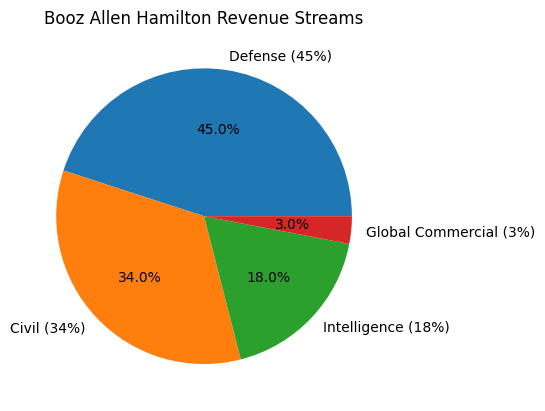
Almost all of Booz Allen’s revenue comes from the U.S. federal government. Primarily the Department of Defense, intelligence agencies, Homeland Security, and other federal departments.
This is not a business that depends on consumer demand. It doesn’t care if TikTok is trending or if mall traffic is down. It doesn’t depend on fashion cycles or holiday sales.
Its customer is the U.S. government.
Government contracts are usually multi-year agreements. They are structured. They are planned in advance. Often, funding is allocated well before the work begins. That creates visibility into future revenue.
Cyber threats do not disappear during recessions. In fact, they often increase. Geopolitical tension does not pause because the stock market is down. Military systems still need maintenance. Intelligence agencies still need data analysis. Federal IT systems still require upgrades.
That means the core demand for Booz Allen’s services does not depend on consumer spending or economic mood. It depends on national security, defense priorities, and digital modernization. Those are long-term themes.
What Could Go Wrong
No business is risk-free. Booz Allen is heavily dependent on U.S. government spending.
The biggest structural risk here is extreme revenue concentration. Nearly 98% of Booz Allen Hamilton’s revenue comes from U.S. government contracts, leaving almost no commercial buffer. That works well during periods of strong federal spending, but it creates a single-customer dependency at scale.
Any political gridlock, budget delays, government-wide efficiency initiatives, or procurement slowdowns can immediately pressure revenue conversion — even with a large backlog in place. Federal budget cycles are inherently unpredictable, and visibility can deteriorate quickly if appropriations are delayed or priorities shift.
A second near-term headwind is the Civil segment reset. Management has acknowledged that this business is undergoing restructuring, with revenue expected to decline in the low double digits in FY2026. While the reset may strengthen long-term alignment and margins, it introduces short-term pressure on growth and earnings momentum.
In simple terms: the company is highly exposed to one customer and is navigating a meaningful segment slowdown at the same time. If federal spending tightens or the Civil turnaround takes longer than expected, growth could stall and valuation multiples could compress.
📊 The Company’s Financial Condition
⭐️⭐️⭐️⭐️⭐️
Financial Score: 98 / 99
Cash flows are generated primarily through multi-year U.S. government engagements across defense, intelligence, and civil agencies.
Unlike commercially diversified consulting firms, BAH’s revenue base is concentrated but contract-driven, providing visibility through backlog and program continuity rather than exposure to short-term consumer or corporate demand swings.
The balance sheet reflects controlled leverage and consistent profitability, allowing the company to fund operations, reinvest in capabilities, and return capital to shareholders without stretching its payout profile.
💰 Current Dividends & Dividend Growth
Booz Allen’s dividend profile reflects a growth-oriented payout policy supported by earnings expansion:
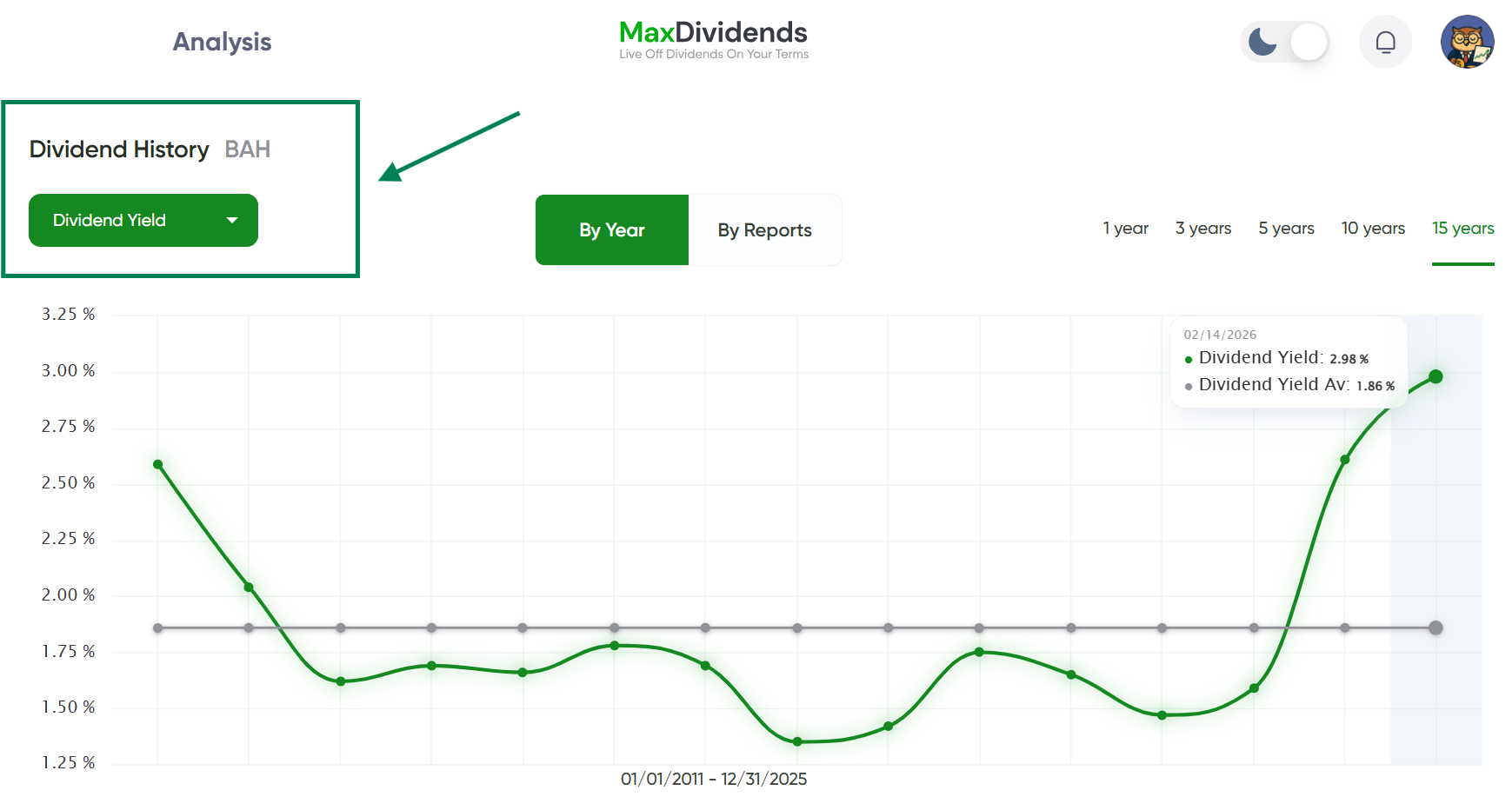
Dividend Yield: ~2.98%
Consecutive Years of Growth: 13
5Y Dividend Growth: +77%
10Y Dividend CAGR: ~15.5%
5Y Average Payout Ratio: 49%
TTM Payout Ratio: ~32%
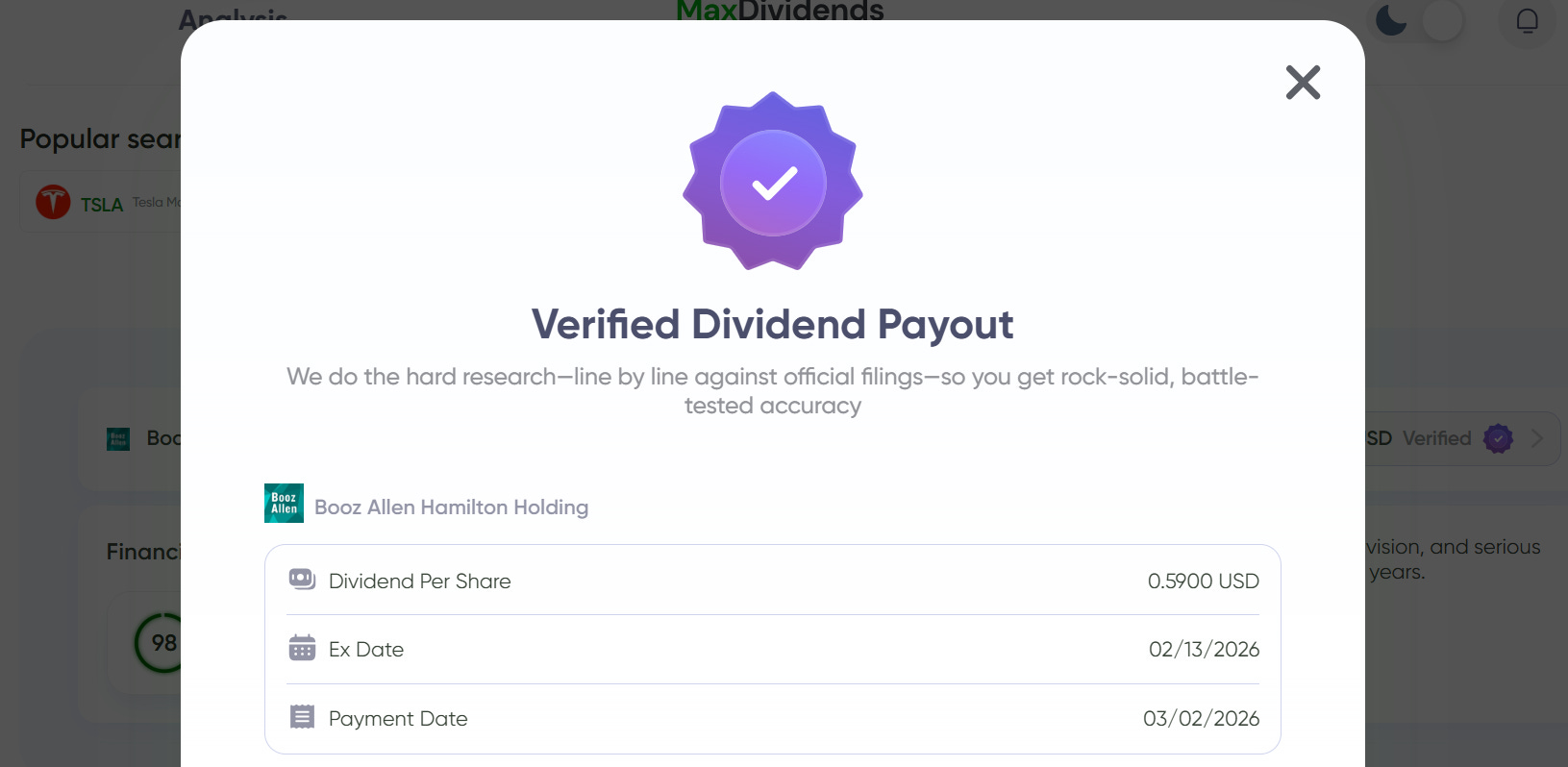
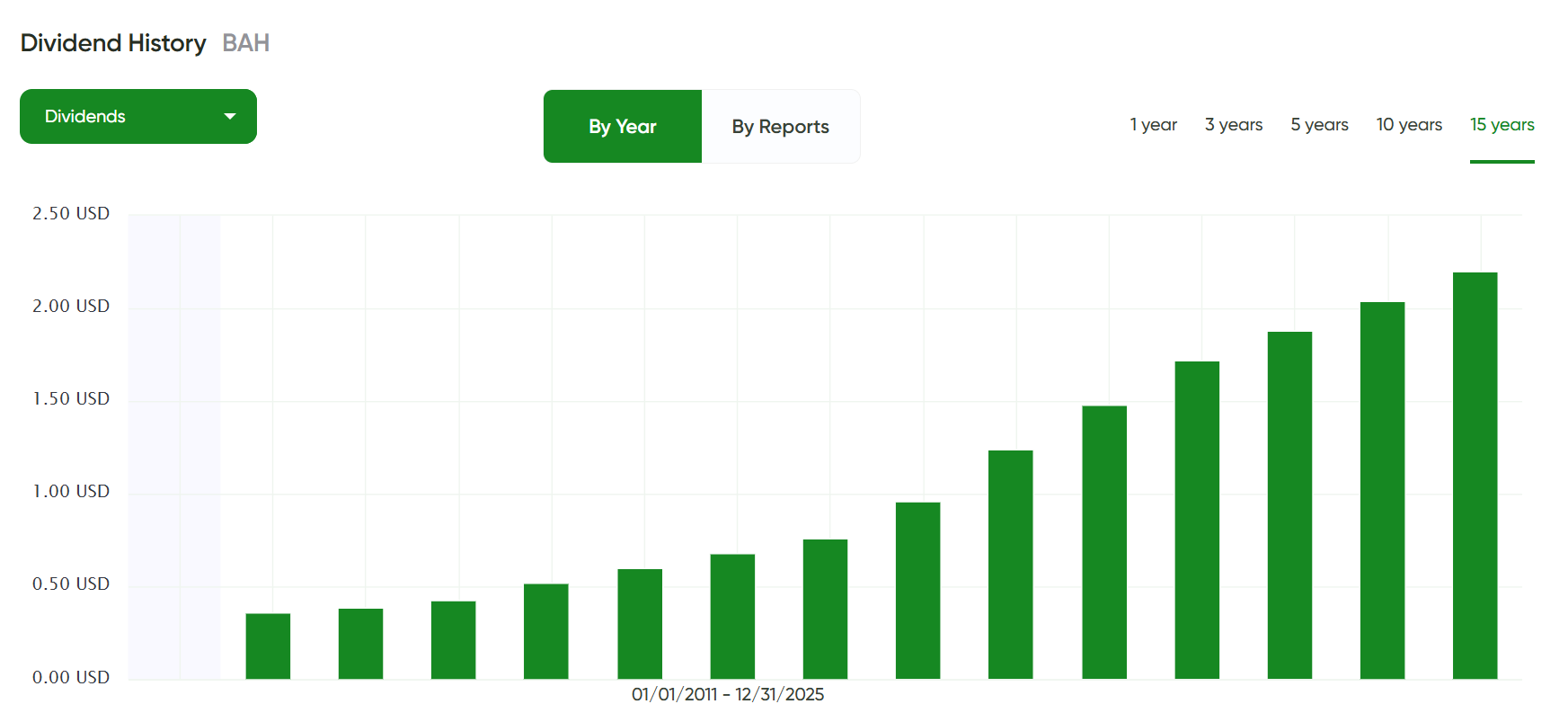
The most important metric here is coverage. With a payout ratio near one-third of earnings, the dividend is supported by underlying profitability rather than financial leverage.

This is not a high-yield strategy. It is a dividend growth strategy with room for continuation if earnings remain stable.
📈 Future Dividend Yield on Cost (MaxRatio)
MaxRatio is an estimated dividend yield on cost calculated by combining the current dividend yield with the 5-year & 10-year average dividend growth rate, projected over the next 10 years. It provides a clear outlook on future dividend returns.
Booz Allen’s MaxRatio ~10+ ✅
That means an investor today can reasonably expect their yield on cost to approach 9–10% over the next 10–12 years if dividend growth trends continue.
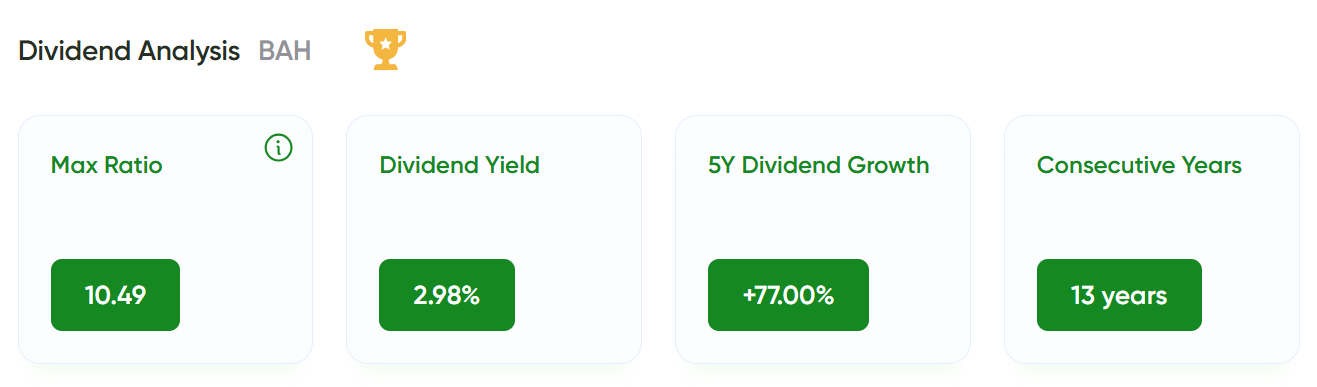
If dividend growth trends remain in the high single-digit to low double-digit range over the next decade, today’s ~3% yield could meaningfully compound over time.
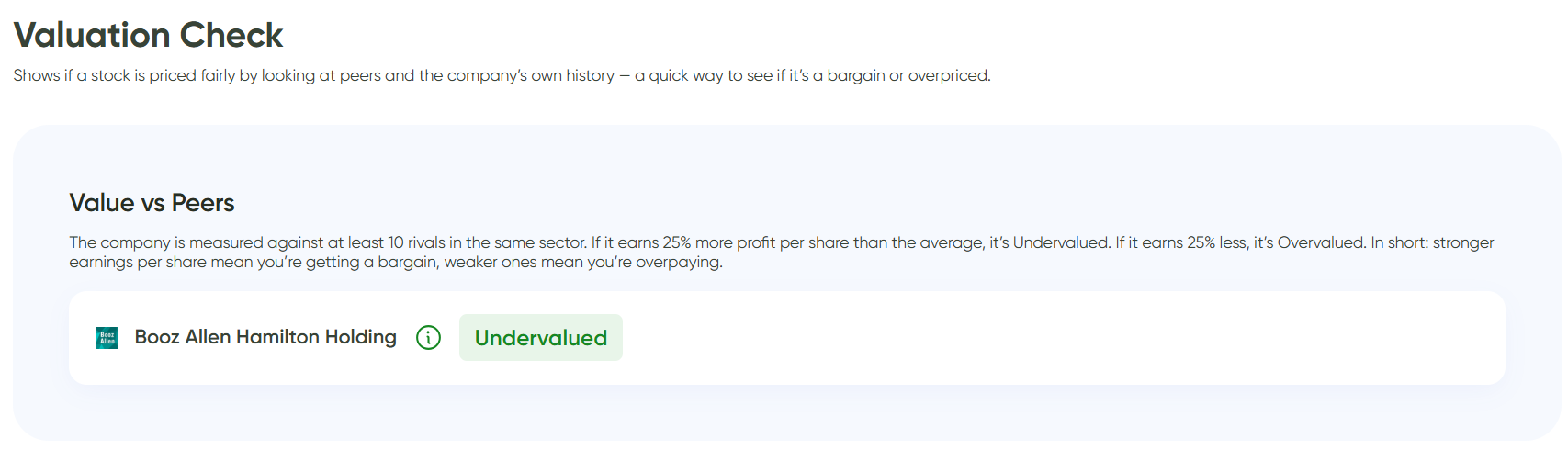
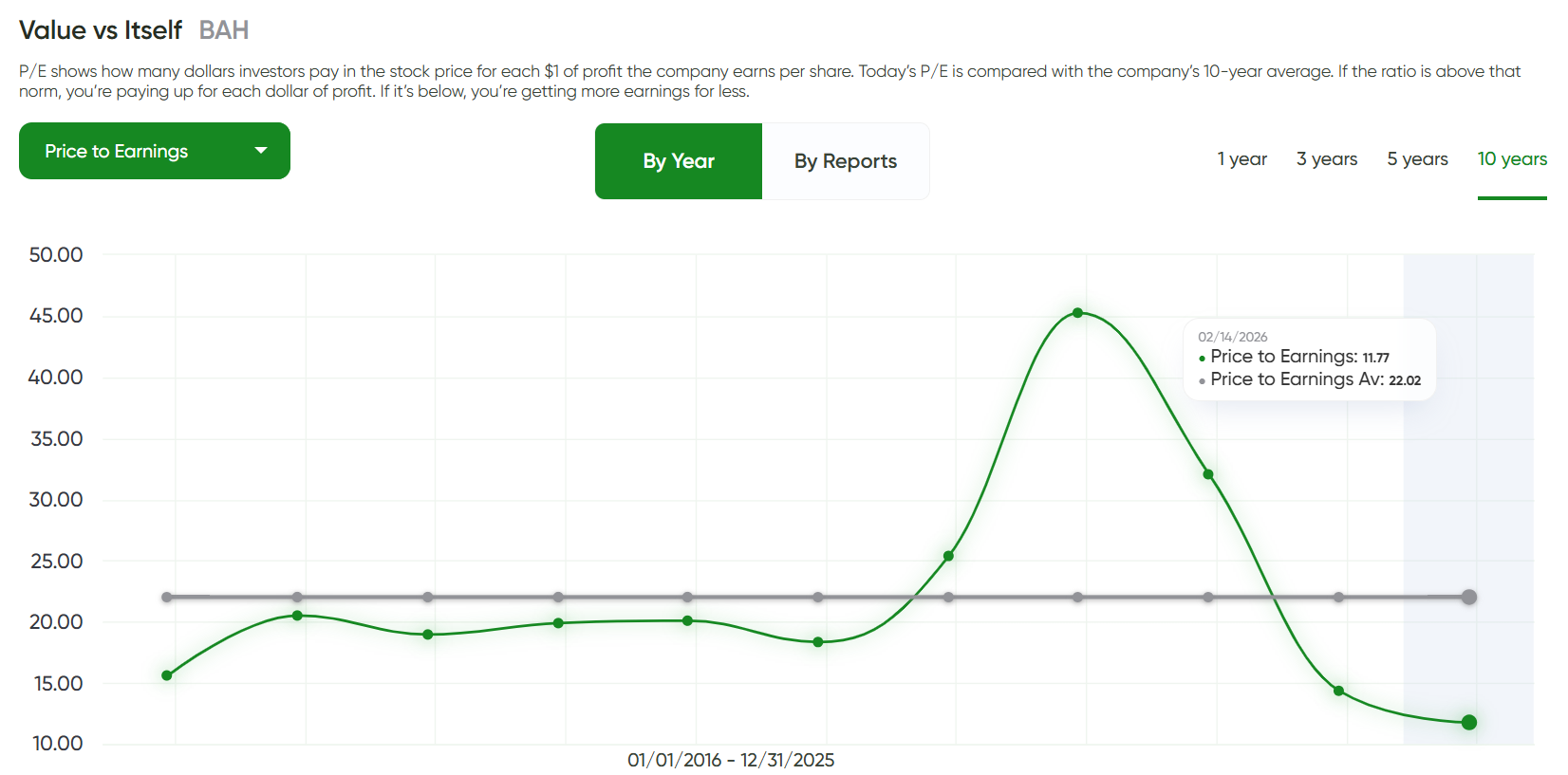
The Company’s Fair Value Today: Seems Undervalued
Current Company P/E < Compare to Av. Competitors P/E? - Yes ✅
Current P/E < 10 Years Company Av. P/E? - Yes ✅
Current Dividend Yield > 10 Years Company Av. Dividend Yield? - Yes ✅
Analysts Price Consensus for Today
Based on the most recent available estimates:
Current share price: ~$80
Average analyst price target: ~$100
Upside potential: +25%
According to the 16 analysts' twelve-month price targets for Booz Allen Hamilton, the average price target is $101.25.
Max’s Conclusion: ✅
📝 Recent Operating Highlights
Below is a summary of the company’s most recently reported full fiscal year results, with year-over-year dynamics to provide clearer context around operating trends.
📊 Revenue & Net Profit Trends
In the most recently reported fiscal year, Booz Allen Hamilton generated total revenue of approximately $10.7 billion, representing an increase of roughly +12–14% year over year compared with the prior period.
Net income for the same period amounted to approximately $690–700 million, reflecting growth of about +15–18% year over year. Earnings expansion was primarily driven by strong defense and intelligence segment performance, steady contract execution, and controlled cost structure rather than one-time items.
On a trailing twelve-month basis, revenue has continued to show mid-single to low-double-digit growth, with quarterly fluctuations typically tied to contract timing and federal funding cycles rather than shifts in end demand.
💼 Gross Profit & Margin Dynamics
Gross profit for the fiscal year was reported at approximately $3.3–3.5 billion, representing growth broadly in line with revenue expansion.
Gross margin has remained relatively stable, reflecting the company’s labor-intensive, contract-based operating model. While wage pressure and competitive bidding remain ongoing factors, margin compression has not been significant in recent reporting periods.
📈 Operating Income Performance
Operating income amounted to approximately $1.1–1.2 billion, representing a year-over-year increase in the low-to-mid-teens percentage range.
Operating margin has remained near historical levels, supported by disciplined cost management and favorable contract mix within defense and intelligence segments.
This reflects operational consistency rather than margin expansion driven by aggressive pricing.
📊 Interim Results (Latest Reported Period)
On an interim basis, the most recent quarterly results showed continued revenue growth in the high-single-digit range year over year, with earnings growth generally tracking revenue expansion.
Quarterly volatility tends to reflect:
Timing of federal awards
Program funding approvals
Labor utilization rates
There have been no signs of structural deterioration in demand.
💰 Dividend & Cash Returns
Booz Allen Hamilton currently offers a dividend yield of approximately 2.98%. Dividend payments have increased consistently for 13 consecutive years, reflecting a structured and earnings-supported payout policy.
Most recent dividend increase: in line with the company’s historical mid-to-high single-digit annual growth pattern.
Most recent dividend increase (2026): +7.27% year over year
5-year cumulative dividend growth: approximately +77%
Trailing payout ratio: around 32%, it indicates that dividend distributions remain comfortably covered by earnings, leaving flexibility for continued growth without reliance on increased leverage.
🔮 Outlook: Federal Contract Stability With Budget Sensitivity
Booz Allen Hamilton continues to operate under a management approach focused on disciplined contract execution, labor cost control, and capital allocation aligned with earnings growth and cash generation.
Revenue dynamics are primarily influenced by U.S. federal budget priorities, defense and intelligence funding levels, and the timing of contract awards and renewals. Demand is tied less to traditional economic cycles and more to policy direction and national security spending trends.
At the same time, revenue remains concentrated within a single customer ecosystem — the U.S. government. While this provides structural demand stability in areas such as defense modernization, cybersecurity, and analytics, it also introduces sensitivity to:
Budget negotiations
Appropriation timing
Agency reprioritization
Federal efficiency initiatives
Operational performance remains closely tied to workforce utilization rates, labor cost management, and contract mix. Margins are influenced more by execution efficiency and program structure than by pricing power or volume acceleration.
My Comments
To put everything into context, here’s how I’m personally looking at Booz Allen Hamilton right now.
First — partners, please treat this as my personal view, not a recommendation. This is simply how I think about my own capital and the framework I use to evaluate opportunities. I always share my thinking openly with you, but every decision here is specific to my portfolio and my risk tolerance.
Earlier this year, I added BAH to my watchlist
From what I see, I like almost everything about the company — with one clear exception: revenue concentration tied primarily to a single customer ecosystem, the U.S. federal government.
That said, even that does not overly concern me.
In my view, the risk is visible and widely understood. It’s not hidden. And I also believe it’s reasonable to assume that internally the company is continuously working to diversify within federal programs and across agencies, even if it remains structurally government-focused.
If we apply the same skepticism broadly, we could question companies like Lockheed Martin or other major defense contractors for similar concentration dynamics. Federal exposure is not unique to Booz Allen — it’s inherent to the industry.
Looking at the financial statements, I personally see a business that appears operationally healthy.
The dividend history is also reasonable in context. The company has been paying dividends for 13 years and has increased them every single year since initiation — including again this year. For a company that only began paying dividends relatively recently, that consistency matters.
A payout ratio around 30% of earnings, combined with a ~3% starting yield, looks balanced to me. It’s not aggressive. It’s not stretched. It leaves room for continued growth.
Valuation is another factor. By most comparative measures, the stock appears undervalued relative to its own history and sector positioning.
For my own portfolio, I would consider initiating or building a position if the yield moves above 3% more comfortably — which would likely correspond to a price level closer to the mid-$70 range per share. Around that level, the margin of safety improves in my view.
When I step back, I see BAH as the type of business I generally like to allocate capital to: Financially strong. Structurally relevant. Growing dividends. Reasonably priced.
Not perfect. Not risk-free. But understandable. And that’s usually enough for me to stay interested.
It’s less ideal if we need a business that is fully diversified across customers and has minimal policy/budget exposure. With BAH, we accept that the customer base is concentrated — and we size the position accordingly.
— Max
You Weren’t Born to Work Forever
With time, things change. You start a business and suddenly cash flow matters more than ever. A corporate restructure hits and someone younger, cheaper replaces you. The market slows down right when your expenses don’t. Kids grow up. Parents age. Energy shifts. And somewhere along the way you realize — working forever was never the plan.
We weren’t born to clock in endlessly.
We built MaxDividends because we understand those realities firsthand. We’re building a system that helps both you and us get paid — not once, not temporarily, but year after year. The goal is simple: live off dividends. On our own terms.
Because alternative income isn’t a luxury. It’s stability when life shifts. It’s leverage when you want options. It’s freedom to decide how long — and how hard — you work.
We’re building income for our families. We think about stability. About optionality. About not working forever. About creating something that pays us consistently — and becomes a legacy for the next generation.
After years of working with 35+ U.S. investors — homeowners, fathers, business owners — the same core frustrations keep coming up again and again. And at some point, it became obvious: these aren’t just your pains. They’re ours too.
That’s exactly why the MaxDividends App was born.
A technology-driven, time-tested system built around one shared goal: to live off dividends, to grow rising passive income, and to build something that lasts beyond us.
Here are the top 5 pains. And exactly how the App solves them.
1️⃣ “I don’t know if this dividend is actually safe.”
A 6% yield looks attractive. An 8% yield looks even better. But you and I both know yield alone means nothing. The real question is: is this stable income… or a risky game? This is where Fin Score changes everything.
The MaxDividends Financial Score is not a cosmetic metric. It’s a structured system that analyzes earnings quality, payout ratios, cash flow strength, debt load, consistency of dividend growth, and overall business resilience. It clearly separates strong, expanding businesses from stagnating or fragile ones.
In seconds, you understand whether you’re looking at a durable income machine — or a potential dividend cut.
That’s the difference between stable income and speculative investing. Fin Score lives inside the App and gives you that clarity instantly.
2️⃣ “I’m not sure when to buy.”
You like the company. Dividend growth is solid. But is today the right moment?
The App helps you understand valuation in two clicks. You instantly see whether the company is overvalued or undervalued relative to:
Its own historical valuation
Its current financial results
Market conditions
Comparable businesses
Deep data analysis is translated into clear visual signals. In seconds, you understand what to do right now. Not based on emotion. Not based on headlines.
This is not guesswork. It’s a system. And the system lives inside the App.
3️⃣ “My portfolio feels random. I forget why I bought something.”
Over time, positions pile up. A high yielder here. A growth stock there. A legacy holding from years ago. Then the market drops 20% and suddenly you’re questioning everything. Should I hold? Sell? Add more? Do nothing?
Clear answers are only possible when you operate inside a system.
The MaxDividends System gives structured signals at any moment in time. That’s why we sleep calmly whether the market rises or falls. We know what to do — and when to do it.
Inside the App, this logic becomes action through MaxDividends Pulse — a built-in navigation system. Clear signals. Clear direction.
You also see:
Yield layers
Dividend growth layers
Sector exposure
Income distribution
Every position keeps its history — why it entered your watchlist, what metrics mattered, what the dividend profile looked like. You stay anchored to logic instead of emotion. That’s how income keeps growing — even when markets fluctuate.
4️⃣ “I can’t clearly see my future income.”
This one is huge. Portfolio value goes up. It goes down. But what about next year’s dividend income? Five years from now? When do you hit your target?
The App tracks verified dividend income and projects forward based on real payouts and realistic growth assumptions. And here’s what makes this powerful: each quarter, real portfolio income results track in line with — or above — the projections inside the App. That means progress is visible. Measurable. Real.
You see:
Your current income
Your projected income
The timeline to your goal
The distance remaining
You don’t just “hope” you’ll reach your income target. You see the path.
And yes, the App includes powerful built-in boosters designed to accelerate your income automatically — small structural advantages that, over time, create outsized results.
5️⃣ “I’m not sure what to buy now.”
Which companies? Which ETFs? How should you allocate capital? What deserves new money today?
Searching randomly for ideas can easily derail years of effort.
Inside the App, you have:
Curated Top Dividend Stock Lists
Structured buy logic after selection
The founder’s own purchases with commentary
High-quality ETF and ready-made sets
Clear capital allocation guidance
And then there’s one of the most powerful tools — the MaxDividends Assistant.
It analyzes your portfolio and builds a personalized list of top dividend ideas tailored to your situation, your goals, and your current structure.
This is not theory. It’s a working system translated into simple technology inside the MaxDividends App.
🎁 Right now, the MaxDividends App is available only to a very limited group of people. There’s no open registration — access is restricted. And that’s because the app is truly powerful: valuable, important, and built to change the way you grow your dividend income.
Inside the App, everything is automated: dividend tracking, payout growth monitoring, alerts when something breaks, valuation signals, and ranking by MaxRatio, yield, and growth.
In addition, you get in-depth breakdowns of our best dividend ideas, curated lists of top dividend stocks, the founder’s real-money portfolio and purchases, the founder’s watchlist, and access to our private community chat.
The good news? If you want in, we’ll give you access for free. Just hit the button below and leave your request — we’ll make sure you’re among the few who get inside.
As an early adopter, you’ll not only get free access but also the chance to shape the product with your feedback, and our full support on your dividend journey.
🔓 Request Free Early Access to the MaxDividends App 🔓
Unlock instant 🎁 access to the MaxDividends Income System & App, featuring our top undervalued dividend picks and the most promising dividend ideas for 2026.