


Medtronic grew from $8 first-month revenue in 1949 to $33.54 billion in fiscal 2025, a 4,192x increase over 76 years. Five CEOs drove this ascent through pacemaker breakthroughs, R&D doubling from $37M to $2.8B, 50+ acquisitions totaling $50B+, and robotics/TAVR acceleration. Each leader compounded the last’s gains, proving sustained strategic execution outperforms market speculation.
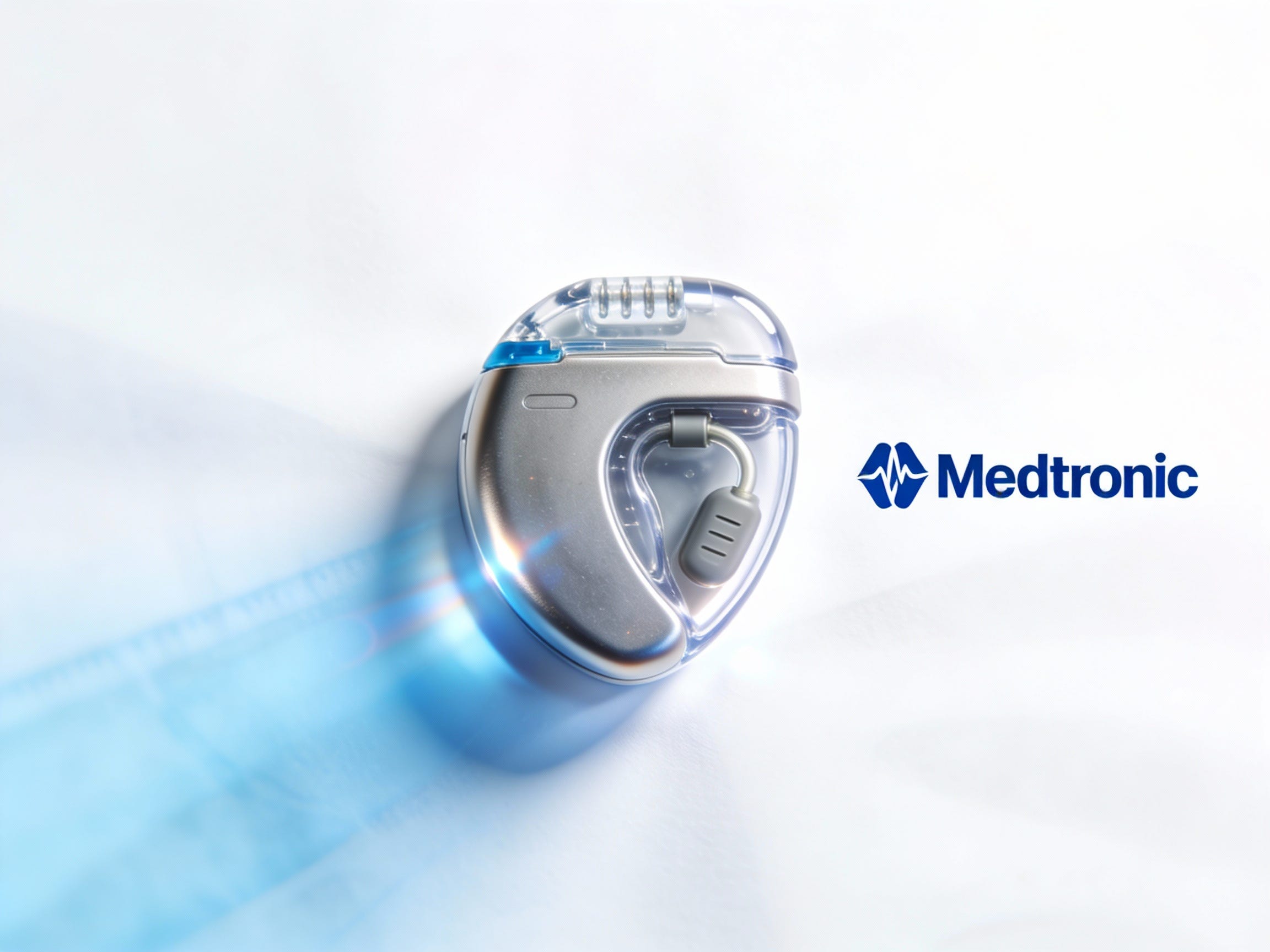
Earl Bakken: Pacemaker Birth Catalyzes Explosive Growth
Earl Bakken and Palmer Hermundslie launched Medtronic in 1949 from a Minneapolis garage, earning just $8 in their first month repairing hospital centrifuges. Revenue accelerated to $100 million by 1975 and $200 million by 1979. The pivotal moment came on Halloween 1957 when a Minnesota power outage killed a child dependent on a plug-in pacemaker; Bakken responded by delivering the world’s first battery-powered wearable pacemaker in just three weeks, licensing the Greatbatch-Chardack W-01 battery technology. Subsequent innovations followed: the Xytronics telemetry pacemaker in 1963 enabled remote heart monitoring, while the Azure demand pacemaker in 1972 became the first FDA-approved model using lithium batteries.
Facing near-bankruptcy in 1960, Bakken crafted the enduring Mission Statement prioritizing patient welfare over profits, which stabilized the company. Medtronic went public that year with $1 million in revenue and listed on the NYSE in 1977. By 1985, pacemaker market share reached 35% with hundreds of millions in annual revenue, prompting Bakken’s retirement after 36 years. Bakken hired an engineer in 1957 to collaborate with C. Walton Lillehei, pioneering demand pacing that eliminated constant stimulation. The 1960 public offering raised $1 million at $2.25 per share, while 1975’s $100 million revenue marked 10,000% growth from 1949. The Mission—”alleviate pain, restore health, extend life”—adopted in 1960 remains unchanged 65 years later. First pacemakers shipped to Europe in 1960 and Japan in 1962.
Winston Wallin: R&D Surge Fuels $1 Billion Milestone
Winston Wallin assumed CEO duties in 1985 and doubled R&D spending from $37 million to $75 million within three years, equating to 11% of revenue against the industry average of 7%. Revenue hit the $1 billion milestone in 1991, reflecting a $1 billion increase during his tenure. He launched the Activitrax in 1988, the first rate-responsive pacemaker using a minute ventilation sensor that captured 20% market share. Acquisitions like La Jolla Technology bolstered neurological stimulation capabilities, while the Synchromed implantable drug pump gained FDA approval in 1987 for chronic pain and spasticity. International sales surged 25% annually, establishing pacemaker dominance in Europe and Japan.
The stock rose 300% during his tenure, reaching a $3.2 billion market cap by 1991. Wallin professionalized post-founder operations, strengthening supply chain and quality systems. The Activitrax revolutionized demand response by adjusting pacing to patient activity levels. R&D emphasis yielded the 1986 CPI, the first single-lead dual-chamber pacemaker. Wallin passed away in 2010 at age 84.
Bill George: 18% CAGR Transforms $1B into $5B Empire
Bill George took the helm as CEO from 1991 to 2001, growing revenue from $1 billion to a projected $5 billion by 2000 at an 18% compound annual growth rate over 13 years. Market capitalization exploded from $1.1 billion to $60 billion, quadrupling S&P 500 returns. Pacemaker revenue’s share dropped from 70% to 25% as diversification into Parkinson’s and spinal treatments took hold, making Medtronic Minnesota’s most valuable public company with a $35 billion peak valuation. He orchestrated 50 acquisitions, including the landmark $3.5 billion Sofamor Danek deal in 1999 that secured 40% of the spinal market; Medtronic Neurologic alone generated $1.2 billion in revenue by 2001.
Annual R&D reached $600 million, or 12% of revenue, powering innovations like the Activa deep brain stimulation system FDA-approved for Parkinson’s in 1997. Revenue climbed from $2.6 billion in FY1996 to $3.3 billion in FY1999, bolstered by the InterStim sacral nerve stimulation device FDA-cleared for incontinence in 1997. George’s authentic leadership model emphasized mission and values, earning him “best CEO” recognition twice. He later authored “Authentic Leadership” post-tenure.
Art Collins: High-Growth Lines Drive $10.1B to $11.3B Surge
Art Collins led as CEO from 2001 to 2011, lifting revenue from $10.1 billion in FY2005 to $11.3 billion in FY2006, a 12% increase. Cardiac Rhythm Management, Spinal, and Neurological segments powered 75% of revenue with over 25% growth rates. The company amassed $6 billion in cash alongside $300 million invested in 60 minority stakes targeting China, Russia, Japan, and Brazil. Revenues and EPS compounded at over 15% annually across his 15-year tenure. CoreValve secured the first CE Mark for transcatheter aortic valve replacement in 2007, while the $3.9 billion Kyphon acquisition in 2007 targeted vertebral fracture treatment.
Q1 FY2003 delivered $2.1 billion in revenue, up 20%, with EPS growth of 19%. R&D hit $1 billion, representing 10% of revenue, as market cap reached $40 billion by 2011. Collins positioned the company for the transformative Covidien pursuit that enabled the $42.9 billion deal. He doubled international revenue share through emerging markets expansion.
Omar Ishrak: $42.9B Covidien Deal Unlocks $150B Valuation
Omar Ishrak served as CEO from 2011 to 2020, masterminding the $42.9 billion Covidien acquisition in 2015—the largest tax inversion—relocating headquarters to Ireland while accessing $14 billion in overseas cash. Revenue rose from $20.3 billion in FY2015 to $27.2 billion in FY2020. The company achieved a $150 billion valuation, though Congress subsequently blocked copycat deals like Pfizer-Allergan. Covidien’s vascular business added $4.2 billion in revenue. R&D reached $2.7 billion in FY2020, or 10% of revenue.
Emerging markets doubled under his value-based healthcare focus. Market cap peaked at $170 billion in 2019, with combined revenues showing $13 billion non-US and $3.7 billion from emerging markets. Ishrak committed $10 billion over 10 years to US R&D, venture capital, and acquisitions. He transitioned to Intel Chairman in 2020.
Geoff Martha: $31.2B to $33.5B Amid Innovation Acceleration
Geoff Martha has led as CEO since 2020, growing revenue from $31.2 billion in FY2021 to $33.54 billion in FY2025. Q2 FY26 posted $8.96 billion, up 6.6% reported and 5.5% organic. Cardiovascular generated $11.6 billion in FY23. FY25 organic growth guidance stands at 4.5–5%. Pulsed Field Ablation launched successfully, with TAVR exceeding 50,000 annual implants. Hugo robotic system reached 100+ sites.
Q4 FY25 achieved 3.7% organic growth despite Specialty Therapies decline. Q3 FY25 delivered $8.39 billion, up 4.0%. R&D totals $2.8 billion in FY25, or 8.4% of revenue. Neuroscience and Surgical segments grew 11-12% in FY22.
Conclusion: Strategic Patience Built $4,192x Revenue Machine
Bakken’s pacemakers, Wallin’s R&D 11%, George’s 18% CAGR/$60B cap, Collins’ 75% high-growth lines, Ishrak’s $42.9B deal, Martha’s $33.5B acceleration prove visionary execution compounds wealth. Medtronic’s 76-year ascent validates long-term strategic focus over speculation.
Someone’s sitting in the shade today because someone planted a tree a long time ago. ― Warren Buffett.
Learn the MaxDividends Way
Start Here
🔑 Explore the Premium Hub (exclusive — upgrade to unlock)
Guides & Step-by-Step
Deep Insights
📖 I ❤️ Dividends: Why I Believe Dividend Investing Is the Best Strategy | E-Book
How Effective is the MaxDividends Strategy for Building Growing Passive Income
Help & Support
Got a question about dividends? Ask Max, your AI Dividend Assistant!
Didn’t get the answer you need? Reach out: max@maxdividends.app or team@maxdividends.app — we’ll help you out.