


In the shadow of revolutions, exile, and industrial upheaval, a penniless apprentice-chemist named Henri Nestlé invented something that would become a lifeline: infant formula. Before vaccines, before pasteurization, before modern hospitals, his creation was the difference between life and death for newborns.
This is the story of how a refugee with no formal education helped reduce infant mortality across Europe—and accidentally founded a global food empire.
Born into Chaos (1814–1833)
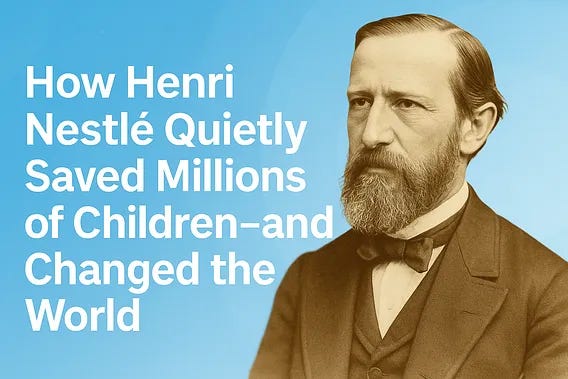
Henri Nestlé (born Heinrich Nestle) came into the world on August 10, 1814, in Frankfurt—just as Napoleon was being packed off to Elba. His was not a comfortable childhood. The eleventh of fourteen children in a Protestant glazier’s family, young Heinrich faced poverty, religious discrimination, and political tension.
With school behind him at fifteen, he took up a pharmacy apprenticeship in Frankfurt’s Hirschgraben district. That hands-on job, mixing chemicals in a dusty apothecary, would shape the rest of his life. He became obsessed with preservation, nutrition, and how science could be used to support the fragile early stages of life.
Exile and Reinvention in Switzerland (1833–1866)
Political uprisings swept Germany in 1833, and Heinrich—now 19—fled west to the safety of neutral Switzerland. He landed in Vevey, a lakeside town near Lausanne, and rebranded himself as “Henri Nestlé”—a name that literally meant “little nest.”
In Vevey, he found mentors. Working for chemists like François-Louis Cailler (whose family would later pioneer Swiss chocolate), Nestlé deepened his knowledge of food chemistry. He experimented with infant nutrition, glass bottling, milk sterilization, and wheat-based baby foods long before there was a commercial market for any of it.
In his spare time, he tinkered. And what he was tinkering with—eventually—was a way to mimic mother’s milk.
The Formula That Changed Everything (1867)
In September 1867, Nestlé got a desperate call: a newborn, Wanner, was dying. Premature, underweight, unable to digest his mother’s milk. Doctors were helpless.
Nestlé tried a last-ditch blend: wheat flour cooked to break down starches, cow’s milk, and a sugar syrup to make it digestible. They called it Farine Lactée. It worked.
The infant survived. So did fifteen others in the following weeks at the hospital in Vevey. Local doctors documented the results: babies who otherwise would’ve died were thriving on Nestlé’s formula.
At a time when 1 in 4 infants didn’t make it past their first year in parts of Europe, Nestlé’s concoction offered more than calories—it offered hope. Swiss public records later showed infant mortality in the Canton of Vaud dropped from 23% to 15% during this period.
Nestlé received over 1,200 letters from mothers crediting his invention with saving their children.
From Kitchen to Continent (1868–1873)
Demand exploded. By 1868, Nestlé’s product was being sold in five countries, and by 1873, annual sales had reached 500,000 tins.
To meet demand, he partnered with Adolf Stoessel, a banker from Frankfurt, to fund expansion. He opened factories in London, Paris, and Frankfurt, each equipped with chemical labs to guarantee product purity.
Nestlé personally oversaw batch quality. Every shipment had to meet his exacting safety standards—at a time when food safety laws were virtually nonexistent.
Even the Russian imperial family noticed: Princess Natalia Dolgorukova used Nestlé’s formula for her son, a child of Tsar Alexander II.
A Key Ingredient in the Chocolate Revolution (1875)
Nestlé’s innovation didn’t stop with baby food. In 1875, his condensed milk became the secret sauce in Daniel Peter’s invention of milk chocolate.
Peter—Nestlé’s neighbor in Vevey and son-in-law to chocolate maker François-Louis Cailler—had been trying to blend milk and chocolate for years. With Nestlé’s stabilized milk, he cracked the formula. Swiss milk chocolate was born—and with it, an entire global industry.
An Exit and a Legacy (1875–1890)
In March 1875, childless and suffering from gout, Henri Nestlé sold his company for 1 million Swiss francs—a massive sum at the time—to a consortium led by Jules Monnerat and Gustave Marquis.
He stayed out of management, but not out of sight. He remained in Vevey, quietly watching as his name spread from baby bottles to cocoa tins to global billboards.
When he died in 1890 in Montreux, the company still bore his name.
Final Thought: A Formula for Impact
Henri Nestlé didn’t set out to build a global empire. He set out to help one baby.
But when that one baby lived, and others followed, his invention took on a life of its own.
Today, Nestlé S.A. is the largest food company in the world. But behind the multinational marketing and $90B in annual revenue stands a story much quieter—and far more profound.
A refugee, a broken system, a tinkerer, and a baby who lived.
Someone’s sitting in the shade today because someone planted a tree a long time ago. ― Warren Buffett.
Learn the MaxDividends Way
Start Here
🔑 Explore the Premium Hub (exclusive — upgrade to unlock)
Guides & Step-by-Step
Deep Insights
📖 I ❤️ Dividends: Why I Believe Dividend Investing Is the Best Strategy | E-Book
How Effective is the MaxDividends Strategy for Building Growing Passive Income
Help & Support
Got a question about dividends? Ask Max, your AI Dividend Assistant!
Didn’t get the answer you need? Reach out: max@maxdividends.app or team@maxdividends.app — we’ll help you out.