

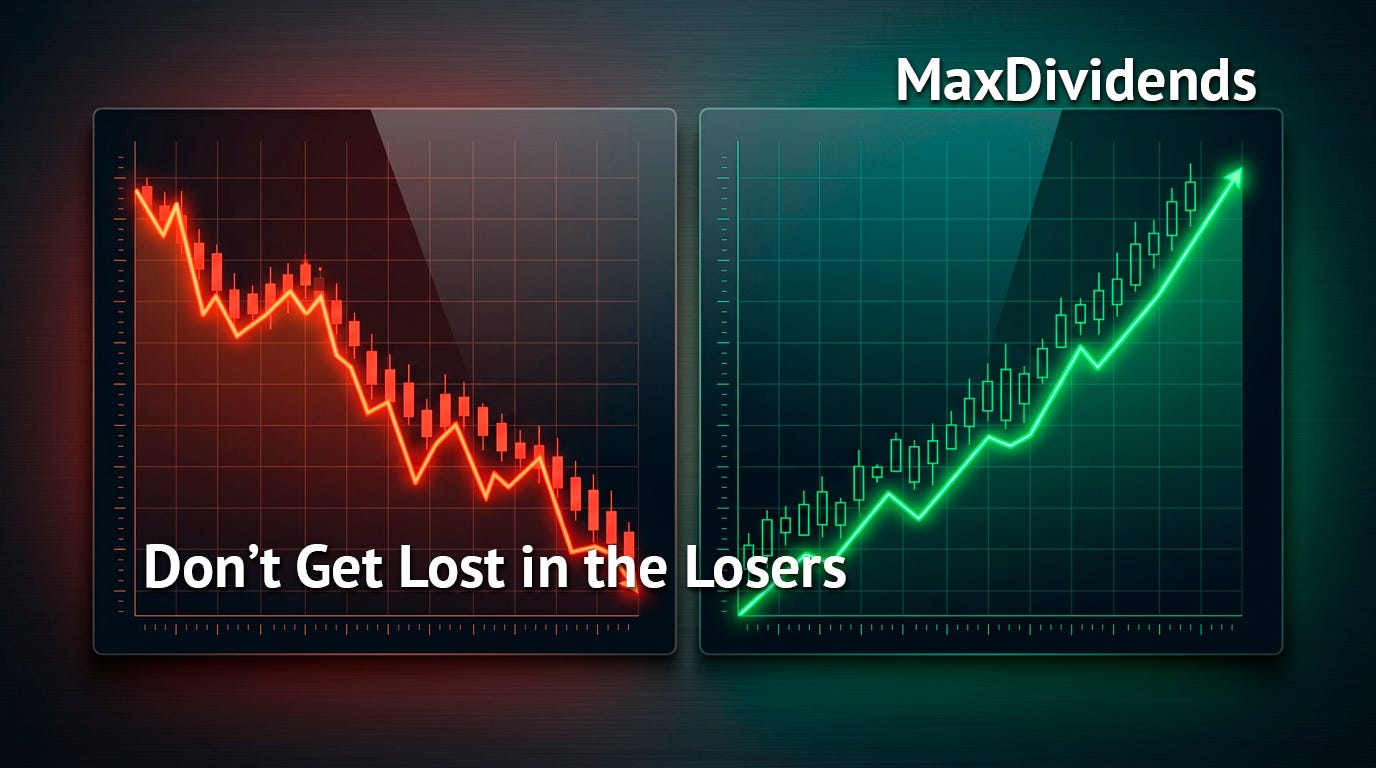
A lot of investors fixate on the names that went wrong and miss the actual scorecard. One bad position, or even a few, does not mean the strategy failed. What matters is whether the portfolio as a whole is still compounding in the right direction, because investing is a portfolio game, not a highlight-reel game.
That lesson is even more important in 2026, when concentration risk is still real, leadership is still narrow, and investors keep getting pulled into the drama of a few big names instead of the bigger picture. When a small group dominates the tape, it becomes easy to overreact to the losers and underappreciate the winners.
Why the losers fade
A weak position usually becomes less important as its weight in the portfolio shrinks. If the original allocation was sensible and dividends were being collected along the way, the damage often becomes much smaller than it first looked. A bad investment can become a footnote instead of a disaster if it is contained properly.
Sometimes the market proves people wrong. In 1999, many thought Philip Morris would fail, and it did not. In 2003-4, many thought McDonald’s was toast, and that call aged badly too.
The Microsoft, Lehman, and 3M lesson
The simplest examples make the point best. If someone had put $1,000 into Lehman Brothers in 2007, that $1,000 was lost. If someone had put $1,000 into 3M in 2007, the result was roughly break-even when sold. But if someone had put $1,000 into Microsoft in 2007, that stake would have grown to about $15,000.
Those numbers matter because they show how unpredictable outcomes really are. Nobody could have known in 2007 which one would fail, which one would tread water, and which one would compound dramatically. That uncertainty is exactly why the portfolio has to be built for both good surprises and bad surprises.
Dividends make that lesson even stronger. The examples ignore any dividends received and redeployed elsewhere, which means the real return expectations would have been higher. Cash from one holding can help offset weakness elsewhere and push the overall portfolio result higher over time.
Stick to the process
The goal is not to be right on every investment. The goal is to get the entry signal right, avoid breaking compounding early, and let the process do its job. That is why many long-term investors prefer to stay steady instead of constantly rewriting the plan.
Most holdings will not become Microsoft, but most will not become Lehman either. A reasonable expectation is that a minority of positions will drive most of the gains, while the rest average out somewhere near break-even. The point is not to know which category a stock belongs to today. The point is to stay in long enough for the winners to reveal themselves.
Selling should be rare. A dividend cut or an acquisition can justify it, but constant trading usually creates more mistakes than value. The longer the holding period, the more passive and less hands-on the process tends to become, and that often helps rather than hurts.
Ronald Read’s example
Ronald Read’s story is the perfect reminder of how this works in practice. He died at 92 with a portfolio worth $8 million, built patiently through blue-chip dividend stocks and decades of discipline. He owned at least 95 stocks, and that broad base mattered more than any single position.
One of those positions was Lehman Brothers, which went to a 100% loss when it collapsed. But because he owned 90+ other securities, that one disaster did not ruin the outcome. He still ended up with an $8 million portfolio.
That is the whole idea in one story. A diversified investor can lose 100% on one security and still finish with millions if the rest of the portfolio is built the right way.
The real takeaway
The biggest mistake is not owning a few losers. The biggest mistake is letting them distract from the bigger portfolio picture. Investors need to judge the whole system, not the loudest disappointment inside it.
A strong portfolio has built-in defenses: diversification, regular investing, and enough patience for the winners to matter. It does not depend on being perfect, because perfection is not realistic.
And that is the core lesson: nobody will be right on every trade or every stock. But if the process is solid, the winners can more than compensate for the losers, and the upside from capital gains and dividends can still be enormous.
Someone’s sitting in the shade today because someone planted a tree a long time ago. ― Warren Buffett.
Learn the MaxDividends Way
Start Here
🔑 Explore the Premium Hub (exclusive — upgrade to unlock)
Guides & Step-by-Step
Deep Insights
📖 I ❤️ Dividends: Why I Believe Dividend Investing Is the Best Strategy | E-Book
How Effective is the MaxDividends Strategy for Building Growing Passive Income
Help & Support
Got a question about dividends? Ask Max, your AI Dividend Assistant!
Didn’t get the answer you need? Reach out: max@maxdividends.app or team@maxdividends.app — we’ll help you out.