

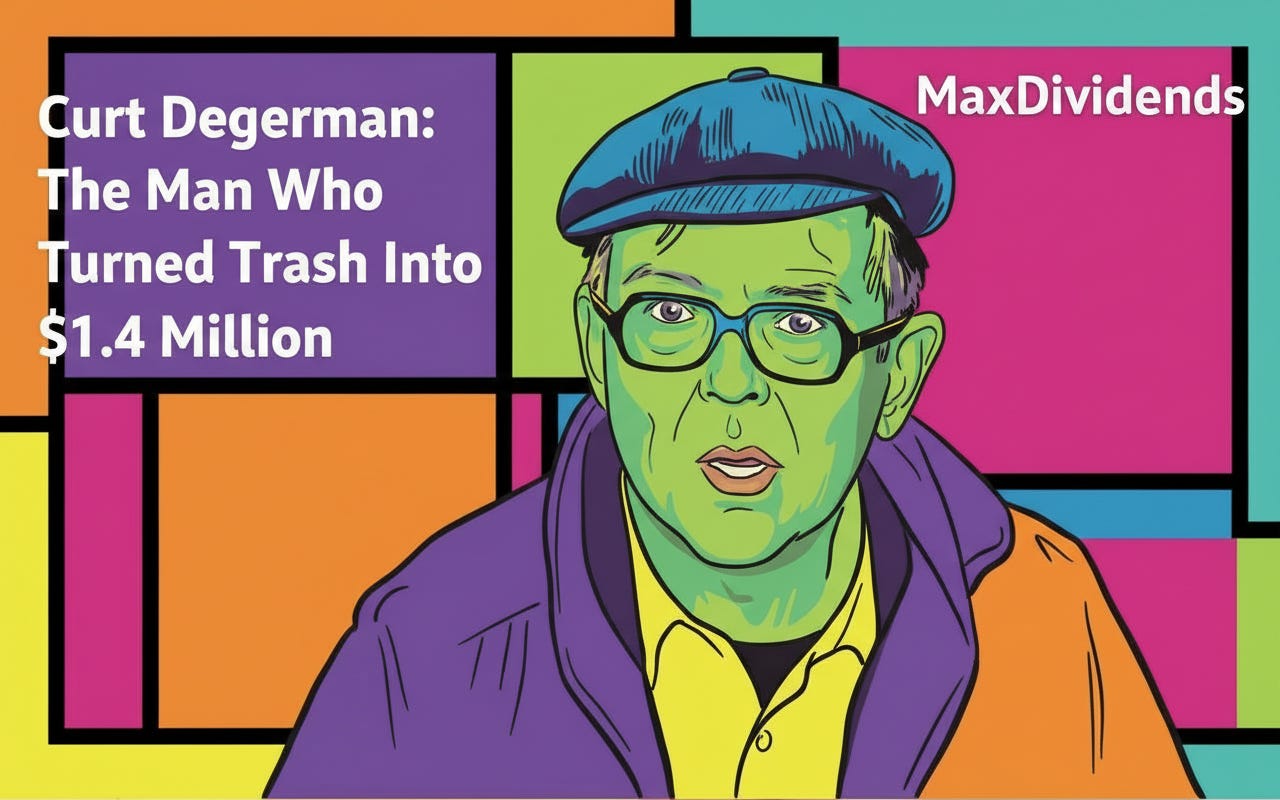
Curt Degerman’s rise from a homeless man to a millionaire stands as one of the most detailed case studies in disciplined, long-term wealth accumulation. By the time of his death in 2008, his estate was valued at $1.4 million, most of it built by recycling bottles and cans over 40 years and reinvesting every penny into Swedish mutual funds and gold bars. His life offers an unmatched blend of analytical rigor, relentless thrift, and market insight.
A Life of Self-Made Knowledge
Born in 1948, Degerman dropped out of school in his teens and drifted into homelessness, surviving in the Swedish town of Skellefteå. For over four decades, he was a fixture at local libraries, studying the financial pages of Dagens Industri and learning about market dynamics, investment strategies, and mutual fund mechanics. Despite lacking formal training, he became an expert on Swedish stock market trends, tracking share prices and company performance through daily research.
The Portfolio: Mutual Funds and Gold
Degerman’s investment portfolio was not speculative or risky. Instead, it was methodical and diversified. By the time of his death, he owned 8 million Swedish Kroner in mutual funds—equivalent to $1.1 million at 2008 exchange rates. He also kept 124 gold bars in a bank safety deposit box, valued at 2.6 million Kroner ($379,000). In addition, he owned a cottage in the suburbs of Skellefteå, a local bank account with 6,500 euros ($8,800), and 450 euros ($610) in cash at home.
All of his mutual fund investments were made incrementally, as he reinvested the proceeds from recycling, often buying small blocks of shares whenever possible. His holdings included funds with exposure to Swedish retailers, banks, and consumer staples. For example, typical mutual fund positions in Sweden during this period offered 5–7% annual returns in dividend-paying blue chips, with total returns averaging 10% per year over the long run.
The Gold Investment: Strategic Asset Allocation
Degerman’s purchase of 124 gold bars was not impulsive. Each bar weighed about 1 kilogram, meaning he held a total of 124 kilograms of gold. In 2008, gold traded at roughly $950 per ounce (about $30,000 per kilogram), aligning closely with his reported $379,000 valuation. Gold provided a hedge against inflation and currency fluctuations, offering asset class diversification that proved crucial during periods of financial volatility.
Thrift and Lifestyle: Extreme Discipline
Degerman’s spending habits were minimal by any measure. He lived in a cottage he owned outright, never paid rent or mortgage, and rarely spent money on food, clothes, or transportation. His signature blue anorak and ragged trousers were worn for years, and he rode a bicycle everywhere, avoiding car ownership and transport costs.
He saved nearly every krona earned from recycling and invested over 95% of his income. Even in his later years, he subsisted on leftovers and fast food scraps, allowing his investments to compound without interruption.
Legal and Financial Details After Death
Upon Degerman’s death, his estate faced a legal dispute. His $1.4 million was left to his cousin, with whom he had maintained regular contact. His will was detailed and unambiguous, specifying the exact shares, gold bars, and accounts to be transferred. The distribution was eventually settled, with the cousin receiving the lion’s share and the remainder divided among other relatives.
Long-Term Returns: The Math of Compounding
Degerman’s mutual fund investments grew from small, incremental purchases over 40 years. Assuming an average annual return of 10%, a cumulative investment of 100,000 kroner per year would yield 8 million kroner by 2008. His gold investment, held for over 20 years, increased in value as global demand for precious metals surged, with gold rising from $200 per ounce in the 1980s to $950 per ounce in 2008.
Conclusion: The Anatomy of a Financial Anomaly
Curt Degerman’s life offers a rare glimpse into the power of self-education, disciplined saving, and strategic investing. His portfolio, built from nothing but recycled cans and bottles, reached $1.4 million through meticulous planning and relentless execution. The numbers, not sentiment, define his legacy: 8 million kroner in mutual funds, 124 kilograms of gold, and a lifetime of thrift.
Someone’s sitting in the shade today because someone planted a tree a long time ago. ― Warren Buffett.
Learn the MaxDividends Way
Start Here
🔑 Explore the Premium Hub (exclusive — upgrade to unlock)
Guides & Step-by-Step
Deep Insights
📖 I ❤️ Dividends: Why I Believe Dividend Investing Is the Best Strategy | E-Book
How Effective is the MaxDividends Strategy for Building Growing Passive Income
Help & Support
Got a question about dividends? Ask Max, your AI Dividend Assistant!
Didn’t get the answer you need? Reach out: max@maxdividends.app or team@maxdividends.app — we’ll help you out.