


It’s not Amazon, but it’s learning fast. This is the electronics retailer that survived showrooming, matched online prices, and rebuilt itself as an omnichannel destination with high-margin media and marketplace streams. The payout has climbed for 22 straight years, and the latest quarter shows comps turning positive, operating income expanding, and new profit engines scaling faster than most retailers dare to hope.
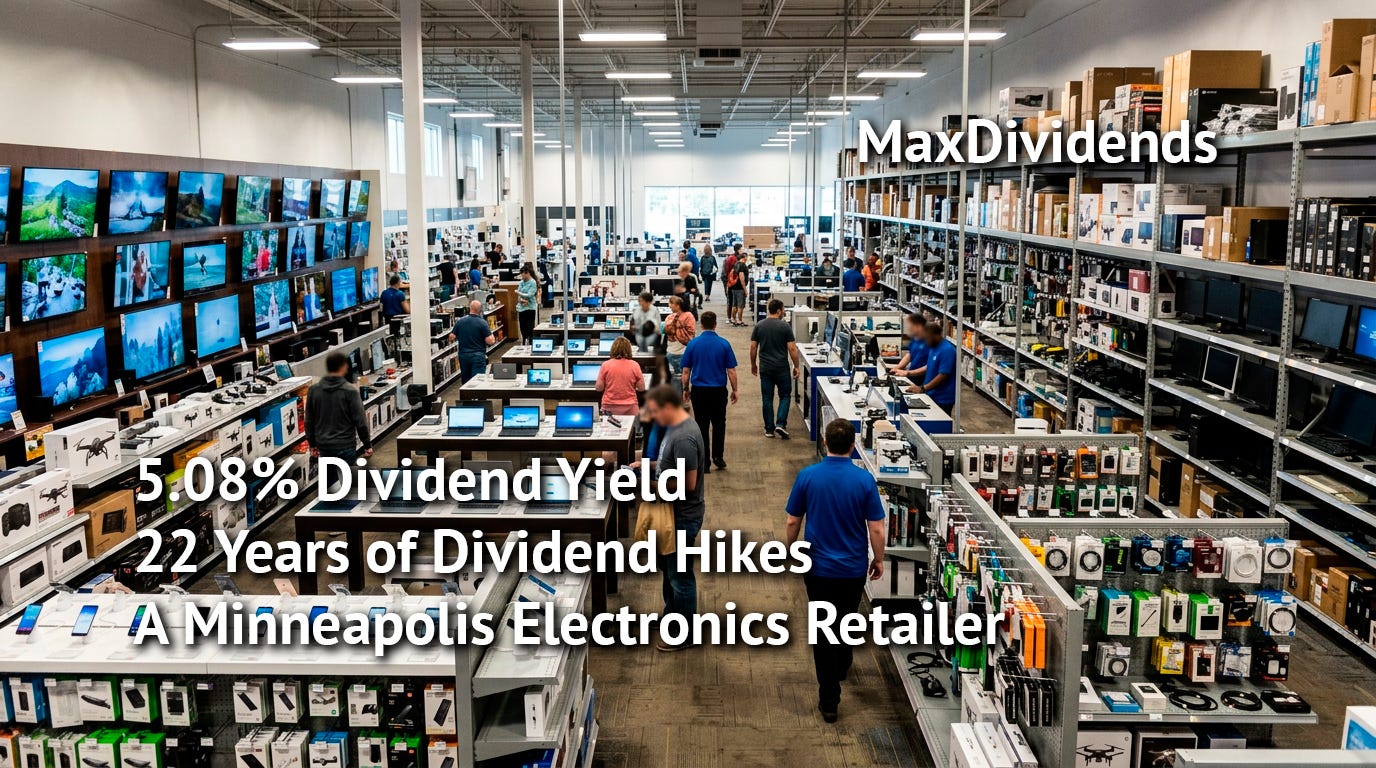
Best Buy (BBY)
Financial Score: 95 / 99
Quick Tip
To keep your portfolio strong, stay on top of the financials for each company you hold. Solid companies mean better returns, so be sure to check in on their quarterly and annual numbers.Interesting stocks usually score 80+ on the Financial Scale, with top players hitting 90+. If that score dips below 80, it might be a good time to consider cutting ties before things take a turn.Best Buy Co., Inc. (BBY) is a Minneapolis-based consumer electronics retailer serving customers across the U.S. and Canada through 1,117 stores and a growing digital platform. Founded in 1966 as Sound of Music in St. Paul, Minnesota, it rebranded to Best Buy in 1983 and launched the high-volume, low-price superstore model that reshaped the industry. Today it sells computing, mobile phones, consumer electronics, appliances, entertainment, and services, with new profit streams like Best Buy Ads and a third-party Marketplace adding high-margin revenue alongside traditional retail.
Dividend engine: 22 years of hikes at a turned-around retailer
Best Buy pays $3.84 per share annually, a 5.08% forward yield, with a 71.11% payout ratio and a 5-year dividend-growth rate of +73.00%. That payout ratio is solid for a retailer that has rebuilt cost discipline and now runs multiple high-margin streams. The 22-year streak of hikes reflects management’s commitment to growing the dividend alongside earnings, supported by a customer base that keeps coming back for hardware, services, and Geek Squad support, plus a revenue mix that’s less dependent on pure product margins than it was a decade ago.
Latest reported numbers: Q1 FY27 ended May 2, 2026
For the 13-week first quarter ended May 2, 2026, Best Buy reported revenue of $8.936 billion, up 1.9% year-over-year, with comparable sales +2.0%. Operating income was $370 million (4.1% of revenue) vs. $219 million (2.5%) last year. GAAP net earnings were $276 million ($1.31/share diluted), vs. $202 million ($0.95/share), and adjusted diluted EPS was $1.28 vs. $1.15, per the May 28, 2026 SEC-exhibited press release. The company also returned $202 million to shareholders through dividends in the quarter and reaffirmed FY27 adjusted EPS guidance of $6.30–$6.60.
Growth story: Ads, Marketplace, and a CEO transition
Best Buy’s growth is now driven by high-margin media and third-party commerce, not just product sales. Best Buy Ads collections are projected to approach $1 billion in FY27 (up ~10%), while U.S. Marketplace gross merchandise volume is expected to reach at least $1.2 billion; domestic Marketplace GMV hit roughly $250 million in Q1, pushing domestic sales growth above 4% when included. The company also announced a CEO transition: Corie Barry will step down later in 2026, with Jason Bonfig taking over effective November 1, 2026, focusing on advancing Best Buy as a retail, media/advertising, and technology company while expanding reach and elevating the customer experience.
A 1966 audio store that survived a tornado
Best Buy’s origin story is literally storm-driven. In 1981, a tornado damaged the Roseville, Minnesota Sound of Music store, and Richard Schulze ran a “Tornado Sale” in the parking lot, selling damaged stock at deep discounts. The four-day event generated more revenue than a typical month, revealing the power of a high-volume, low-price model and directly leading to the 1983 rebrand to Best Buy and the launch of the superstore format. That forced experiment became the foundation for the modern retail empire.
Final take
Best Buy offers 5.08% yield, $3.84 annual dividend, 22 years of hikes, +73.00% 5-year dividend growth, and a 71.11% payout ratio. The business is supported by positive comps, operating income rate expansion, and scaling high-margin streams like Ads and Marketplace, but consumer electronics remains cyclical and competition with Amazon is relentless. Financial Score: 95. This is a strong, highly reliable company—scores above 90 are considered elite, signaling genuine durability in earnings, cash flow, and dividend coverage. The turnaround is real, the high-margin engine is scaling, and the dividend track record is solid. Investors should still verify sustained comp growth, Ads/Marketplace execution, and the impact of the CEO transition before building a position.
Someone’s sitting in the shade today because someone planted a tree a long time ago. ― Warren Buffett.
Learn the MaxDividends Way
Start Here
🔑 Explore the Premium Hub (exclusive — upgrade to unlock)
Guides & Step-by-Step
Deep Insights
📖 I ❤️ Dividends: Why I Believe Dividend Investing Is the Best Strategy | E-Book
How Effective is the MaxDividends Strategy for Building Growing Passive Income
Help & Support
Got a question about dividends? Ask Max, your AI Dividend Assistant!
Didn’t get the answer you need? Reach out: max@maxdividends.app or team@maxdividends.app — we’ll help you out.