


Before We Start
Hey friends!
Today, I’m excited to introduce Dave Ahern, the author of Dividend School on Substack and an important part of the MaxDividends team.

Dave brings deep knowledge of dividend investing and a real talent for explaining complex financial topics in a simple, practical way. That’s exactly the kind of expertise we’re bringing together at MaxDividends.
We’re now working closely with Dave to bring you more quality research, fresh perspectives, and useful investing insights. And we’re just getting started! We have a lot more exciting things planned together, and I can’t wait to share them with you.
Today, Dave takes a closer look at five REITs, each with its own strengths, risks, and opportunities for dividend investors.
I’ll hand it over to Dave from here. Enjoy the read!
Intro
REITs Explained: What they are, where to hold them, and five worth a closer look
Most people who want to own real estate picture a rental house. A tenant, a mortgage, a phone call at 2 a.m. about a broken water heater.
There is an easier way to collect rent. You can own a slice of thousands of buildings, leased to some of the biggest companies in the country, for the price of one share of stock. Nobody calls you about the water heater.
That is what a real estate investment trust, or REIT, offers. It is also one of the most misunderstood corners of dividend investing, because the numbers most investors check first, earnings per share and the payout ratio based on it, tell you almost nothing useful about a REIT.
This article walks through what REITs are, how they make money, how to judge them, which accounts suit them best, and five REITs worth studying today.
What a REIT Actually Is
A REIT is a company that owns, and usually operates, income-producing real estate. Congress created the structure in 1960 so that ordinary investors could own large commercial properties the same way they own shares of any other business.
The deal Congress struck is simple. A REIT pays no corporate income tax on the profits it passes through to shareholders. In exchange, it has to follow a set of rules that keep it focused on real estate and keep the cash flowing to investors.
The main rules:
Pay out at least 90% of taxable income to shareholders as dividends each year
Hold at least 75% of total assets in real estate, mortgages, cash or government securities
Earn at least 75% of gross income from rents, mortgage interest or property sales
Have at least 100 shareholders, with no more than 50% of shares held by five or fewer people
That 90% rule is the reason REITs are dividend stocks by design. Management can’t sit on a pile of profits. The cash goes out the door to you.
The trade-off is that REITs keep very little to reinvest. To grow, they raise money by selling new shares or borrowing. That matters later, when we talk about what to watch.
How REITs Make Money
Most REITs you will come across are equity REITs. They own buildings and collect rent. A smaller group, mortgage REITs, lend money against real estate and earn the interest. Mortgage REITs behave more like banks, and they are a different animal. This article sticks to equity REITs.
An equity REIT’s business is about as old as business gets. Buy or build a property, lease it to a tenant, collect rent, and raise the rent over time. The details that separate a great REIT from a mediocre one come down to three things.
The lease. Many of the steadiest REITs use triple-net leases. Under a triple-net lease, the tenant pays the property taxes, the insurance and the maintenance on top of rent. The landlord collects a check and does little else. Leases often run 10 years or longer and carry built-in rent increases every year.
The tenant. A long lease is only as good as the company signing it. A REIT leased to a strong, profitable business is far safer than one leased to a struggling retailer, no matter how long the lease runs.
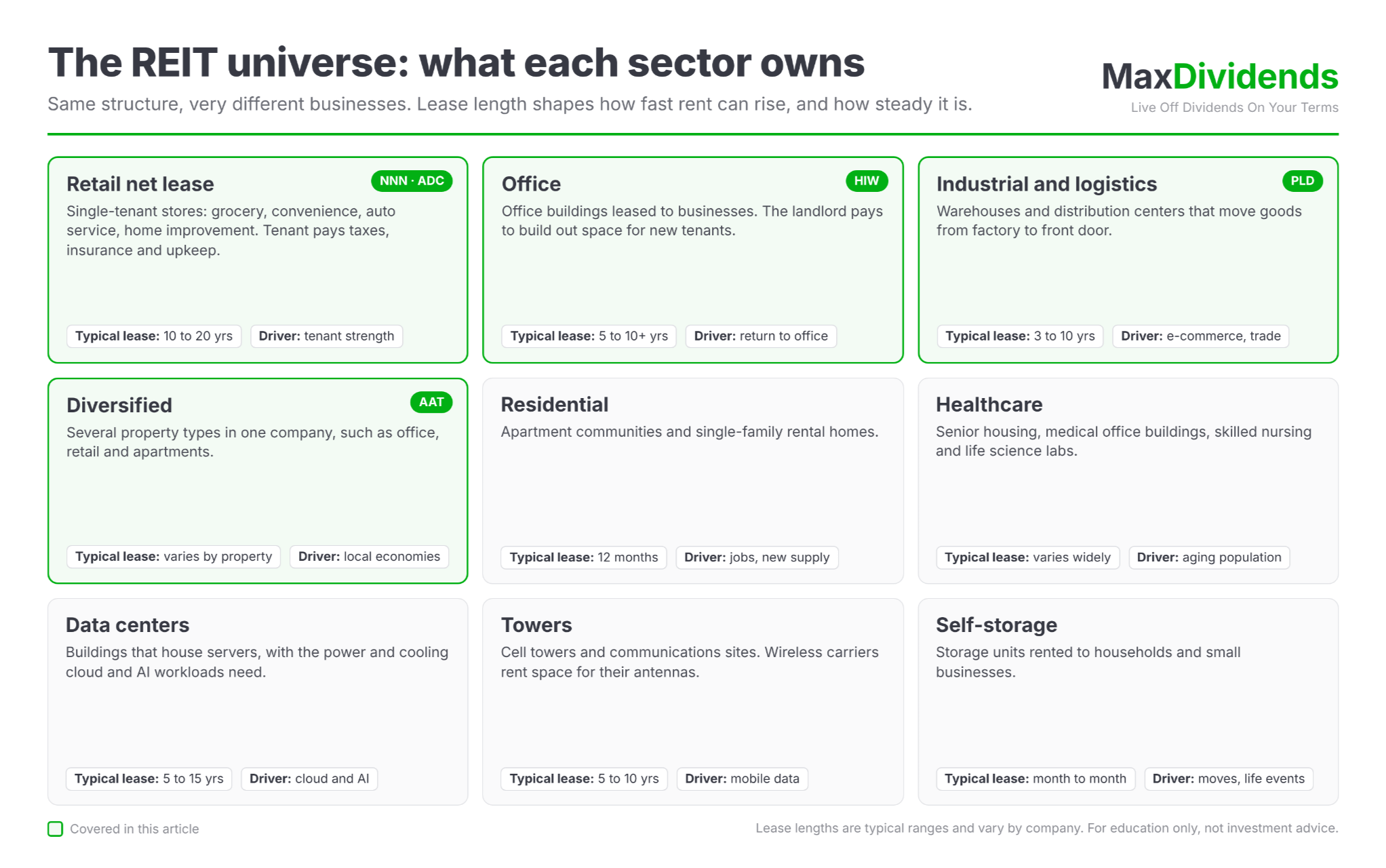
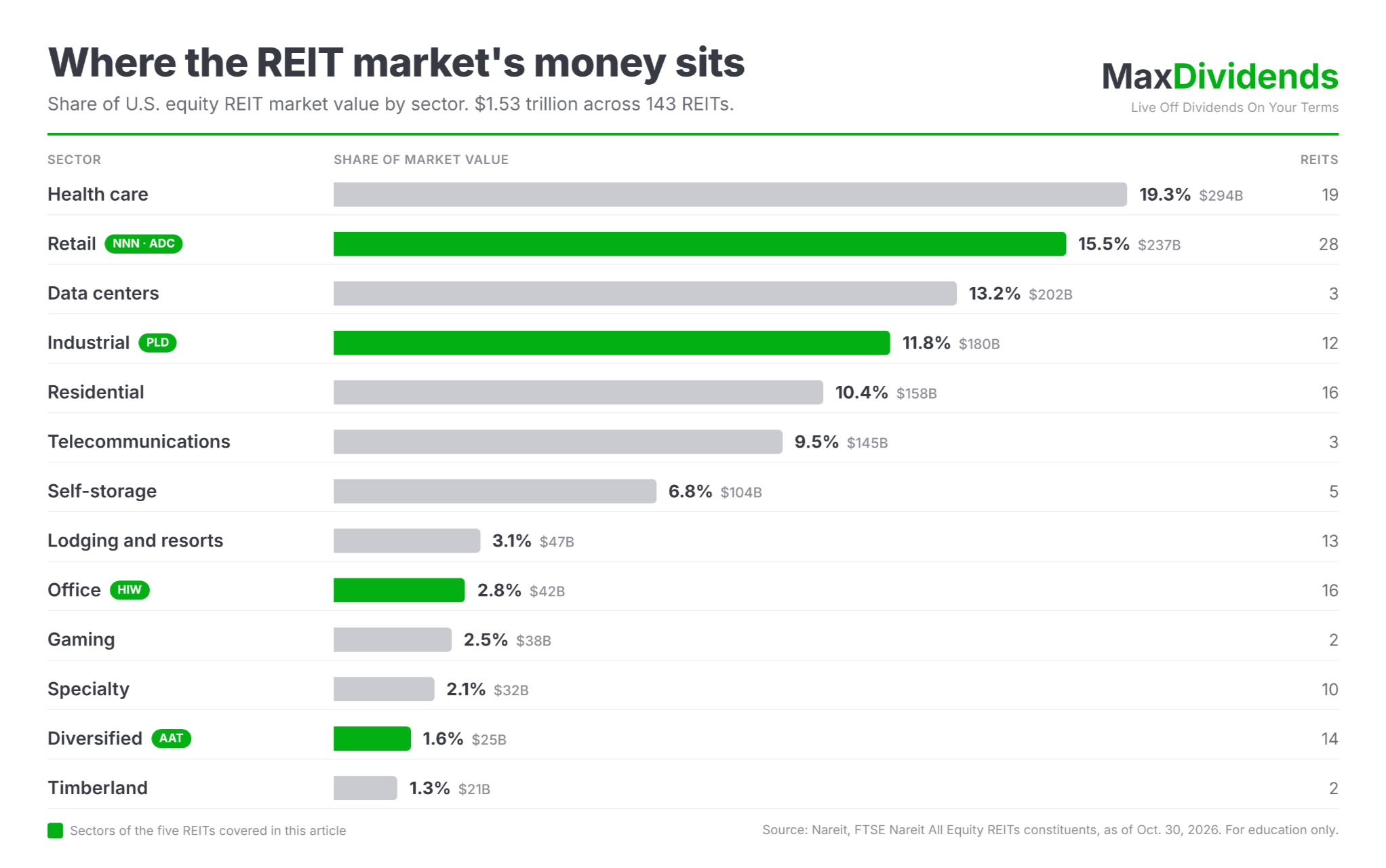
The property type. REITs specialize. Some own stores, some own warehouses, apartments, cell towers, casinos, hospitals, data centers, self-storage units or office buildings. Each sector has its own economics. Office buildings have struggled since the pandemic. Warehouses boomed with e-commerce. Cell towers ride the growth in mobile data.
Owning a few REITs across different property types spreads your risk the same way owning stocks across different industries does.
How to Judge a REIT (And Why EPS Misleads You)
Here is the trap most new REIT investors fall into. They look up a REIT, see a payout ratio of 200% or higher, and conclude the dividend is about to be cut.
It usually isn’t. The problem is the earnings number.
Accounting rules require a REIT to deduct depreciation from its earnings, as if its buildings were wearing out and losing value every year. For a factory machine, that makes sense. For a well-located building with land underneath it, it often doesn’t. Real estate frequently holds its value or rises over time. Depreciation is a large, non-cash expense that pushes reported earnings far below the cash the business actually produces.
So REIT investors use different measures.
FFO (funds from operations): net income with depreciation added back and gains or losses from property sales removed. It’s the industry’s standard measure of operating cash flow.
AFFO (adjusted funds from operations): FFO minus the recurring capital spending needed to keep the buildings in shape, along with a few other adjustments. AFFO is the closest thing to the cash available to pay you. When I judge a REIT’s dividend, AFFO is the number I care about most.
AFFO payout ratio: the dividend divided by AFFO per share. For most well-run REITs, something in the 70% to 85% range leaves a reasonable cushion.
Net debt to EBITDA: how many years of operating cash flow it would take to pay off the debt. Around 5x to 6x is typical for the sector. Much higher than that and the REIT has less room for error.
Occupancy: the share of the portfolio that’s leased. Empty buildings don’t pay rent.
One caution. AFFO isn’t defined by accounting rules, so each REIT calculates it a little differently. Compare a REIT against its own history and against close peers, and you will rarely be misled.
Why Interest Rates Matter So Much
REITs are sensitive to interest rates for two reasons.
The first is borrowing. Because REITs pay out most of their income, they rely on debt and new shares to buy properties. When rates rise, new debt costs more, and the spread between what a REIT pays for money and what it earns on new properties shrinks.
The second is competition for your dollar. When a 10-year Treasury pays 4% or more with no risk, income investors demand more from a REIT before they will buy it, so REIT prices tend to fall when rates rise.
That has been the story for several years now. Share prices across much of the sector have gone sideways or down, even at REITs where the rent checks kept growing. For a patient investor, that gap between the business and the stock price is where opportunity tends to show up.
Where to Hold REITs: the Account Matters
This is the part of REIT investing that gets skipped most often, and it can make a real difference to what you keep.
Most dividends from regular companies are “qualified,” which means they are taxed at the lower long-term capital gains rates of 0%, 15% or 20%. Most REIT dividends aren’t qualified. Because the REIT itself paid no corporate tax, the government taxes most of its dividend as ordinary income, at your regular income tax rate.
There is some relief. The Section 199A deduction lets you deduct up to 20% of qualified REIT dividends, which lowers the effective top federal rate on them to about 29.6%. That deduction was set to expire after 2025, but the One Big Beautiful Bill Act, signed in July 2025, made it permanent at 20%.
Part of a REIT dividend can also be classified as “return of capital.” That portion isn’t taxed when you receive it. Instead, it lowers your cost basis, and you pay the tax later when you sell. Your 1099-DIV breaks out each piece.
With that in mind, here is how the main account types stack up.
Roth IRA
For most people, this is the best home for REITs. The dividends grow tax-free and come out tax-free in retirement. Ordinary income treatment stops mattering, because there is no tax at all. If you plan to reinvest dividends for years, this is where the compounding is cleanest.
Traditional IRA or 401(k)
Also a strong choice. Dividends compound with no tax drag each year. You pay ordinary income tax on withdrawals, but that’s true of everything in the account, so the REIT dividend loses nothing relative to your other holdings.
Health savings account (HSA)
If your HSA allows you to invest in individual stocks, it works like a Roth for qualified medical spending. Few people think of it for REITs, but it fits.
Taxable brokerage account
Not ideal, but not a deal-breaker either. The 199A deduction softens the bite, and if you’re in a low tax bracket, the difference may be small. Many investors hold REITs in taxable accounts on purpose, because they want the monthly or quarterly income to live on today. If that’s you, just go in knowing that more of the dividend goes to taxes than it would with a typical dividend stock.
A simple rule of thumb: if you have room in a tax-advantaged account, put your REITs there first and keep your qualified-dividend stocks in the taxable account.
I’m not a tax professional, and everyone’s situation is different. Talk to a tax advisor before making changes based on taxes.
