


Tucked into one of America's most important semiconductor and tech corridors, this regulated utility is quietly navigating a payout ratio north of 95% while still chasing one of the more aggressive growth stories in its sector. It just signed its fifth data center contract in under two years, is closing a $1.9 billion cross-state acquisition, and keeps reaffirming earnings guidance even after a bottom-line miss. That's a lot of moving parts for a business most people assume just sends out electric bills.
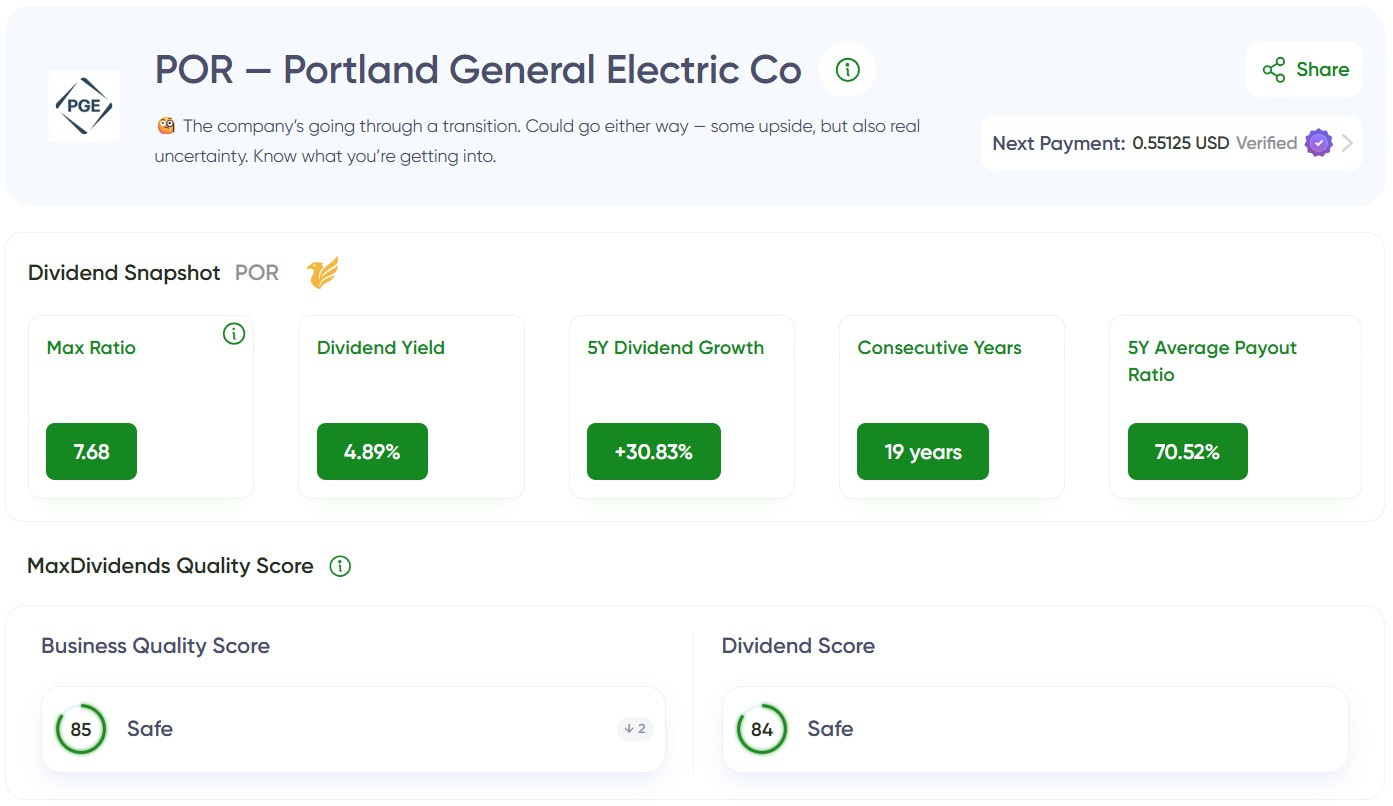
Portland General Electric (POR)
Business Quality Score: 85 / 99
Quick Tip
To keep your portfolio strong, stay on top of the financials for each company you hold. Solid companies mean better returns, so be sure to check in on their quarterly and annual numbers.
—
Interesting stocks usually score 80+ on the Financial Scale, with top players hitting 90+. If that score dips below 80, it might be a good time to consider cutting ties before things take a turn.
Portland General Electric Company (POR) is a regulated electric utility based in Portland, Oregon, serving roughly 950,000 customers across the state’s industrial and tech-heavy corridor. It generates and delivers power through a mix of hydro, natural gas, wind, and solar resources, and is in the process of acquiring Washington state utility assets from PacifiCorp to extend its footprint beyond Oregon.
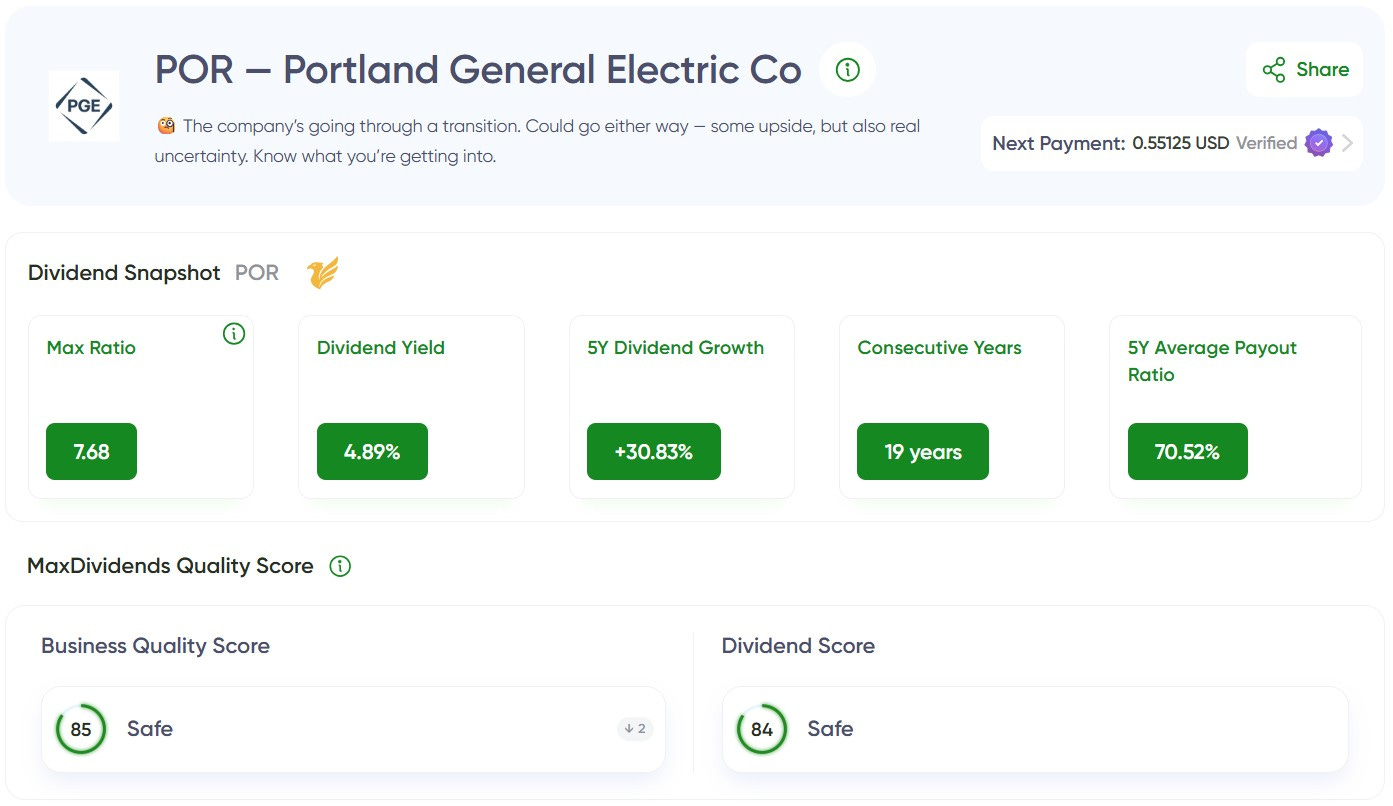
Dividend engine: high payout, long streak
Portland General Electric pays $2.20 per share annually, a 4.93% yield, with a 96.92% payout ratio and a 5-year dividend-growth rate of +30.83%. That payout ratio is extremely tight for a regulated utility, leaving almost no cushion if earnings disappoint, which makes continued rate case success and the pending Washington deal unusually important to watch.
The 19-year streak of hikes shows real commitment, but a near-97% payout means future increases depend heavily on earnings actually catching up to the dividend rather than the other way around.
Q2 2026: a miss, but guidance holds
For the second quarter ended June 30, 2026, PGE reported GAAP net income of $68 million, or $0.59 per diluted share, with revenue of $814 million, up slightly from $807 million a year earlier, per the July 31, 2026. Non-GAAP EPS came in at $0.64, missing the $0.74 consensus estimate, with revenue also falling about 4% short of forecasts, driven largely by timing differences in power cost recognition that management expects to reverse in the second half of 2026.
Despite the miss, PGE reaffirmed full-year 2026 adjusted EPS guidance of $3.33 to $3.53 and its 5%-7% long-term earnings and dividend growth target.
Growth story: data centers and a cross-state acquisition
PGE’s growth engine is now firmly tied to industrial and tech demand. The company has executed five data center contracts totaling 430 MW since 2025, building on industrial demand that grew at a 10% compound annual rate from 2020 to 2025 and is forecast to continue at that pace through 2030.
Separately, PGE’s $1.9 billion acquisition of PacifiCorp’s Washington assets, including the 477 MW Chehalis gas plant and 4,500 miles of transmission lines, is expected to create a combined $9 billion rate base in 2026 and add roughly 140,000 new customers once it closes.
Named after a waterfall, powered since 1888
Portland General’s roots trace to the 1888 Willamette Falls Electric Company, which transmitted power 14 miles from Willamette Falls to downtown Portland, one of the longest electrical transmission lines attempted anywhere in the world at the time.
That early experiment helped prove electricity could travel well beyond where it was generated, a principle the entire modern grid still depends on today.
Final take
Portland General Electric offers a 4.93% yield, $2.20 annual dividend, 19 years of hikes, +30.83% 5-year dividend growth, and a 96.92% payout ratio. The business is backed by reaffirmed 2026 guidance, a growing data center pipeline, and a transformative Washington acquisition, but the razor-thin payout ratio and a Q2 earnings miss leave very little room for error.
Business Quality Score: 85. This company is interesting, but the tight payout ratio means investors should watch execution on the Washington deal and second-half earnings recovery closely before treating it as a core holding.