


Managing retirement savings is a good business—until customers take their money elsewhere. This firm raised operating profit in its latest quarter even as clients pulled out billions. Its dividend still has breathing room, but keeping that check growing will eventually take more than a rising stock market.
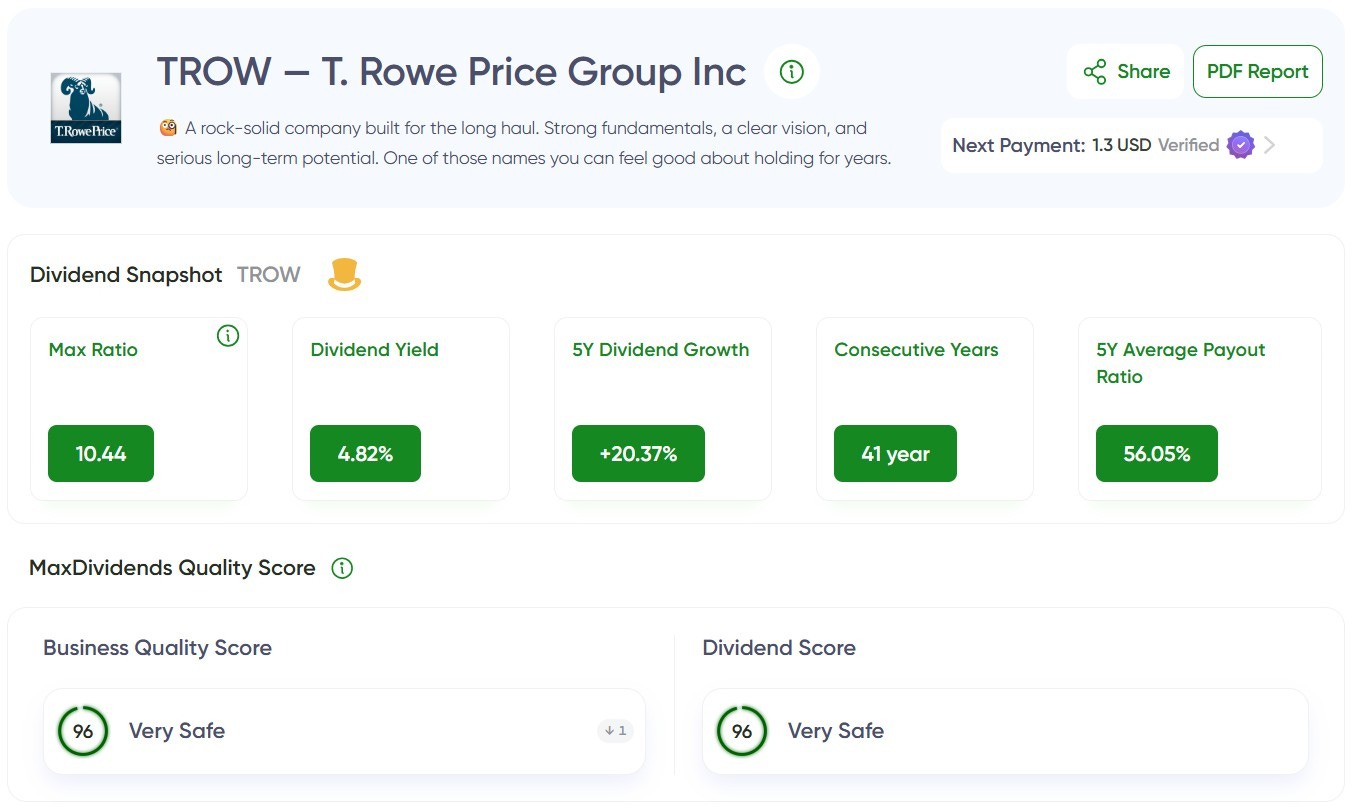
T. Rowe Price Group (TROW)
Business Quality Score: 96 / 99
Quick Tip
To keep your portfolio strong, stay on top of the financials for each company you hold. Solid companies mean better returns, so be sure to check in on their quarterly and annual numbers.
—
Interesting stocks usually score 80+ on the Financial Scale, with top players hitting 90+. If that score dips below 80, it might be a good time to consider cutting ties before things take a turn.
Founded in Baltimore in 1937, T. Rowe Price manages $1.86 trillion for individuals, retirement plans, and institutions. Roughly two-thirds of those assets are retirement-related. It earns fees on the money it manages, so the business does well when portfolios grow and clients stick around. Lately, the second part has been harder.
A generous check, not a stretched one
The annual dividend is $5.20 per share, yielding 4.87%. TROW has raised it for 41 straight years, with payments up 20.37% over five years. A 52.58% payout ratio leaves nearly half of earnings after dividends. Management also reported $4.9 billion in cash and discretionary investments. There is room to handle a rough patch without immediately putting the payout under pressure.
The business earned more. Shareholders didn’t.
In its October 29, 2026, Q3 report, revenue rose 5.9% to $2.005 billion and operating income climbed 19.7% to $769.8 million. Yet net income fell 5.2% to $612.3 million, or $2.79 per share, as investment-related income dropped. Adjusted EPS rose 1.8% to $2.86. In plain English: managing clients’ money became more profitable, but weaker gains on the company’s own investments dragged down the final result.
New products are bringing money in
TROW’s ETFs held $33.8 billion, up from $6.9 billion two years earlier, largely thanks to new client money. Separately managed accounts reached about 36,000 funded accounts, up more than 50% year over year. Those are real signs of demand, not just higher stock prices inflating asset values. The catch: across the whole firm, quarterly net outflows were still $28.3 billion. The newer businesses are growing; they haven’t yet stopped the overall leakage.
Paid to hold, not churn
The founder chose to charge clients based on assets managed rather than commissions on trades. That changed the incentive: buying and selling more often no longer automatically produced a bigger bill. It gave the firm a practical reason to think long term, not just talk about it. Today, the challenge is convincing clients that its investment judgment remains worth paying for.
Final Take
TROW offers a 4.87% yield backed by a 52.58% payout ratio—not a dividend that currently consumes nearly every dollar earned. The operating business is improving, and newer products are winning customers. But persistent withdrawals keep this from being an easy income pick. Business Quality Score: 96, as supplied, rather than independently verified. Worth watching for the dividend; worth buying only with a clear view of why client outflows should improve.