


Most regional banks talk about organic growth and hope for the best. This one has spent the last few years quietly stitching together an acquisition machine, closing multiple deals that expanded its footprint into new states while still managing to grow its net interest margin during one of the choppiest rate environments banks have faced in years. It just crossed the $21 billion asset mark, a threshold that used to belong only to much larger regional players.
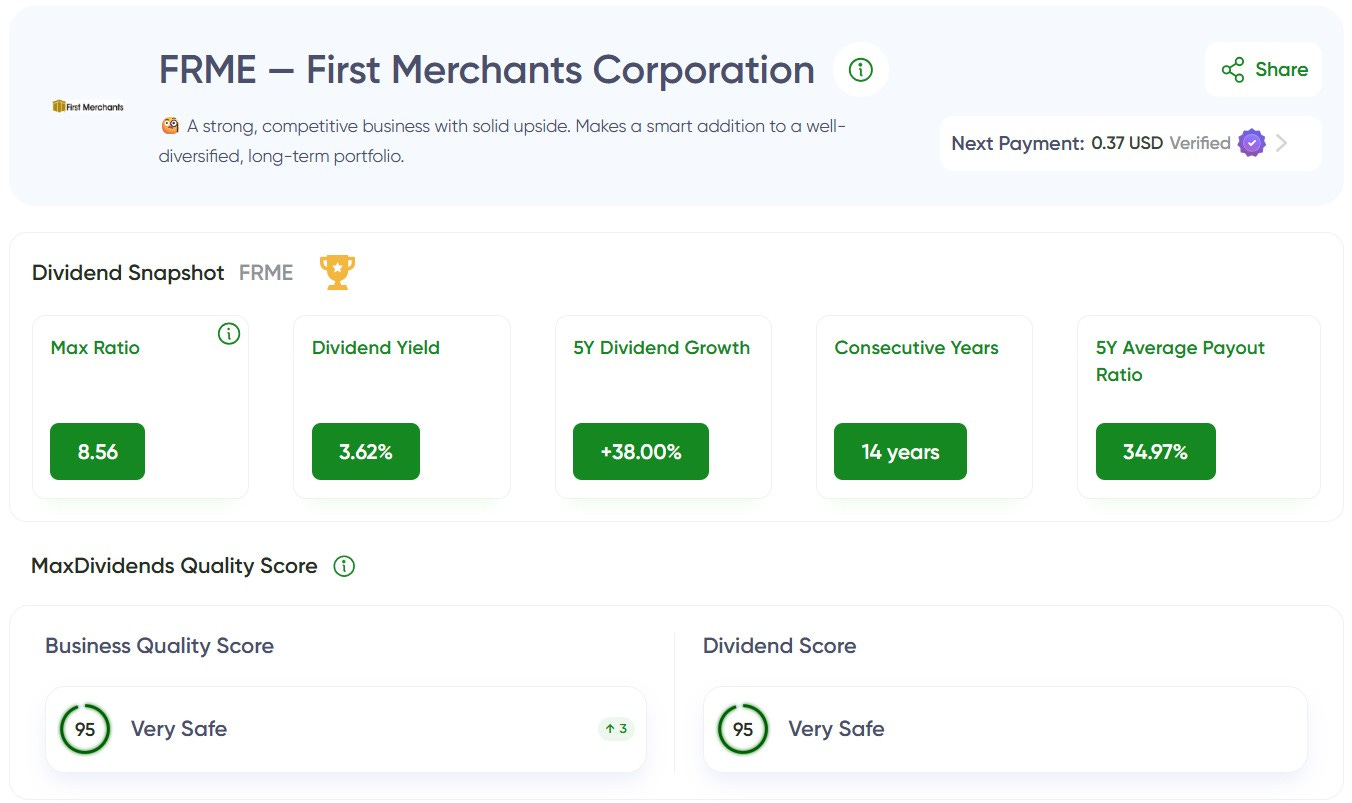
First Merchants Corporation (FRME)
Business Quality Score: 95 / 99
Quick Tip
To keep your portfolio strong, stay on top of the financials for each company you hold. Solid companies mean better returns, so be sure to check in on their quarterly and annual numbers.
—
Interesting stocks usually score 80+ on the Financial Scale, with top players hitting 90+. If that score dips below 80, it might be a good time to consider cutting ties before things take a turn.
First Merchants Corporation (FRME) is a Muncie, Indiana-based bank holding company operating primarily through First Merchants Bank, serving commercial and retail customers across Indiana, Illinois, Michigan, and Ohio. Founded in 1893 as Merchants National Bank of Muncie, the company has grown through decades of organic expansion and acquisitions into central Indiana’s largest financial services holding company.
Dividend engine: 14 years, plenty of breathing room
First Merchants pays $1.48 per share annually, a 3.55% yield, with a 47.44% payout ratio and a 5-year dividend-growth rate of +38.00%. That payout ratio is comfortably conservative for a regional bank, leaving substantial earnings retained to absorb credit costs and fund continued acquisitions without threatening the payout. The 14-year streak of hikes reflects a management team that treats dividend growth as core to its capital return strategy, even while simultaneously integrating multiple bank acquisitions and navigating credit provisioning cycles.
Q2 2026: a credit charge dents an otherwise solid quarter
For the second quarter ended June 30, 2026, First Merchants reported net income of $43.5 million, or $0.70 per diluted share (adjusted EPS of $0.74), down from $0.98 a year earlier, missing the $1.02 consensus estimate, per the July 22, 2026 press release filed with the SEC. Revenue rose 19.3% year over year to $196.1 million, total assets reached $21.35 billion, total loans hit $15.5 billion, and net interest margin expanded to 3.38%, but the quarter absorbed a $33 million credit loss provision tied to two problem commercial credits. Year-to-date net income stood at $72.14 million as the newly closed First Savings acquisition began contributing to the balance sheet.
Growth story: acquisitions doing the heavy lifting
First Merchants’ growth engine right now runs almost entirely through M&A. The company completed its $243.22 million acquisition of First Savings Financial Group in 2026, adding roughly $2.4 billion in assets and expanding its footprint into southern Indiana. That deal followed a steady acquisition cadence that has pushed total assets from $19.0 billion at the end of 2025 to $21.35 billion by mid-2026, a jump of more than 12% in half a year driven almost entirely by deal-making rather than organic loan growth.
A schoolteacher started what became a $21 billion bank
First Merchants traces its roots to 1893, when the Merchants National Bank of Muncie was founded by a local former schoolteacher looking to serve his community’s financial needs. More than 130 years and dozens of mergers later, that single Indiana storefront has grown into a multi-state holding company with over $21 billion in assets, proving that small-town banking ambitions can compound into something enormous given enough decades and a willingness to keep buying.
Final take
First Merchants offers a 3.55% yield, $1.48 annual dividend, 14 years of hikes, +38.00% 5-year dividend growth, and a 47.44% payout ratio. The business is backed by a completed First Savings acquisition, expanding net interest margin, and rapid asset growth, but a Q2 EPS miss driven by a $33 million credit provision and ongoing acquisition integration are real near-term risks. Business Quality Score: 95. That’s elite territory, and it suggests a genuinely durable franchise, though the recent credit charge is worth watching closely before treating this as a set-and-forget holding.