


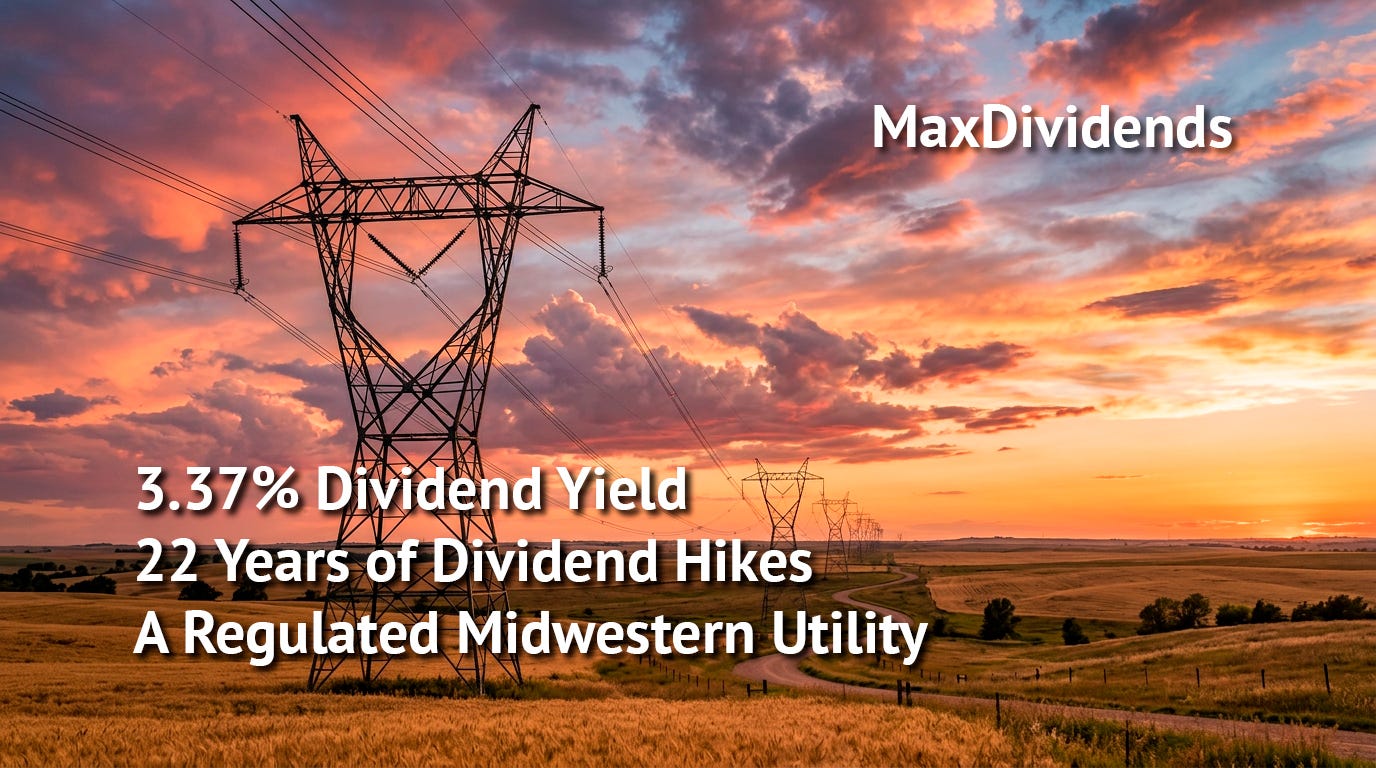
It’s a grid operator that doesn’t chase headlines, yet its earnings have become more resilient over time thanks to rate-based returns, heavy infrastructure spending, and a surge in demand from data centers and industrial users. The dividend has moved up for 22 straight years, and the business model is built to keep cash flows predictable even when the broader economy wobbles.
Evergy (EVRG)
Financial Score: 86 / 99
Quick Tip
To keep your portfolio strong, stay on top of the financials for each company you hold. Solid companies mean better returns, so be sure to check in on their quarterly and annual numbers.Interesting stocks usually score 80+ on the Financial Scale, with top players hitting 90+. If that score dips below 80, it might be a good time to consider cutting ties before things take a turn.Evergy, Inc. (EVRG) serves 1.7 million electric customers in Kansas and Missouri through regulated subsidiaries focused on generation, transmission, and distribution. It emerged from the 2018 merger of Westar Energy and Great Plains Energy and now runs a classic investor-owned utility model: invest in infrastructure, recover costs via approved rates, and grow earnings through rate base expansion plus large-load contracts.
Dividend engine: 22 years of hikes at a regulated utility
Evergy pays $2.78 per share annually, a 3.37% forward yield, with a 73.74% payout ratio and a 5-year dividend-growth rate of +32.00%. The payout ratio is on the higher side but still consistent with regulated utilities that fund grid modernization and leverage control under fixed-rate frameworks. The 22-year streak of hikes reflects management’s willingness to grow the dividend alongside earnings, supported by a customer base that’s highly inelastic and a revenue model tied to rate approvals rather than commodity swings.
Latest reported numbers: 2025 full year and Q4 2025
For full-year 2025, GAAP earnings were $855.6 million ($3.66/share) vs. $873.5 million ($3.79/share) in 2024; adjusted earnings were $893.8 million ($3.83/share) vs. $877.9 million ($3.81/share). Q4 2025 GAAP earnings were $84.3 million ($0.36/share), adjusted earnings $99.8 million ($0.42/share), per the February 19, 2026 SEC-exhibited press release. The company also received approval for new large-load power tariffs in Kansas and Missouri, a key step for monetizing heavy demand without passing costs to existing ratepayers.
Growth story: data centers, not just rate base
Evergy’s largest tailwind is now load, not just meters. It signed electric service agreements for 1.9 GW with Google, Meta, and Beale Infrastructure, with at least one more expected in 2026, and is in advanced discussions for an additional 2–3.5 GW. Retail sales are expected to rise up to 8% annually driven by data-center growth, and the company increased its 2026–2030 capital plan to $21.6 billion (up 24%) to support generation and grid upgrades. Missouri approved a large-load rate plan requiring 12-year minimum contracts, collateral equal to two years of bills, and exit fees, ensuring costs are fully recovered from large users.
Why the credit view is mixed
S&P Global Ratings forecasts Evergy’s consolidated FFO-to-debt at 13%–15% through 2026, which is acceptable but not elite for a utility. A Kansas rate case settlement pushed the long-term EPS growth target down to 4%–6% through 2026 (from 6%–8%), reflecting a 9.4% return on equity and a tougher regulatory environment. That mix—strong large-load pipeline but tighter rate-case outcomes—creates a story that’s interesting but not automatically safe.
Final take
Evergy offers 3.37% yield, $2.78 annual dividend, 22 years of hikes, +32.00% 5-year dividend growth, and a 73.74% payout ratio. The business is supported by a $21.6B capital plan, a 15 GW large-load pipeline (5 GW advanced), and data-center-driven load growth, but regulatory friction and capital intensity remain real risks. Financial Score: 86. This company is interesting, but the score suggests you should dig deeper and recheck the financials—especially FFO-to-debt, rate-case outcomes, and execution on the large-load pipeline—before treating it as a core holding.
Someone’s sitting in the shade today because someone planted a tree a long time ago. ― Warren Buffett.
Learn the MaxDividends Way
Start Here
🔑 Explore the Premium Hub (exclusive — upgrade to unlock)
Guides & Step-by-Step
Deep Insights
📖 I ❤️ Dividends: Why I Believe Dividend Investing Is the Best Strategy | E-Book
How Effective is the MaxDividends Strategy for Building Growing Passive Income
Help & Support
Got a question about dividends? Ask Max, your AI Dividend Assistant!
Didn’t get the answer you need? Reach out: max@maxdividends.app or team@maxdividends.app — we’ll help you out.