


This company drills for natural gas, transports it, stores it, and delivers it to homes. Owning that whole chain has helped support decades of dividend increases. Now management plans to separate the drilling and gathering operations from the utilities and pipelines. Investors buying for income need to understand not just today’s payout, but what will be supporting it after the breakup.
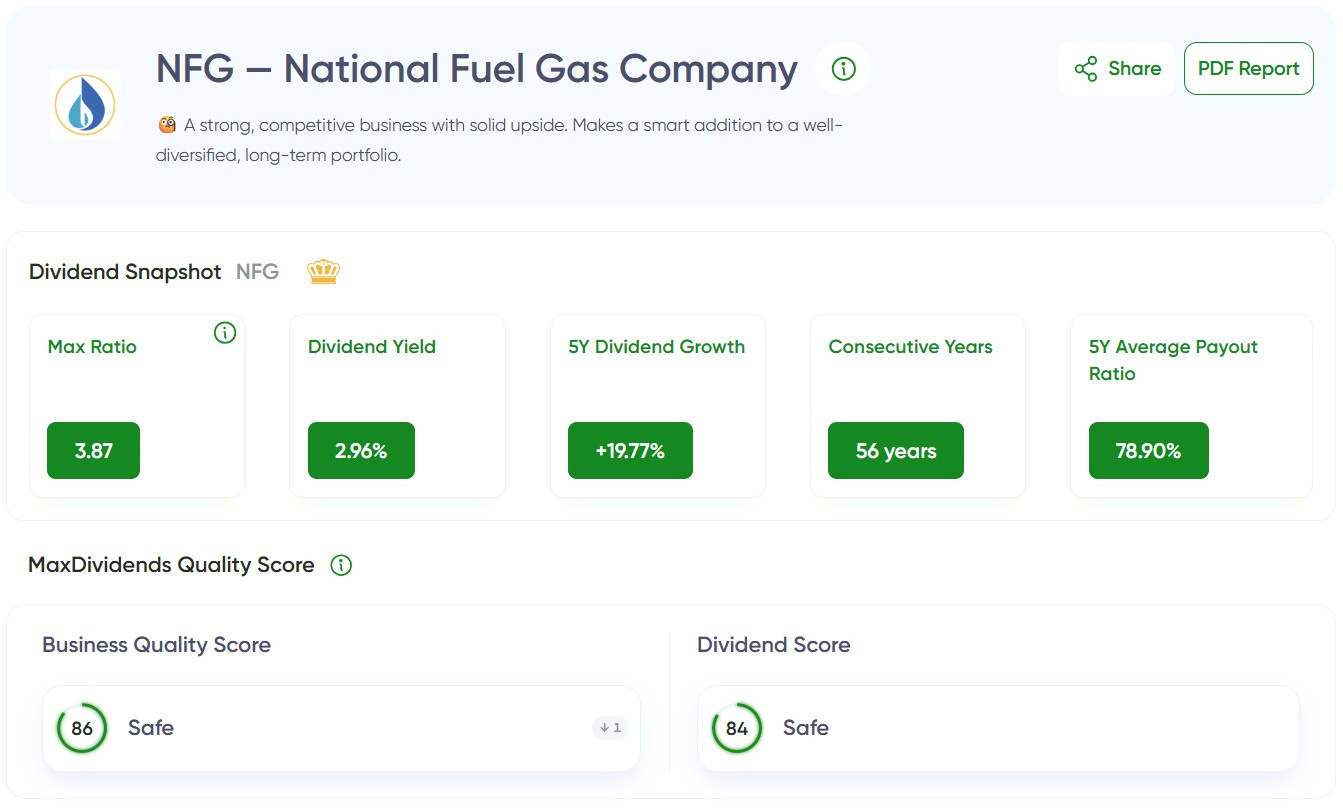
National Fuel Gas (NFG)
Business Quality Score: 86 / 99
Quick Tip
To keep your portfolio strong, stay on top of the financials for each company you hold. Solid companies mean better returns, so be sure to check in on their quarterly and annual numbers.
—
Interesting stocks usually score 80+ on the Financial Scale, with top players hitting 90+. If that score dips below 80, it might be a good time to consider cutting ties before things take a turn.
Based in Western New York, National Fuel combines gas production with pipelines, storage, and regulated utilities. Its October acquisition of CenterPoint’s Ohio gas utility added approximately 335,000 customers, extending its utility operations beyond New York and Pennsylvania. That gives the company more regulated earnings alongside its more unpredictable drilling business—for now.
The dividend leaves plenty behind
NFG pays $2.22 per share annually, yielding 2.96%, with 56 consecutive years of increases. Payments have grown 19.77% over five years. The 31.53% payout ratio is the reassuring part: dividends consume less than a third of earnings, leaving substantial room for investment and weaker gas markets. That does not guarantee future increases, but it is a much better starting point than a payout that needs nearly every dollar earned.
Higher sales, less profit
The November 4, 2026, fiscal Q4 report showed revenue of $467.9 million, up 2.5%, but operating income fell 12.4% to $157.5 million as expenses increased. Net income declined to $97.5 million from $107.3 million, with GAAP EPS falling to $1.02 from $1.18. Adjusted EPS held at $1.22. Higher realized gas prices helped, but production fell 7%: better prices could not fully make up for selling less gas and spending more to operate.
More customers, more pipe
The Ohio acquisition doubled the utility’s rate base—the assets on which regulators allow it to earn a return. Meanwhile, the Tioga Pathway and Shippingport Lateral pipeline projects entered service on November 1, adding another source of growth. The planned Seneca Resources spinoff, expected in the second half of 2027, would leave NFG more focused on utilities, pipelines, and storage. That could make earnings less sensitive to gas prices, though the separation still has to be completed.
An empty field with a second job
In 1916, a National Fuel predecessor developed America’s first underground natural gas storage reservoir at Zoar Field, south of Buffalo. The clever part was reusing a depleted gas field: instead of abandoning the underground formation, the company put gas back into it for later use. That made it possible to save supplies for cold weather rather than rely entirely on gas arriving through pipelines when heating demand surged.
Final Take
The 2.96% yield comes with a low 31.53% payout ratio and 56 years of dividend increases. Business Quality Score: 86 suggests a solid business, but not one to buy without a closer look. Ohio adds regulated earnings, and the new pipelines support growth. Rising costs, lower gas production, and the planned spinoff are the complications. The dividend has breathing room; the bigger question is how the separation changes earnings and dividend coverage.