


Most utilities are content growing their rate base at a comfortable, unremarkable pace. This one just told investors it sees more than $71 billion of investment opportunity ahead through 2035, and that Google and Amazon broke ground on data center projects in its territory worth a combined $25 billion in a single quarter. That's not the kind of talk you usually hear from a company whose main job is keeping the lights on across the Midwest.
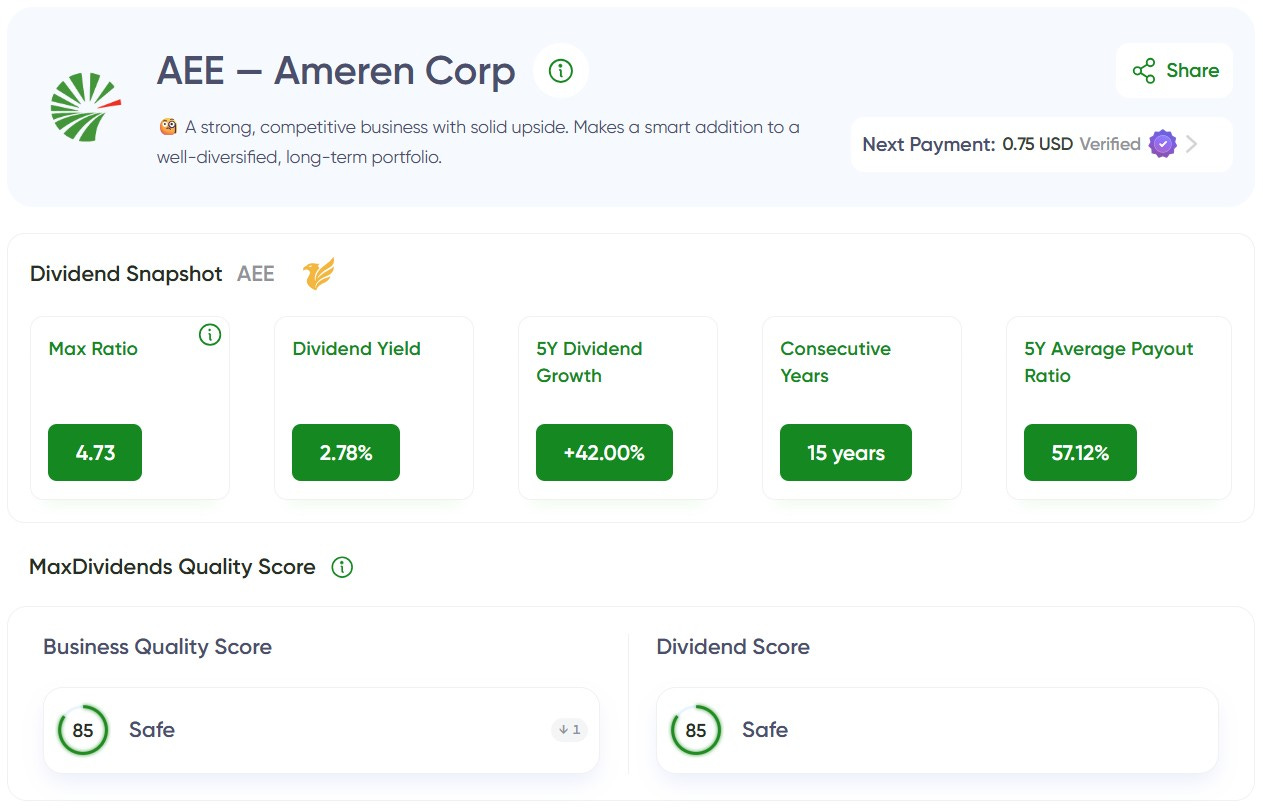
Ameren (AEE)
Business Quality Score: 85 / 99
Quick Tip
To keep your portfolio strong, stay on top of the financials for each company you hold. Solid companies mean better returns, so be sure to check in on their quarterly and annual numbers.
—
Interesting stocks usually score 80+ on the Financial Scale, with top players hitting 90+. If that score dips below 80, it might be a good time to consider cutting ties before things take a turn.
Ameren Corporation (AEE) is a St. Louis-based utility holding company formed by the 1997 merger of Union Electric Company and CIPSCO Inc., serving regulated electric and natural gas customers across Missouri and Illinois. It runs a classic rate-based model: invest in generation, transmission, and distribution, then recover costs plus an approved return through state-regulated rates.
Dividend engine: 15 years, comfortably funded
Ameren pays $3.00 per share annually, a 2.81% yield, with a 52.82% payout ratio and a 5-year dividend-growth rate of +42.00%. That payout ratio is on the conservative end for a regulated utility, leaving plenty of room to keep funding a massive capital program without stressing the balance sheet. The 15-year streak of hikes reflects earnings growth tied to rate case approvals and rate base expansion rather than commodity swings, and management has already reaffirmed guidance that points toward continued growth through the back half of the decade.
Q2 2026: EPS beat, revenue miss
For the second quarter ended June 30, 2026, Ameren reported net income of $314 million, or $1.13 per diluted share, up from $275 million, or $1.01 per share, a year earlier, beating the $1.08 consensus estimate, per the July 30, 2026 press release on PR Newswire. Total operating revenues fell to $2.09 billion from $2.22 billion, missing the $2.27 billion forecast, largely due to a sharp drop in off-system electric sales and capacity revenue at Ameren Missouri, which fell from $471 million to $148 million. Operating income still climbed to $459 million from $411 million, and management reaffirmed full-year 2026 EPS guidance of $5.25 to $5.45.
Growth story: data centers rewriting the capital plan
Ameren’s growth story is now inseparable from data centers. Google and Amazon broke ground on data center projects in its service territory during Q2 2026 with a combined planned investment of $25 billion, and management outlined an investment opportunity exceeding $71 billion through 2035, including a five-year 2026-2030 plan of $31.8 billion. That spending is expected to grow the regulated rate base from $28.8 billion in 2025 to $47.7 billion by 2030, a roughly 10.6% compound annual growth rate, with a preferred-scenario load growth assumption of 1.5 gigawatts by 2032.
Born from a dam and a merger of century-old rivals
Ameren didn’t start as one company; it was stitched together in 1997 from Union Electric, founded in St. Louis back in 1902, and CIPSCO of Illinois, itself dating to the same year. Decades before that merger, Union Electric built the Bagnell Dam in 1929, a hydroelectric project so large it created the Lake of the Ozarks, a 1,400-mile shoreline lake that exists purely as a side effect of a utility trying to keep the lights on in Missouri.
Final take
Ameren offers a 2.81% yield, $3.00 annual dividend, 15 years of hikes, +42.00% 5-year dividend growth, and a 52.82% payout ratio. The business is backed by reaffirmed 2026 guidance, a $71 billion long-term investment runway, and marquee data center customers like Google and Amazon, but the Q2 revenue miss and reliance on volatile off-system sales are real near-term risks. Financial Score: 86. This company is interesting, but the score suggests digging deeper into revenue volatility and execution on the data center pipeline before treating it as a core holding.