

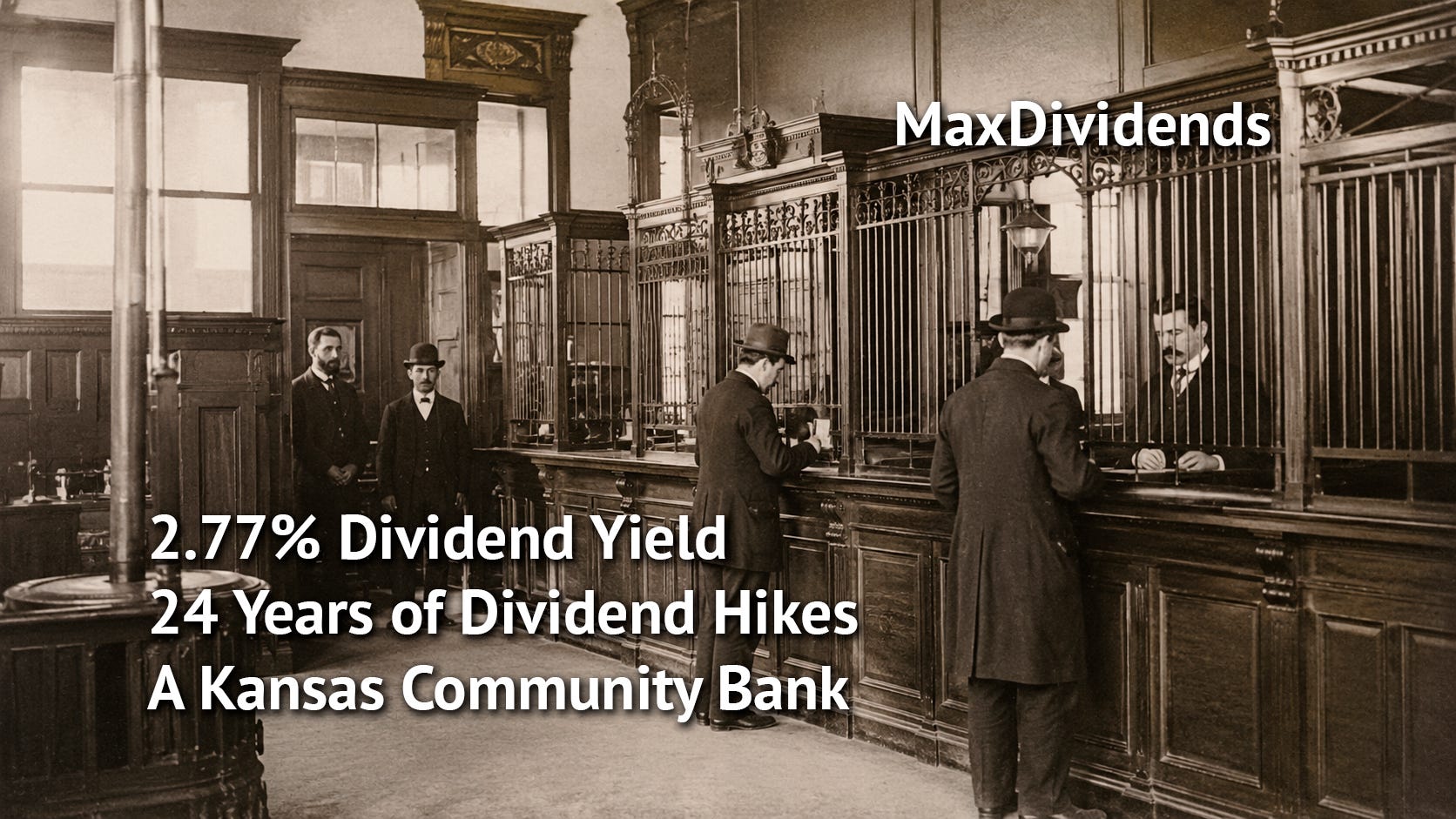
Sometimes the best business model is simply knowing your neighborhood better than the mega-banks do. This institution has spent nearly 140 years quietly building out a network across a single state, lending to local farmers, small businesses, and homeowners.
It just posted record quarterly revenue and expanded its profit margins during an interest rate environment that crushed many of its peers, proving that disciplined agricultural and commercial real estate lending can still generate reliable cash.
Landmark Bancorp (LARK)
Financial Score: 90 / 99
Quick Tip
To keep your portfolio strong, stay on top of the financials for each company you hold. Solid companies mean better returns, so be sure to check in on their quarterly and annual numbers.
—
Interesting stocks usually score 80+ on the Financial Scale, with top players hitting 90+. If that score dips below 80, it might be a good time to consider cutting ties before things take a turn.
Landmark Bancorp, Inc. (LARK) is the Manhattan, Kansas-based holding company for Landmark National Bank. Founded in 1885 as the Manhattan Buildings & Savings Association, it operates 29 branches across 23 Kansas communities, stretching from Garden City to Pittsburg.
The bank focuses heavily on relationship-driven community banking, providing commercial real estate, agricultural, residential mortgage, and consumer lending tailored to the specific needs of the Kansas heartland.
Dividend math: low payout, decades of consistency
Landmark Bancorp pays $0.84 per share annually, a 2.77% yield, with a 26.92% payout ratio and a 5-year dividend-growth rate of +63.00%. That payout ratio is incredibly conservative, meaning the bank retains nearly three-quarters of its earnings to absorb credit shocks and fund local loan growth without breaking a sweat.
The 24-year streak of dividend increases—maintained through the 2008 financial crisis, the pandemic, and the recent regional banking stress—shows a management team that views the dividend as a non-negotiable piece of its total return strategy for shareholders.
Q1 2026: record revenue and margin expansion
For the first quarter ended March 31, 2026, Landmark reported record total revenues of $18.8 million, up 14% from $16.5 million a year earlier. Net earnings totaled $5.1 million, an 8.5% year-over-year increase, while diluted EPS hit $0.83, up 7.8% from $0.77, beating expectations.
According to the April 28, 2026 earnings release on GlobeNewswire, the beat was driven by a 14.5% jump in net interest income to $15 million, fueled by a net interest margin that expanded sequentially and year-over-year to 4.24%, showcasing excellent balance sheet management in a tricky rate environment.
Growth: the quiet power of steady lending
Landmark doesn’t chase flashy national growth; it simply deepens its hold on Kansas. As of Q1 2026, gross loans reached $1.09 billion, representing 11.5% average loan growth over the trailing year. The bank offset softness in residential and general commercial balances by successfully growing its commercial real estate and specialized agricultural loan portfolios.
Meanwhile, total deposits climbed to $1.4 billion, reflecting strong local deposit gathering in money market and checking accounts, keeping the bank’s loan-to-deposit ratio at a healthy, highly liquid 79.1%.
1885: Building Manhattan, Kansas
Landmark’s roots go back to April 1885, when it was chartered as the Manhattan Buildings & Savings Association. It was originally formed not as a traditional commercial bank, but specifically to help local residents finance and build homes as the city of Manhattan, Kansas, was rapidly growing.
That foundational focus on local real estate and community building never left its DNA, eventually evolving into the multi-branch, agriculture-and-real-estate-heavy regional bank that operates today.
Final take
Landmark Bancorp offers a 2.77% yield, $0.84 annual dividend, 24 years of hikes, +63.00% 5-year dividend growth, and a 26.92% payout ratio. The business is supported by record Q1 revenue, expanding net interest margins, and a highly conservative payout that leaves plenty of room for future hikes.
The main risks are geographic concentration in a single state and exposure to the agricultural and commercial real estate cycles. Financial Score: 90. This is a genuinely strong and reliable community bank—scores of 90 and above are considered elite, and Landmark earns it through disciplined local underwriting, sticky deposits, and a dividend track record that speaks for itself.