


Missile defense is becoming a bigger growth engine for this aircraft builder. Customers need more interceptors, and management is expanding production to meet that demand. The latest quarter showed progress: missile sales outpaced aircraft growth, profits increased, and the annual forecast improved. The challenge is building more without allowing costs to swallow the gains.
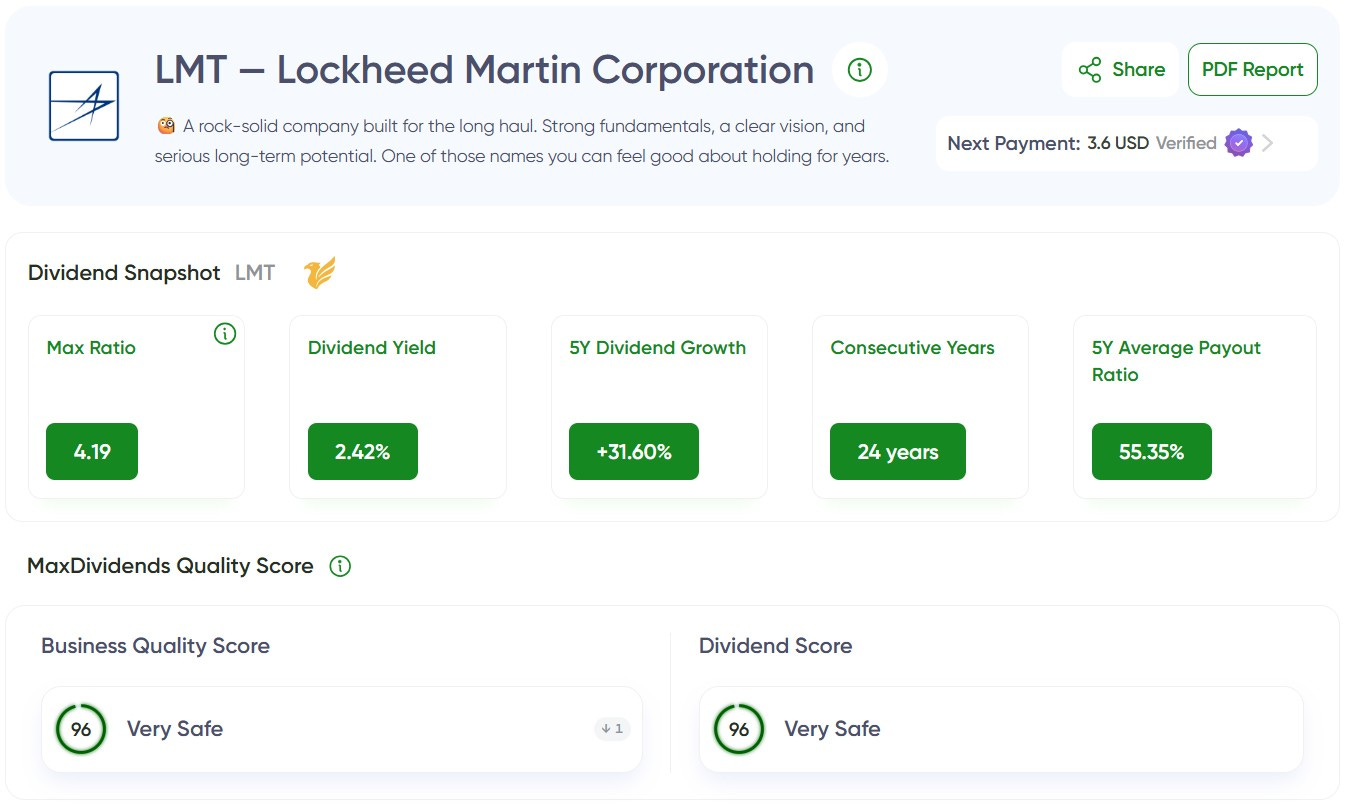
Lockheed Martin (LMT)
Business Quality Score: 96 / 99
Quick Tip
To keep your portfolio strong, stay on top of the financials for each company you hold. Solid companies mean better returns, so be sure to check in on their quarterly and annual numbers.
—
Interesting stocks usually score 80+ on the Financial Scale, with top players hitting 90+. If that score dips below 80, it might be a good time to consider cutting ties before things take a turn.
Lockheed Martin builds F-35 fighters, helicopters, missile defenses, and space systems for U.S. and allied customers. Delivering equipment starts relationships that can last decades through maintenance, upgrades, and replacement orders. That gives the business staying power, but demanding contracts mean even technically successful programs can lose money when costs run over budget.
A dividend supported by cash
Lockheed pays $14.40 annually, yielding 2.42%, with 24 consecutive years of increases and +31.60% five-year dividend growth. The 51.15% payout ratio leaves roughly half of earnings available for other needs. Q3 operating cash flow of $3.438 billion, less $439 million of capital spending, left about $3 billion in free cash flow. That supports both production investment and shareholder payments, although government payment timing can make quarterly cash generation uneven.
A strong quarter investors rewarded
Shares rose nearly 7% after the October 22, 2026 report. Sales increased 11% to $20.7 billion, while EPS reached $7.97 against $7.52 expected. Net income rose 14% to $1.845 billion, and operating profit reached $2.443 billion. Management raised its annual outlook for the second consecutive quarter. Higher output was translating into higher profits—not merely a larger order book—although a lower operating margin showed that production growth still brings cost pressure.
Missiles are changing the growth story
Missiles and Fire Control sales grew 24%, supported by Patriot interceptors, THAAD defenses, and tactical missiles. A $52.5 billion multiyear PAC-3 award helped lift backlog to $292 billion, giving factories a longer production pipeline. Aircraft remained important: higher F-35 production and support activity lifted Aeronautics sales 13%. Lockheed is expanding both businesses, but missile defense is increasingly driving its momentum.
Faster Than a Bullet
Lockheed’s SR-71 Blackbird could fly faster than a rifle bullet. In 1976, it set a speed record of more than 2,193 mph—a record for a piloted, air-breathing jet that still stands. The breakthrough was making that speed useful: the aircraft could sustain it on reconnaissance missions, rather than reach it briefly during a test. It photographed targets and escaped threats through speed and altitude instead of carrying weapons.
Final Take
Lockheed is turning defense demand into higher production and profits. Larger missile programs could sustain that expansion alongside aircraft maintenance and upgrades. Business Quality Score: 96 places it in the elite group above 90, but risks remain: fixed-price overruns, supplier bottlenecks, and unresolved F-35 funding could hurt margins or delay cash receipts. The 2.42% yield and 24-year dividend-growth record have support; the business must now prove it can deliver larger volumes profitably.