


An insurer can nearly double reported earnings while its underlying profit falls. Here, stock-market gains boosted the investment portfolio, while catastrophe claims weakened insurance results. Behind those swings sits a business built around independent agents, collecting premiums and investing the proceeds. The distinction matters: market gains can lift reported profits without improving the profitability of insurance policies.
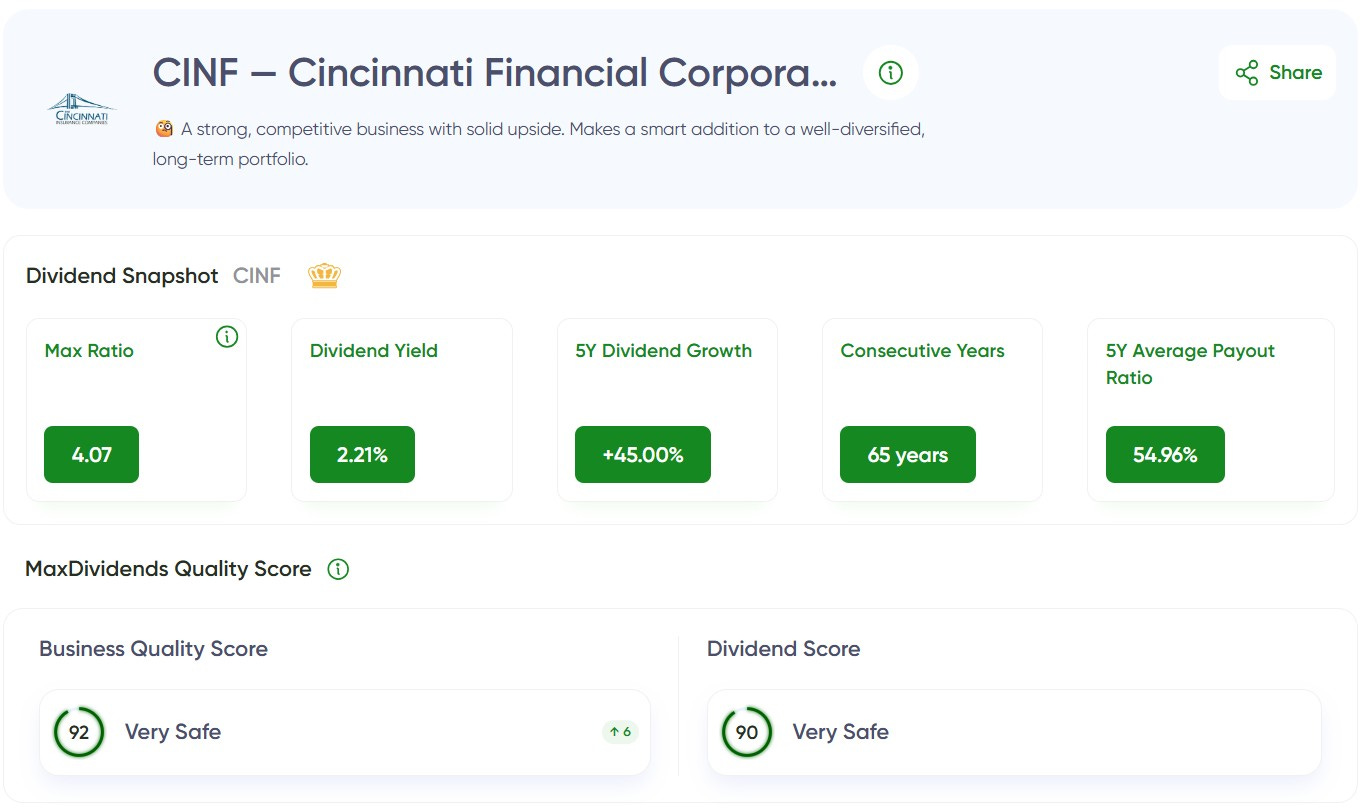
Cincinnati Financial (CINF)
Business Quality Score: 92 / 99
Quick Tip
To keep your portfolio strong, stay on top of the financials for each company you hold. Solid companies mean better returns, so be sure to check in on their quarterly and annual numbers.
—
Interesting stocks usually score 80+ on the Financial Scale, with top players hitting 90+. If that score dips below 80, it might be a good time to consider cutting ties before things take a turn.
Cincinnati Financial Corporation is a Fairfield, Ohio-based insurance holding company offering commercial, personal, specialty, and life coverage. Four independent agents founded its principal insurance company in 1950.
Independent agencies remain its core distribution channel, connecting the insurer with customers rather than relying on a company-owned sales force.
A dividend cushion that needs context
Cincinnati Financial pays $3.76 per share annually, a 2.21% yield, with 65 consecutive years of increases and +45.00% five-year dividend growth. The 17.74% payout ratio suggests substantial coverage, but investment gains inflate GAAP earnings and can make that cushion look larger.
Operating earnings and capital strength therefore matter alongside the headline ratio. The dividend record is exceptional; one low payout figure does not tell the whole story.
Q2 2026: investment gains mask weaker operations
The July 27, 2026 release reported Q2 revenue of $4.274 billion, net income of $1.255 billion, and diluted EPS of $8.05 versus $4.34 a year earlier. Non-GAAP operating income fell to $224 million, or $1.43 per share, from $311 million, or $1.97.
An $882 million after-tax increase in the value of stocks still held boosted GAAP earnings, while higher catastrophe losses hurt operating results.
Premiums and bond income drive recurring growth
Property and casualty earned premiums increased 6.3% to approximately $2.6 billion, supported by renewal pricing, insured exposures, and new business. Investment income rose 12%, including 14% growth in bond interest income.
These provide two recurring earnings drivers, but stronger premiums do not guarantee better underwriting profits when claims costs rise faster.
The Insurer That Patented Its Own Software
Cincinnati Insurance’s first patent wasn’t for an insurance product—it was for software. Its Cinergy initiative pioneered a markup-language-driven system for administering insurance products, helping the company bring new coverage to market faster.
Behind an insurer associated with local agents and personal relationships was an in-house technology breakthrough: the business built around handshakes also became a patent holder.
Final take
Some experts emphasize premium growth and rising investment income; others focus on catastrophe losses and weaker operating earnings. Analysts expect full-year EPS of $8.44 and $8.97 next year, though these remain forecasts. The 2.21% yield provides moderate income, while the 17.74% payout needs context because investment gains influence earnings.
Business Quality Score: 92—an elite level reflecting long-term business strength, not immunity to losses. The key question is whether recurring insurance profits improve alongside premium growth.