

This is one of those rare insurers where the story is not just about collecting premiums, but about consistently turning underwriting discipline and investment income into a multi‑decade shareholder compounding engine. It writes commercial, personal, and excess‑and‑surplus policies across the U.S., and when the combined ratio behaves, the investment portfolio has a habit of quietly amplifying returns. Put those together and you get a business that can grow book value, raise the dividend, and still stomach catastrophe years without losing its long‑term stride.
Cincinnati Financial (CINF)
Financial Score: 87 / 99
Quick Tip
To keep your portfolio strong, stay on top of the financials for each company you hold. Solid companies mean better returns, so be sure to check in on their quarterly and annual numbers.Interesting stocks usually score 80+ on the Financial Scale, with top players hitting 90+. If that score dips below 80, it might be a good time to consider cutting ties before things take a turn.Cincinnati Financial (CINF) is a property‑casualty and life insurance group headquartered in Fairfield, Ohio, operating through subsidiaries that focus on commercial lines, personal lines, excess and surplus lines, reinsurance, and life insurance. It distributes primarily via independent agents, giving it local reach and underwriting insight across markets while keeping the balance sheet and capital allocation centralized. Over decades, it has built a reputation for maintaining conservative reserving practices and a strong capital position, using that foundation to support steady growth in premiums, investment income.
Dividend engine: decades‑long habit with room to run
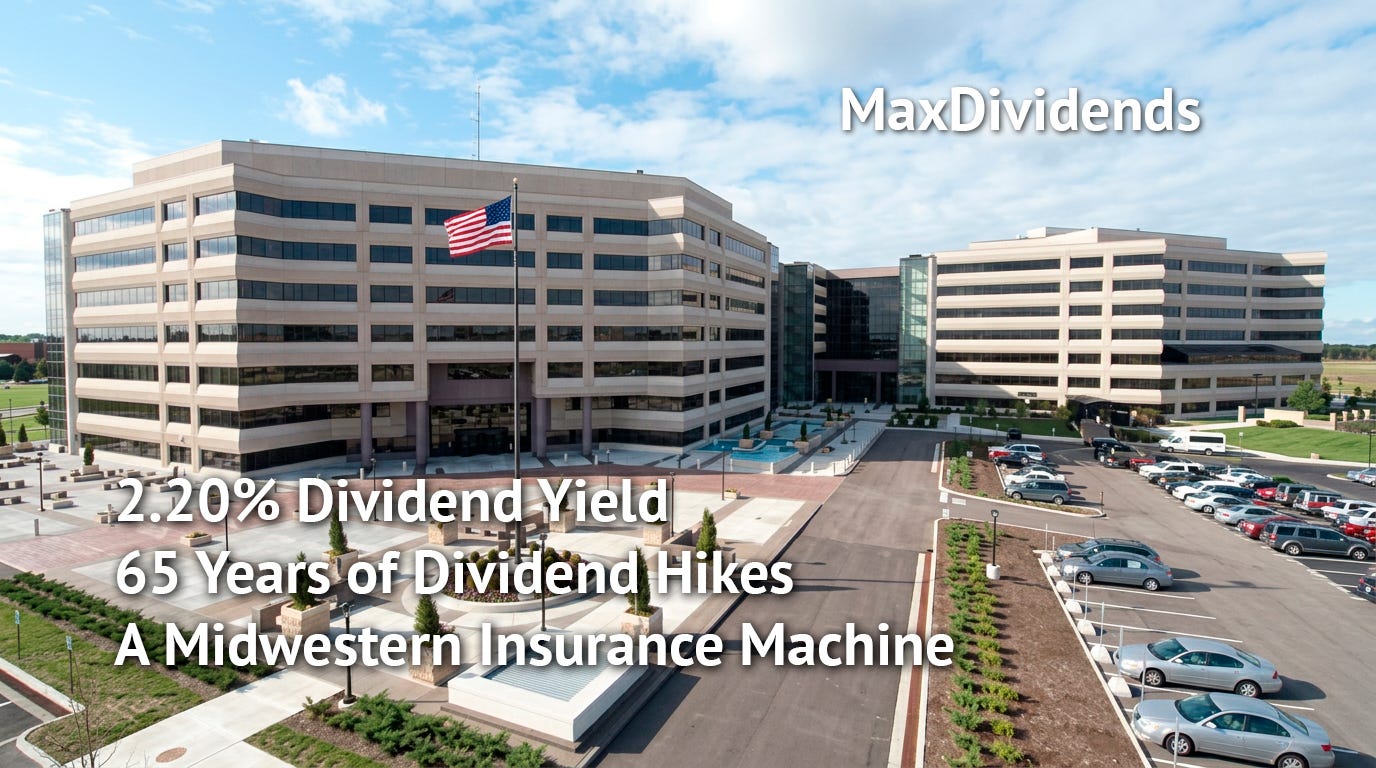
A 2.20% dividend yield and $3.48 annual dividend might not headline‑grab on their own, but the context changes everything: a 22.94% payout ratio and 65 consecutive years of dividend growth. That’s Dividend King territory, and it means the board has kept raising the payout through multiple interest‑rate regimes, market crashes, and insurance cycles without stretching the business. Add +45.00% dividend growth over the last five years and you get a picture of a company willing to let the dividend grow with earnings while still retaining the bulk of profits to fund underwriting and investments. It’s a “sleep‑at‑night” setup for long‑term investors who want both income and compounding, not a short‑term yield stunt.
Q4 2025: strong net income, healthier underwriting, and solid EPS beat
For Q4 2025, reported February 8, 2026, Cincinnati Financial delivered net income of $676 million, or $4.29 per share, up from $405 million, or $2.56 per share, in Q4 2024—helped by a $145 million after‑tax increase in the fair value of equity securities still held. Non‑GAAP operating income rose 7% to $531 million, or $3.37 per share, compared with $497 million, or $3.14 per share, a year earlier, as underwriting and investment income both contributed. Full‑year 2025 net income reached $2.393 billion, or $15.17 per share, versus $2.292 billion, or $14.53 per share, in 2024, with non‑GAAP operating income up 5% to $1.254 billion, or $7.95 per share, despite some pressure on property‑casualty underwriting profit.
Growth levers: premiums, combined ratios, and a bigger investment engine
Premium growth is doing real work: Q4 2025 revenue came in around $3.09 billion, up roughly 21–22% year over year, with non‑GAAP operating income up 7% and a property‑casualty combined ratio of 85.2% that helped pull the full‑year combined ratio down to 94.9%. Net written premiums grew 5% in Q4, with Commercial Lines up 7%, Personal Lines up 14%, and Excess and Surplus Lines up 11% for the full year—showing broad‑based demand and pricing discipline across the book. On top of that underwriting performance, after‑tax net investment income increased by $112 million in 2025, giving the company a bigger investment engine to support future earnings and dividend growth as rates and markets evolve.
Fun Fact – From a 1950 Cincinnati agency cluster to a national independent‑agent network
Cincinnati Financial traces its roots to 1950, when a small group of independent agents in Cincinnati formed an insurance company that would stay loyal to the independent‑agency model instead of chasing direct‑to‑consumer trends. That decision—betting on local agent relationships rather than call centers or mass advertising—has quietly shaped its culture and distribution strategy for decades, helping it build a national footprint while still feeling like a “local” insurer to many of its policyholders.
Final Take – A true Dividend King with a quality score to match
Cincinnati Financial offers a 2.20% yield, $3.48 annual dividend, a modest 22.94% payout ratio, and an extraordinary 65‑year dividend‑growth streak, plus +45.00% 5‑year dividend growth—this is classic Dividend King territory backed by real earnings power. Q4 2025 and full‑year 2025 numbers—net income of $676 million ($4.29 per share) in Q4, non‑GAAP operating income of $531 million ($3.37 per share), full‑year net income of $2.393 billion ($15.17 per share), and full‑year non‑GAAP operating income of $1.254 billion ($7.95 per share)—show a franchise that can grow both underwriting and investment income while keeping the combined ratio under control. Financial Score: 87. That’s a strong, “almost elite” level—companies above 90 are the truly bulletproof cohort—but for a diversified insurer with this kind of dividend history, premium growth, and improving combined ratios, the main risks (catastrophe events, equity‑market swings, and competitive pricing) look manageable rather than thesis‑breaking for long‑term, income‑oriented investors.
Someone’s sitting in the shade today because someone planted a tree a long time ago. ― Warren Buffett.
Learn the MaxDividends Way
Start Here
🔑 Explore the Premium Hub (exclusive — upgrade to unlock)
Guides & Step-by-Step
Deep Insights
📖 I ❤️ Dividends: Why I Believe Dividend Investing Is the Best Strategy | E-Book
How Effective is the MaxDividends Strategy for Building Growing Passive Income
Help & Support
Got a question about dividends? Ask Max, your AI Dividend Assistant!
Didn’t get the answer you need? Reach out: max@maxdividends.app or team@maxdividends.app — we’ll help you out.
Vết goo thận a lot