


A factory can postpone buying new equipment. It cannot afford to lose control of pressure, temperature, or a production line. This company supplies the instruments, valves, and software that help keep those operations running. Now, new gas facilities, power projects, and more sophisticated manufacturing are bringing it fresh business. Orders are growing faster than sales—the encouraging part. Turning those orders into profitable deliveries is the next test.
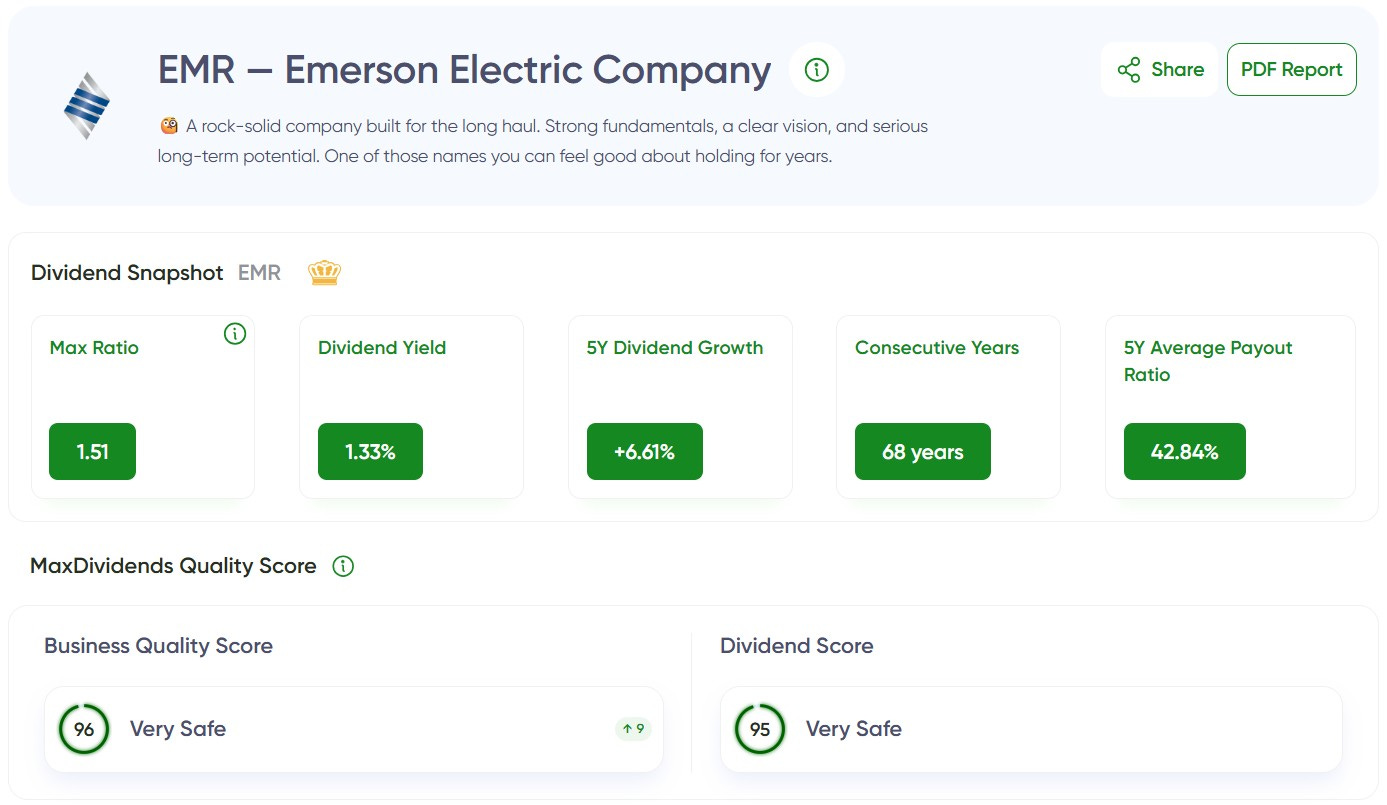
Emerson Electric (EMR)
Business Quality Score: 96 / 99
Quick Tip
To keep your portfolio strong, stay on top of the financials for each company you hold. Solid companies mean better returns, so be sure to check in on their quarterly and annual numbers.
—
Interesting stocks usually score 80+ on the Financial Scale, with top players hitting 90+. If that score dips below 80, it might be a good time to consider cutting ties before things take a turn.
Emerson helps customers run industrial plants, from measuring conditions inside equipment to controlling entire production processes. Management has been reshaping the company around automation and software, where it can sell more than hardware. A customer may buy instruments for a new plant, then rely on Emerson’s software to operate it. That strategy is producing results: software and systems sales exceeded management’s expectations in the latest quarter.
Sixty-eight years of showing up
Emerson pays $2.22 annually, yielding 1.31%, with 68 consecutive years of increases. But longevity and speed are different things: five-year dividend growth is just +6.61%. This is a record of keeping the payment moving, not racing it higher. The 48.58% payout ratio leaves an earnings cushion, and cash coverage looks stronger still. Fiscal 2026 free cash flow was $3.535 billion against $1.244 billion of dividends—room to invest without asking the dividend to step aside.
A good report, with more work ahead
The November 4 report showed Emerson moving in the right direction. Quarterly sales rose 7% to $5.201 billion, beating the roughly $5.12 billion forecast, while adjusted EPS of $1.86 narrowly topped the $1.85 estimate. Net income reached $744 million. More important than the small earnings beat was how Emerson got there: stronger sales, a better mix of business, and cost savings helped profits improve. Still, management expects about 5% sales growth next year. It is making progress, not promising a sudden industrial boom.
Customers are committing, not just talking
Orders increased 14%, lifting backlog to $8.2 billion. Behind those numbers are actual decisions: LNG Canada selected Emerson for expansion work, while a life-sciences customer signed a 10-year manufacturing-software subscription covering three sites. One brings equipment demand; the other builds a longer customer relationship. Software annual contract value grew 10.1% to about $1.7 billion. That gives Emerson more ways to grow, although large projects can take time to reach the income statement.
From Electric Fans to Bomber Turrets
Before it automated factories, Emerson made electric fans and motors. During World War II, it turned that expertise into powered gun turrets for American bombers. By 1944, its plant was producing 2,200 turrets a month, and women made up 40% of the workforce. A company built to move air around a room had become America’s largest producer of aircraft gun turrets—a far more dramatic reinvention than its dividend record suggests.
Final Take
Emerson’s push into automation and software is working: orders are growing, and long-term software agreements are extending customer relationships beyond equipment installation. Business Quality Score: 96 places it in the elite group above 90. But a strong business still faces risks: weak European demand, a subdued outlook for China, and delays on major projects could slow the conversion of orders into sales. The next step is to deliver those projects profitably and build on the software business without letting costs outrun growth.