

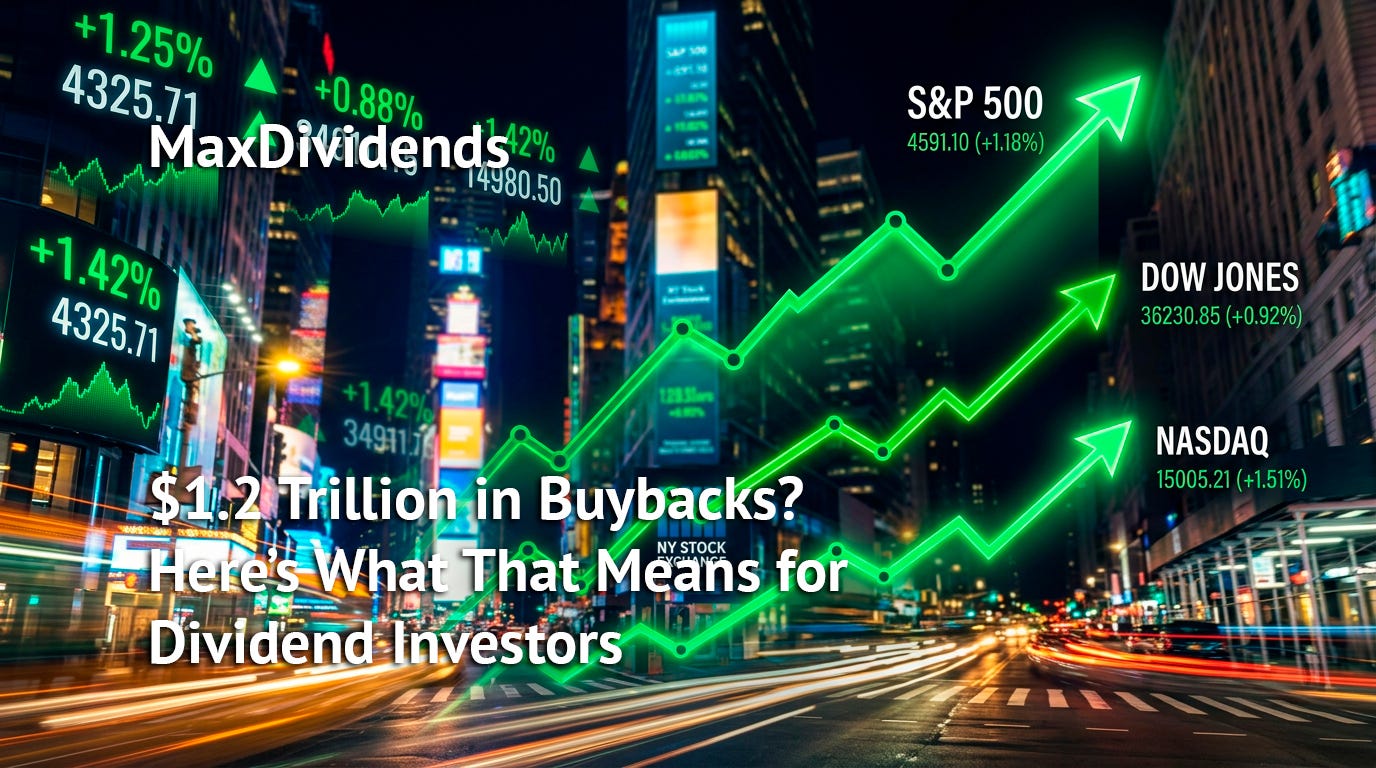
You know things are getting interesting when Wall Street starts throwing around “trillion” like it’s pocket change. In 2026, the big theme isn’t inflation, AI, or even rate cuts — it’s buybacks. U.S. companies are on pace to spend over $1.2 trillion buying back their own shares this year, which could quietly shape your returns if you’re a dividend-focused investor.
📉 Buybacks vs. Dividends: Not a Zero-Sum Game
Buybacks and dividends aren’t enemies. They’re two sides of the same coin when it comes to returning capital to shareholders. But the split between them matters. Last year, S&P 500 firms shelled out $822 billion on buybacks and $561 billion on dividends. That gap could widen further in 2026.
Take Apple, for example. It announced a record-breaking $110 billion buyback in May. Impressive? Sure. But its dividend yield is still just 0.48%, even with mountains of free cash flow. The message: Apple’s rewarding shareholders, just not through cash payouts.
🧩 Why It Matters for Income Investors
Buybacks can support long-term value, especially when stocks are attractively priced. But they’re not a direct income stream. If you’re focused on regular cash flow, it helps to know whether a company is prioritizing repurchases over dividends — or striking a thoughtful balance.
Alphabet (GOOGL) is a good example of this evolving mix. In 2026, it introduced a new $0.20/share quarterly dividend — its first ever — while also committing to $70 billion in buybacks. The company’s signaling a shift toward more shareholder-friendly policies, just with a heavier tilt toward capital appreciation.
💡 Buybacks Can Boost Price — But That’s Not the Whole Story
Goldman Sachs projects total U.S. buybacks will hit $1.2 trillion in 2026, fueled by strong tech earnings and a relatively stable Fed. Buybacks act as a kind of floor for stock prices — companies are stepping in as buyers when others might be backing off.
Nvidia, for instance, has rocketed more than 150% YTD, and Citi named it one of five major buyback engines. Visa is another — up 20% this year, while also repurchasing billions in shares. These moves can indirectly benefit all shareholders, including those focused on dividends, by boosting the stock’s base value.
But of course, buybacks alone aren’t magic. Like any capital strategy, they work best when paired with solid fundamentals and long-term planning.
📊 What Smart Dividend Investors Should Watch
Rather than worrying, it’s more productive to look under the hood. Are your portfolio companies maintaining dividend growth and engaging in sensible repurchases? That combo can be a great sign of financial health.
PepsiCo continues to do both well. The company raised its dividend for the 54th straight year and still runs a steady buyback program. Its yield stands at 3.81%, and the payout ratio remains comfortably sustainable. Johnson & Johnson is another standout, with a 3.27% yield and a 62-year streak of hikes — all while allocating cash toward innovation and shareholder returns.
🔥 Bottom Line
The $1.2 trillion buyback wave in 2026 isn’t something to fear — it’s something to understand. For dividend investors, it’s a signal to stay sharp. Look for companies that manage capital with care, reward shareholders through both price and payout, and maintain a consistent, balanced approach. That’s the sweet spot — and there are plenty of names still hitting it.
Someone’s sitting in the shade today because someone planted a tree a long time ago. ― Warren Buffett.
Learn the MaxDividends Way
Start Here
🔑 Explore the Premium Hub (exclusive — upgrade to unlock)
Guides & Step-by-Step
Deep Insights
📖 I ❤️ Dividends: Why I Believe Dividend Investing Is the Best Strategy | E-Book
How Effective is the MaxDividends Strategy for Building Growing Passive Income
Help & Support
Got a question about dividends? Ask Max, your AI Dividend Assistant!
Didn’t get the answer you need? Reach out: max@maxdividends.app or team@maxdividends.app — we’ll help you out.