


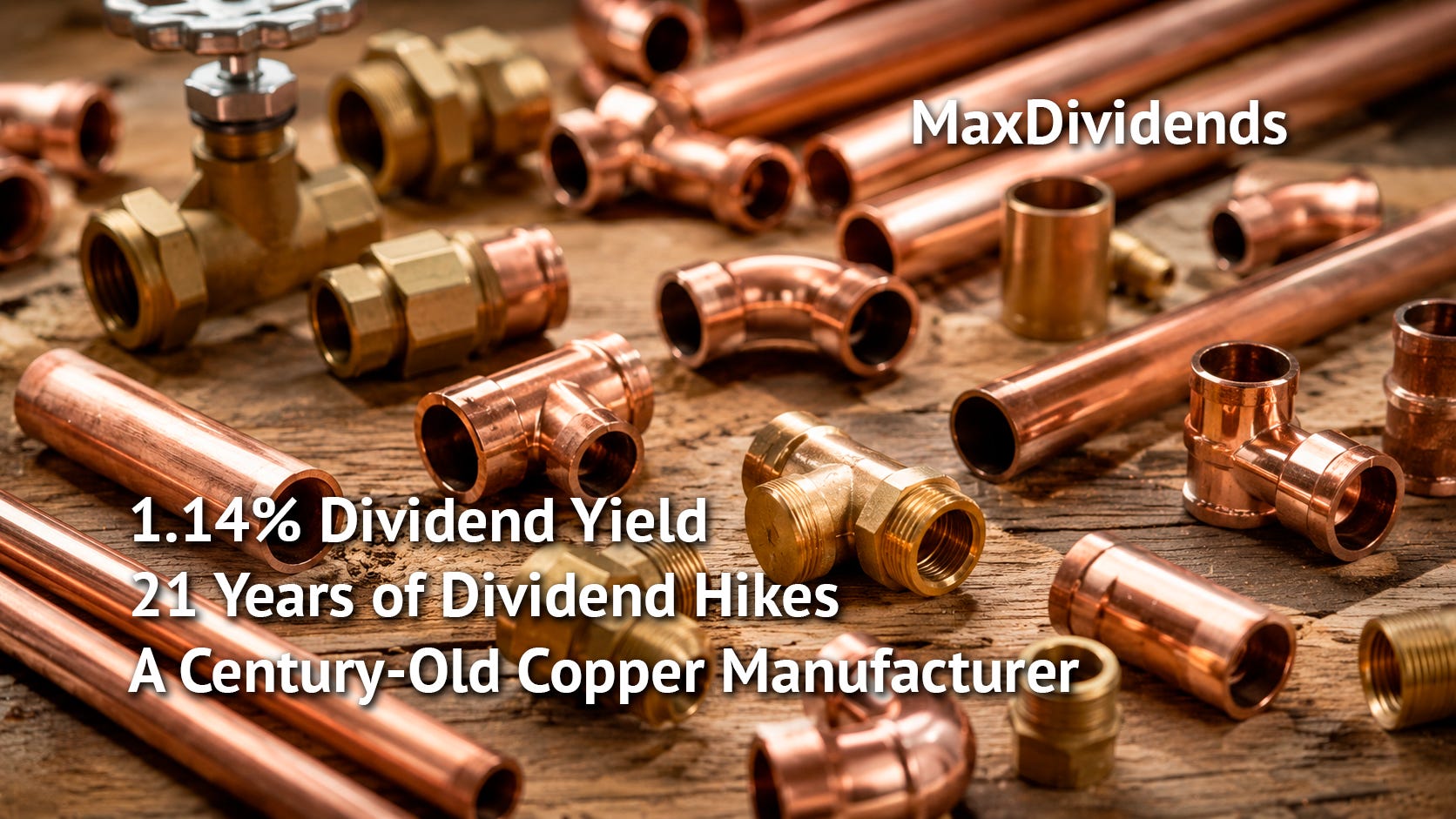
It makes the copper pipes behind your walls, the brass fittings in industrial refrigeration, and the aluminum parts holding commercial HVAC systems together. This is a 100-year-old heavy manufacturer that somehow managed to wipe out all its debt, stack over $1.3 billion in cash, and push its margins to record levels during an otherwise volatile industrial cycle, all while expanding its dividend at an aggressive rate.
Mueller Industries (MLI)
Financial Score: 89 / 99
Quick Tip
To keep your portfolio strong, stay on top of the financials for each company you hold. Solid companies mean better returns, so be sure to check in on their quarterly and annual numbers.Interesting stocks usually score 80+ on the Financial Scale, with top players hitting 90+. If that score dips below 80, it might be a good time to consider cutting ties before things take a turn.Mueller Industries, Inc. (MLI) is a Collierville, Tennessee-based manufacturer of copper, brass, aluminum, and plastic products. Founded in 1917, it operates globally through three segments—Piping Systems, Industrial Metals, and Climate—supplying essential components for plumbing, HVAC, refrigeration, and industrial markets. It’s a Fortune 1000 industrial player that wins on vertical integration, operational efficiency, and a relentlessly clean balance sheet.
Dividend math: aggressive growth, tiny payout
Mueller Industries pays $1.40 per share annually, a 1.14% forward yield, with an 18.32% payout ratio and a 5-year dividend-growth rate of +335.00%. The yield looks small because the stock price has surged, but the actual dividend is growing at a massive pace.
At an 18.32% payout ratio, the company barely feels the dividend obligation—leaving nearly all its free cash flow available to fund acquisitions, share buybacks, and factory upgrades. The 21-year streak of dividend hikes reflects a management team that prefers reliable, compounding capital returns over flashy spending.
Q1 2026: massive margin expansion
For Q1 ended March 28, 2026, Mueller Industries posted net sales of $1.19 billion, up 19.3% year-over-year. Operating income surged 51.4% to $312.2 million, and GAAP net income jumped 51.8% to $239.0 million. Diluted EPS was $2.16 vs. $1.39 a year earlier, beating the consensus estimate of $1.49 by $0.67, per the April 21, 2026 SEC-exhibited earnings release.
The quarter was defined by dramatic gross margin expansion (up 31.8% to $358.4 million) and a $41.4 million divestiture gain, all while sitting on $1.38 billion in cash and equivalents.
Growth: copper acquisitions and cash piles
Mueller’s growth strategy centers on consolidating the industrial metals space using its pristine balance sheet. In Q1 2026, the company announced a $142 million acquisition of a copper-tube manufacturer, directly expanding its core Piping Systems segment. Rather than taking on leverage, Mueller funds these deals straight from cash flow; its debt-to-equity ratio sits at an almost non-existent 0.01.
This M&A strategy, combined with organic margin improvements in its Climate segment, positions the company to dominate regional supply chains as reshoring and infrastructure spending accelerate.
Founded before the Roaring Twenties
Mueller Industries trace its origins back to 1917, originally operating as the Mueller Metals Company in Port Huron, Michigan. It spent its early decades forging brass forgings and munitions during World War I before pivoting into the plumbing and refrigeration fittings that define modern infrastructure.
Over a century later, it’s still making the unglamorous metal components that keep water flowing and air conditioning running, proving that basic materials manufacturing can still generate elite returns if managed correctly.
Final take
Mueller Industries offers 1.14% yield, $1.40 annual dividend, 21 years of hikes, +335.00% 5-year dividend growth, and an 18.32% payout ratio. The business is supported by surging operating margins, a cash pile of nearly $1.4 billion, and a debt-free balance sheet that acts as a fortress against industrial cyclicality, though it remains exposed to copper price volatility and global housing starts.
Financial Score: 89. This company is highly profitable and structurally sound, but the score suggests digging deeper into its cyclical exposure and organic volume growth beyond M&A before treating it as a core holding.