


This transportation operator grew quarterly revenue 20%, but operating income increased only 2% as costs absorbed most of the gains. Its advantage is flexibility: customers can move freight through rail-linked containers, dedicated fleets, or brokerage. The question now is whether higher shipment volumes can deliver better margins.
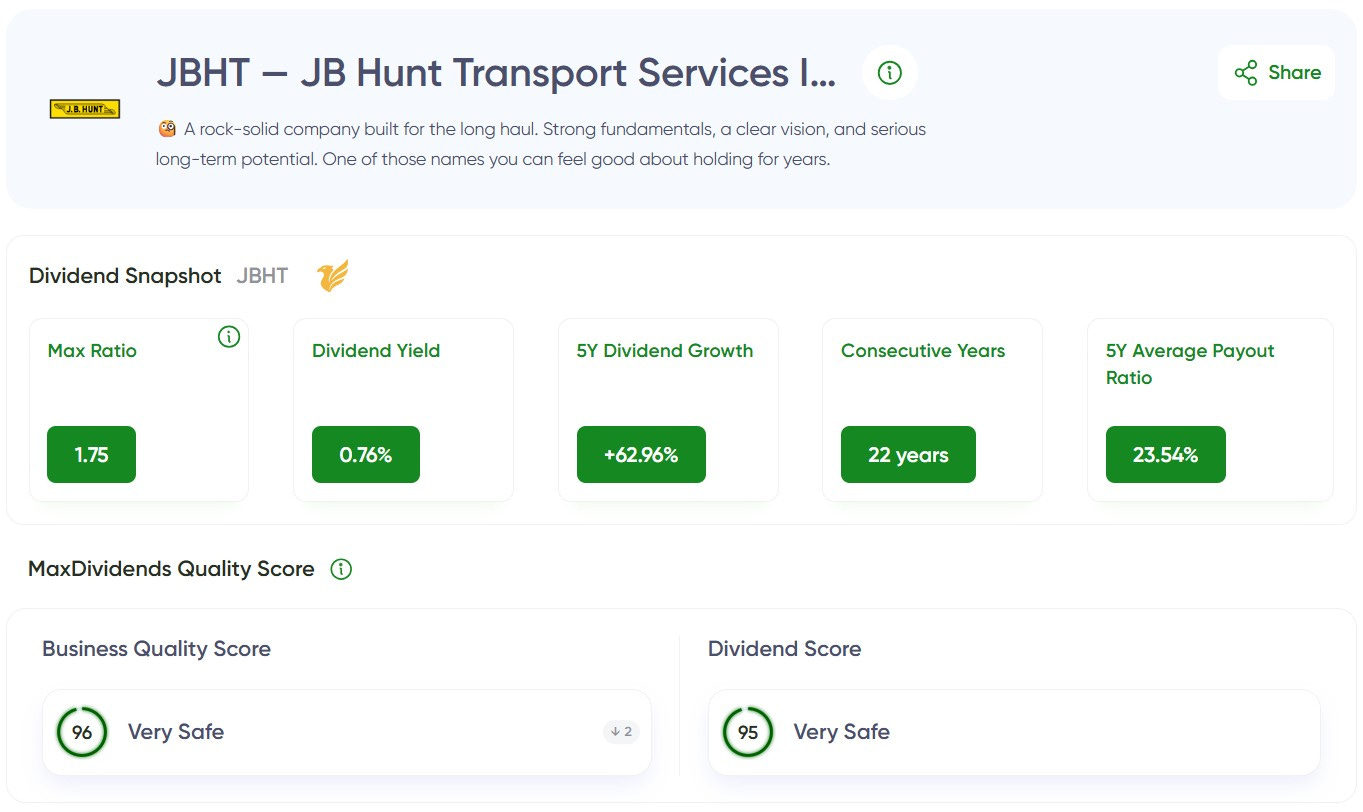
J.B. Hunt Transport Services (JBHT)
Business Quality Score: 96 / 99
Quick Tip
To keep your portfolio strong, stay on top of the financials for each company you hold. Solid companies mean better returns, so be sure to check in on their quarterly and annual numbers.
—
Interesting stocks usually score 80+ on the Financial Scale, with top players hitting 90+. If that score dips below 80, it might be a good time to consider cutting ties before things take a turn.
J.B. Hunt Transport Services, Inc. is a Lowell, Arkansas-based transportation company founded by Johnnie Bryan and Johnelle Hunt in 1961. Its five businesses span intermodal transportation, dedicated fleets, freight brokerage, final-mile delivery, and truckload services, combining company-operated equipment with third-party carriers.
Modest yield, substantial dividend cushion
J.B. Hunt pays $1.80 per share annually, a 0.79% yield, with 22 consecutive years of increases and +62.96% five-year dividend growth. The 25.50% payout ratio leaves roughly three-quarters of earnings retained, providing a cushion against freight downturns. That supports future increases, but fleet replacement and other capital spending still compete for cash. This is a dividend-growth stock, not a high-income holding.
Q3 2026: revenue accelerates, profits lag
In its October 15, 2026 release, J.B. Hunt reported Q3 revenue of $3.68 billion, up 20%, operating income of $247.1 million, up 2%, and GAAP net earnings of $172.4 million versus $170.8 million. Diluted EPS rose to $1.82 from $1.76. Higher purchased transportation, driver-related expenses, and insurance costs limited the benefit of stronger sales.
More rail freight, profitable brokerage
Intermodal revenue increased 20% to $1.83 billion, supported by 8% load growth and an 11% increase in revenue per load. Brokerage revenue rose to $433.8 million from $276.3 million, and the business returned to operating profitability. Both improved, but revenue per load includes fuel effects—not just better pricing.
Rice hulls before highways
The Hunts started in 1961 by recycling rice hulls, a milling byproduct, for the poultry industry. Trucking followed with five trucks and seven trailers. In 1969, they moved to Northwest Arkansas to focus on transportation. The nationwide freight business began with finding a market for agricultural waste.
Final take
Some experts emphasize rising fuel, hiring, and claims costs; others focus on stronger freight demand and contract repricing as potential drivers of margin recovery in 2027. The outlook depends on higher rates catching up with expenses, rather than shipment growth alone. The 25.50% payout provides substantial earnings coverage for dividends, while the 0.79% yield offers limited current income.
Business Quality Score: 96—an elite level reflecting a strong long-term record across sales, profits, dividends, and debt. That business quality does not eliminate freight cyclicality or guarantee a quick recovery in profitability.