


This company is turning payment relationships into a broader services business. Banks and merchants come for transaction processing, then buy tools to fight fraud, understand customers, and improve sales. That strategy is working: services are growing faster than network revenue, helping profits outpace sales. For dividend investors, the opportunity is growing distributions—not a generous starting yield.
Mastercard (MA)
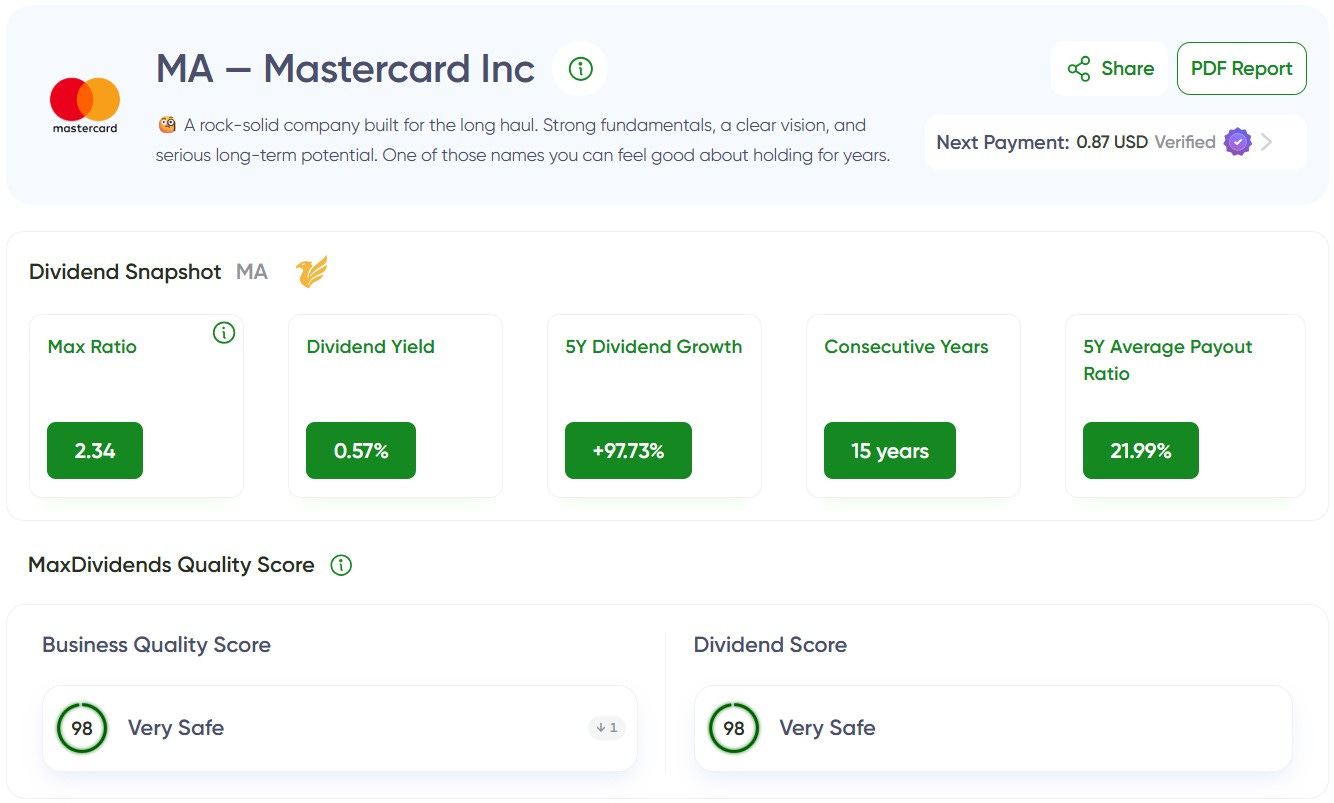
Business Quality Score: 98 / 99
Quick Tip
To keep your portfolio strong, stay on top of the financials for each company you hold. Solid companies mean better returns, so be sure to check in on their quarterly and annual numbers.
—
Interesting stocks usually score 80+ on the Financial Scale, with top players hitting 90+. If that score dips below 80, it might be a good time to consider cutting ties before things take a turn.
Mastercard connects consumers, merchants, and financial institutions across more than 200 countries and territories. Its customers had issued 3.8 billion Mastercard and Maestro cards by September 30, 2026.
Management is expanding that reach while selling more services to existing customers, giving the business two routes to growth: process more payments and earn more from each relationship.
A small dividend, not a stretched one
Mastercard pays $3.48 annually, yielding 0.55%, with 15 consecutive years of increases and +97.73% five-year dividend growth. The 19.14% payout ratio leaves plenty of earnings available to fund expansion and future raises.
But management also favors buybacks, spending $3 billion on repurchases in Q3. There is room to grow the dividend; shareholders should not expect every spare dollar to flow into it.
A beat investors rewarded
The October 29 report beat expectations: revenue reached $9.81 billion against $9.66 billion forecast, and adjusted EPS was $5.31 versus $5.17 expected. Shares closed 4.29% higher. Net income rose 18% to $4.63 billion, faster than revenue’s 14% increase, showing that growth is translating into stronger profits.
Some business arrived earlier than planned, however, and management maintained—not raised—its full-year growth outlook. A strong quarter, with reasons to keep expectations grounded.
Winning customers—and more of their business
A new small-business agreement with India’s HDFC Bank is expected to add 3 million cards. Meanwhile, services revenue grew 19%, supported by security, analytics, and customer engagement.
Mastercard is not simply waiting for consumers to spend more: it is signing distribution partners and selling customers additional capabilities. That gives the company more ways to grow than transaction volume alone.
The Checkout Is Becoming an App
Tap on Phone lets merchants accept contactless payments through a compatible smartphone instead of buying a dedicated terminal. It makes accepting cards easier for smaller businesses—and expands where Mastercard can be used.
Customers are already comfortable tapping: contactless accounted for 81% of in-person switched purchase transactions in Q3.
Final take
Mastercard’s 0.55% yield is small, but its 19.14% payout ratio and 15-year growth streak make it worth examining for rising income. Management’s expansion into services is producing results, and the latest earnings beat supports that direction. Business Quality Score: 98, the supplied BeatMarket rating.
The risks are weaker spending, competing payment systems, and rising customer incentives. This is a dividend-growth candidate, not a high-income stock—and business progress does not make every purchase price attractive.
Your take on global payments companies expanding beyond card networks is interesting, are you seeing more fintech infrastructure trends worth exploring in your coverage?